Quick Answer
For many renters in the four new metro cities, this change is worth exactly nothing. Your HRA exemption is the lowest of three figures, and raising the percentage cap only helps if that cap was the figure holding you back. If your exemption was already limited by the “rent minus 10% of salary” test — which is what happens when your rent is modest relative to your salary — nothing changes. One calculation below tells you which group you are in. And none of it applies unless you are on the Old Regime.
This applies to you if
- You rent your home in Bengaluru, Pune, Hyderabad or Ahmedabad, and you receive HRA as part of your salary.
- You file, or are considering filing, under the Old Regime. Under the New Regime HRA is fully taxable and none of this reaches you.
- You are looking at salary earned on or after 1 April 2026. For the return covering FY 2025-26, only the original four metros qualify.
- Your exemption is the lowest of three figures, so the higher cap only reaches you if the cap was the smallest of them.
- One calculation settles it: rent paid minus 10% of Basic plus DA, compared against 40% of Basic plus DA.
- The eight-city table turns on where your home is, not where your office is — and the rule is loosely drafted on exactly that point.
- None of it applies under the New Regime, which is the default, so this is Old Regime news only.
- Two conditions disqualify you outright, and one of them catches people who own a flat in the same city.
- Form 124 has replaced Form 12BB and now asks for your relationship with the landlord.
How the exemption is actually computed
Your exempt HRA is the lowest of three figures — and for most renters the binding one is the rent test, not the percentage cap that just changed.
For FY 2026-27 the exemption is granted by Schedule III (Table: Sl. No. 11) of the Income-tax Act, 2025. Note the form of that citation: HRA is no longer a section at all. Under the Income-tax Act, 1961 it sat at Section 10(13A); under the 2025 Act it is a Schedule entry. Most commentary online still says “Section 10(13A)” without naming a year or an Act, and for salary earned from 1 April 2026 that provision does not exist. If you are unclear which Act governs which year, start with our guide to the Income-tax Act, 2025 and the AY 2026-27 transition.
The three limits are:
One definition matters enormously and is constantly got wrong: “salary” here means Basic plus Dearness Allowance plus commission calculated as a fixed percentage of turnover. It is not your CTC, and it is not your gross salary. People who use gross salary arrive at a much larger number and are then surprised when their employer or the department computes something smaller.
Because the answer is the lowest of the three, the practical question is always: which one is binding? That single question decides whether the metro change is worth anything to you.
The test: is the cap actually binding for you?
Work out rent paid minus 10% of Basic plus DA. If that figure comfortably exceeds 40% of Basic plus DA, the cap was binding you and the reclassification is real money. If it is smaller, the change is worth nothing.
Three renters, all in Pune, all moving from a 40% cap to a 50% cap.
| Renter | Salary (Basic+DA) / HRA received / Rent | Exempt at 40% | Exempt at 50% | Annual tax saved |
|---|---|---|---|---|
| A — modest rent | Rs 10,00,000 / Rs 5,00,000 / Rs 30,000 a month | Rs 2,60,000 | Rs 2,60,000 | Nil |
| B — high rent | Rs 10,00,000 / Rs 5,00,000 / Rs 60,000 a month | Rs 4,00,000 | Rs 5,00,000 | About Rs 31,200 |
| C — very high rent | Rs 12,00,000 / Rs 6,00,000 / Rs 80,000 a month | Rs 4,80,000 | Rs 6,00,000 | About Rs 37,440 |
Renter A gets nothing. Her rent of Rs 3.6 lakh a year minus 10% of salary gives Rs 2.6 lakh, which is below both the 40% cap of Rs 4 lakh and the 50% cap of Rs 5 lakh. The rent test was binding before and it is still binding after. Raising a cap she never reached changes nothing.
Renter B gains a full Rs 1 lakh of additional exemption, worth about Rs 31,200 in tax at a 30% slab. For her the 40% cap was the binding limit — her rent test allowed Rs 6.2 lakh but the cap held her to Rs 4 lakh. Lifting the cap to Rs 5 lakh releases exactly Rs 1 lakh.
The HRA metro cities list — and which city actually counts
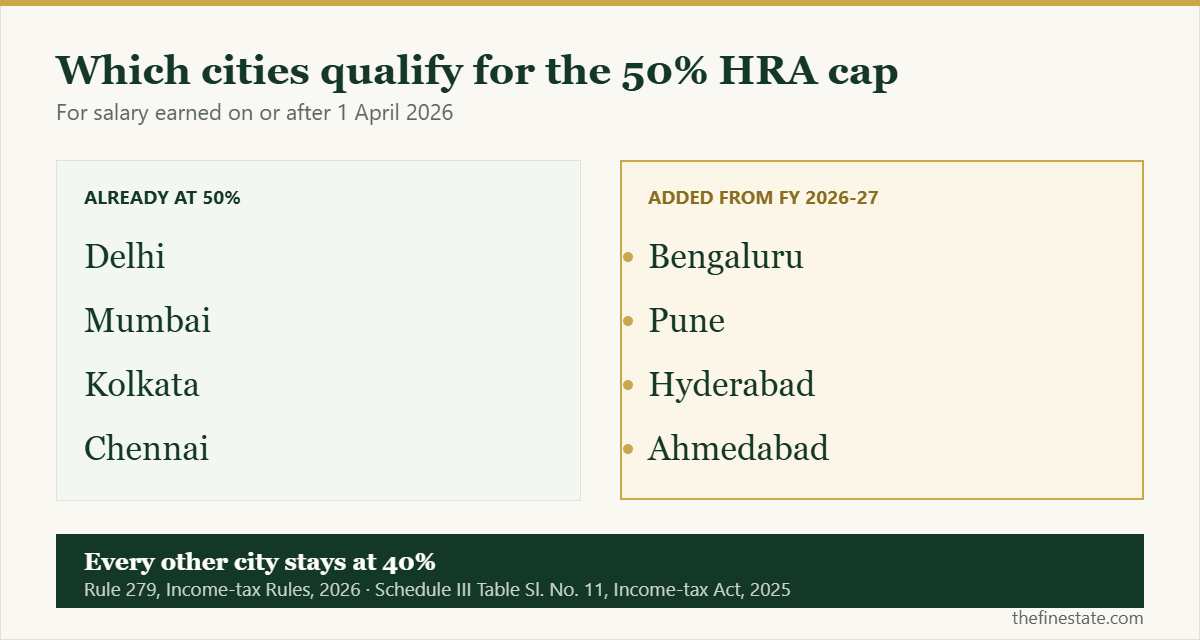
The eight-city test turns on where your rented accommodation is, not where you are employed. Rule 279 is loosely drafted on this exact point, and the enabling provision settles it.
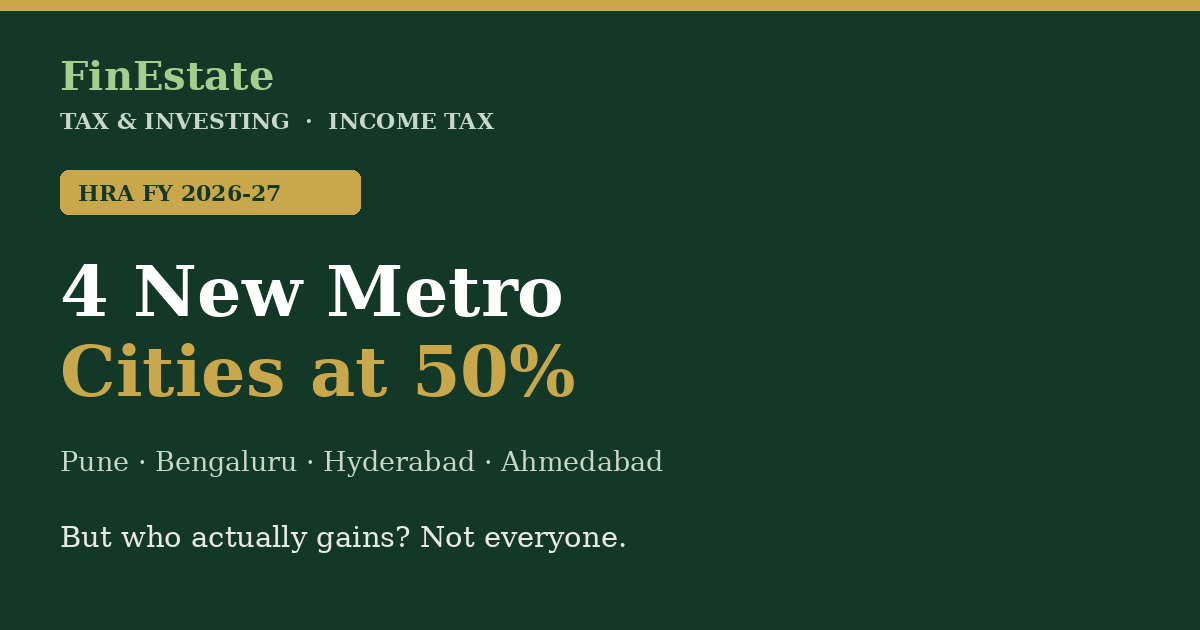
The eight cities qualifying for the 50% cap from FY 2026-27 are Delhi, Mumbai, Kolkata and Chennai, joined by Bengaluru, Pune, Hyderabad and Ahmedabad. Every other city remains at 40%.
Here is the wrinkle nobody covers. Rule 279(1)(c) says the higher rate applies to “an assessee employed in the location mentioned in column B” — while column B is itself headed “Location of residential accommodation”. Read literally, the operative words point at your workplace and the column heading points at your home.
The enabling provision resolves it. Schedule III, Table Sl. No. 11, condition (b) of the Income-tax Act, 2025 requires the prescribed extent to have regard to “the area or place in which such accommodation is situated”. So it is the location of the rented accommodation that governs. If you work in Mumbai but rent in Thane, or work in Gurugram but rent in Delhi, that distinction decides your cap — and it is worth documenting your rental address carefully rather than assuming your office city applies.
Only if you are on the Old Regime
Under the New Regime your entire HRA is taxable, whatever city you live in. Since the New Regime is the default, this reclassification reaches only those who actively opt out of it.
Editor’s Analysis
The reclassification matters more than the arithmetic suggests, because HRA is now the thing that decides which regime you are on. That is the shift I see around me: the regime question has stopped being an income question and become a housing question. The dividing line is no longer what you earn. It is whether you rent expensively in a metro, service a large home loan, or neither. Someone earning Rs 20 lakh with a Rs 60 lakh loan and Rs 40,000 of monthly rent during construction can plausibly clear the break-even and belongs on the Old Regime. Someone earning the same Rs 20 lakh in an owned, unencumbered home has no realistic path there and belongs on the New. Same income, opposite answer — and HRA is usually the single largest reason for the difference.
Which is why the four new cities are a bigger event than a line in a table. Bengaluru, Pune, Hyderabad and Ahmedabad joining the 50 per cent list, notified under the Income-tax Rules, 2026 and applying to salary earned on or after 1 April 2026, strengthens the Old Regime case for renters in exactly the cities where the salaried base has grown fastest. Pulling the other way, the home-loan interest deduction — Section 24(b) of the Income-tax Act, 1961, now Section 22 of the Income-tax Act, 2025 — has been stuck at Rs 2 lakh while ticket sizes have risen sharply, so the buyer who took a loan this year exhausts it in the first year and gets no recognition for the rest of the interest. The Old Regime’s housing advantage is therefore strongest for renters and for people several years into a loan, and weakest for the first-time buyer carrying the largest housing cost of their life.
The practical consequence is that this is not a decision you make once. Your housing situation changes — you buy, you finish construction, you prepay, you move cities — and the regime that suited you last year may not suit you this year. Re-run it annually, and re-run it in the year you move.
The disallowance is specific, and the section number depends on the year. For FY 2026-27 the New Regime denies the Schedule III Sl. No. 11 exemption under Section 202(2)(a)(i) of the Income-tax Act, 2025. For FY 2025-26 and earlier it was Section 10(13A) denied by Section 115BAC(2)(i) of the Income-tax Act, 1961. Different numbering, same outcome: no HRA exemption on the New Regime.
There is a more interesting implication. HRA is one of the largest deductions available to a renting professional and a major component of what makes the Old Regime competitive at all. A larger exemption raises your total deduction figure, which can move you across the break-even point. If you rent expensively in Pune or Bengaluru and were previously just short of that threshold, this is worth re-running — see our FY 2026-27 break-even analysis for the deduction totals you need to clear. And if you are weighing renting against buying, our guide to home-loan interest deductions covers the other side of that comparison — the Rs 2 lakh cap discussed above.
Two conditions that disqualify you outright
You get nothing if you own the accommodation, and nothing if no rent was actually incurred — both stated as conditions in the enabling provision itself.
Schedule III, Table Sl. No. 11 of the Income-tax Act, 2025 attaches conditions to the exemption. Two of them end the enquiry before the arithmetic starts:
- Condition (c) — ownership disqualifies. No exemption is available if the accommodation is owned by you. This catches a specific and not-uncommon case: someone who owns a flat in the same city but lives in rented accommodation elsewhere in it. The ownership test attaches to the accommodation you are claiming for, so read it carefully against your own facts.
- Condition (d) — rent must actually have been incurred. An exemption claimed where no rent was genuinely paid fails at the first condition, regardless of what receipts exist.
What Form 124 changes about documentation
Form 12BB has been replaced by Form 124, and the new form asks for your relationship with the landlord.
Alongside the city reclassification, the administrative side has tightened. Form 12BB — the investment and exemption declaration you give your employer — has been replaced by Form 124 from 1 April 2026. Tax-practitioner reporting places it under Section 392(5)(b) of the Income-tax Act, 2025 read with Rule 205 of the Income-tax Rules, 2026. Note that Rule 205 governs the form; the city table is Rule 279. They are frequently conflated.
If you are filing your own return rather than relying on your employer’s computation, our step-by-step ITR filing guide for salaried filers covers where the exemption is reported.
The substantive change for HRA claimants is a requirement to disclose your relationship with the landlord. Alongside the existing requirement to give the landlord’s PAN where annual rent exceeds Rs 1 lakh, this is aimed squarely at arrangements that exist only on paper.
Claiming HRA on rent paid to a parent remains entirely legal, and for many families it is genuine. But the standard of proof has risen:
One obligation catches high-rent tenants regularly: where monthly rent exceeds Rs 50,000, you as the tenant must deduct TDS and deposit it. This sits at Section 194-IB of the Income-tax Act, 1961. Under the Income-tax Act, 2025 the TDS provisions are consolidated at Section 393 and its tables, and we have not verified the specific table entry that carries the tenant obligation — so confirm the current provision before relying on a section number. The obligation itself is real, it is separate from anything your employer does with your HRA declaration, and it is yours rather than your landlord’s.
Key Takeaways
- From FY 2026-27, Bengaluru, Pune, Hyderabad and Ahmedabad join the four original metros at the 50% cap. This applies to salary earned from 1 April 2026, not to the FY 2025-26 return.
- The exemption is the lowest of three figures: actual HRA received; 50% or 40% of salary; and rent paid minus 10% of salary. Salary means Basic plus DA, not CTC.
- The change only helps if the percentage cap was your binding limit. Where the rent-minus-10% test was already binding, the benefit is nil.
- Illustratively, a Pune renter paying Rs 60,000 a month on Rs 10 lakh Basic plus DA gains Rs 1 lakh of exemption, worth about Rs 31,200 at a 30% slab. A renter paying Rs 30,000 a month on the same salary gains nothing.
- The city test turns on where your rented home is, not your office — per Schedule III Sl. No. 11 condition (b), which resolves a drafting ambiguity in Rule 279.
- Owning the accommodation disqualifies you (condition (c)), and rent must actually have been incurred (condition (d)).
- None of this applies under the New Regime, where HRA is fully taxable. For FY 2026-27 the disallowance is Section 202(2)(a)(i) of the Income-tax Act, 2025.
- Form 124 replaces Form 12BB from 1 April 2026 and adds landlord-relationship disclosure. Landlord PAN is required where annual rent exceeds Rs 1 lakh.
Frequently Asked Questions
Is Bengaluru a metro for HRA, and does the income tax portal treat it that way?
For salary earned from 1 April 2026, yes. Rule 279 of the Income-tax Rules, 2026 lists eight cities at the 50% cap: Delhi, Mumbai, Kolkata, Chennai, Bengaluru, Pune, Hyderabad and Ahmedabad. For the return covering FY 2025-26 the answer is no — only the original four qualified. If a portal or calculator gives you 40% for Bengaluru, check which financial year it is computing before assuming it is wrong — including on the department’s own e-filing portal.
Is Hyderabad a metro city under the HRA exemption?
Yes, from FY 2026-27, at the 50% cap. Same eight-city list, same start date of 1 April 2026, same caveat about earlier years. Whether it is worth anything to you depends entirely on which of the three limits is binding — run the calculation in the test section above.
I work in one city and rent in another. Which city’s rate applies?
The city where your rented accommodation is situated. Rule 279(1)(c) is loosely drafted — its operative words refer to where you are employed, while the column it points at is headed “Location of residential accommodation”. The enabling provision settles it: Schedule III, Table Sl. No. 11, condition (b) of the Income-tax Act, 2025 requires regard to the area in which the accommodation is situated. Document your rental address.
How much HRA can I claim in Ahmedabad from FY 2026-27?
The cap rises from 40% to 50% of Basic plus DA, but the cap is only one of three limits and your exemption is the lowest of them. Compute rent paid minus 10% of Basic plus DA first. If that is below 40% of Basic plus DA, the Ahmedabad reclassification gives you nothing.
Can I claim HRA under the New Tax Regime?
No. Under the New Regime your entire HRA is taxable. For FY 2026-27 the exemption at Schedule III, Table Sl. No. 11 of the Income-tax Act, 2025 is denied by Section 202(2)(a)(i) of the same Act; for FY 2025-26 and earlier, Section 10(13A) of the Income-tax Act, 1961 was denied by Section 115BAC(2)(i). Since the New Regime is the default, you must actively opt for the Old Regime to claim HRA at all.
Can I claim HRA on rent paid to my parents?
Yes, and it is legal, but the documentation standard has risen. Pay through banking channels rather than cash, keep a genuine rent agreement, and ensure your parents declare that rental income in their own returns. Form 124 now requires you to disclose your relationship with the landlord, so an arrangement that exists only on paper is far more likely to be identified.
Primary sources
- Notification No. 22/2026, G.S.R. 198(E), dated 20 March 2026 — making the Income-tax Rules, 2026 under Section 533 of the Income-tax Act, 2025.
- Rule 279, Income-tax Rules, 2026 — the eight-city table prescribing the 50% and 40% extents, including the drafting tension between the operative words of Rule 279(1)(c) and the heading of column B.
- Schedule III, Table Sl. No. 11, Income-tax Act, 2025 — the enabling provision granting the exemption, and conditions (b) location of accommodation, (c) ownership disqualification and (d) rent actually incurred.
- Section 202(2)(a)(i), Income-tax Act, 2025 — New Regime disallowance of the Schedule III Sl. No. 11 exemption for FY 2026-27.
- Section 10(13A) and Section 115BAC(2)(i), Income-tax Act, 1961 — the equivalent position for FY 2025-26 and earlier years.
- Section 194-IB, Income-tax Act, 1961 — tenant TDS where monthly rent exceeds Rs 50,000. The corresponding provision under the Income-tax Act, 2025 sits within Section 393 and its tables; we have not verified the specific entry.
Secondary sources and commentary
- Tax-practitioner reporting on Form 124 replacing Form 12BB from 1 April 2026, stated to be under Section 392(5)(b) of the Income-tax Act, 2025 read with Rule 205 of the Income-tax Rules, 2026. We have not read a primary instrument prescribing Form 124.
- Press coverage of the Income-tax Rules, 2026 notification, March 2026. Cited for corroboration of the notification date only.
The Bottom Line
Four cities moving to the 50% cap is a real benefit, but a narrower one than the headlines suggest. Because the exemption is the lowest of three figures, the higher cap only reaches you if the cap was what held you back. High rent relative to Basic plus DA means real money — roughly Rs 31,000 a year in our worked example. Modest rent means the change is worth nothing, because a different limit was binding all along.
Do the one calculation that settles it: rent paid minus 10% of Basic plus DA, against 40% of Basic plus DA. Then check the three things that override the arithmetic entirely — you must be on the Old Regime, you must not own the accommodation, and it is your rented address that decides your city.
One email when something is published. No daily digest, no tips.
Subscribe freeDisclosure and method
This article explains House Rent Allowance exemption for educational purposes and is not tax advice. All computations are illustrative and were computed by FinEstate on the Schedule III three-limit method. The single point where being wrong costs most is the location test: if you work and rent in different cities, confirm which rate applies to your facts with a qualified chartered accountant before claiming, because the rule is ambiguously drafted and we are relying on the enabling provision to resolve it. The Form 124 attribution and the Income-tax Act, 2025 successor to Section 194-IB are both flagged as unverified in the sources above.
Researched and drafted with AI assistance and reviewed before publication. Rate and provision citations are taken from the Income-tax Act, 2025, the Income-tax Rules, 2026 and the notification listed above, or are labelled as secondary with the source named.
Keep reading
This article is part of our income tax guide — the full set of explainers for salaried Indians, in the order you actually meet them.