Stamp Duty by State in India 2026: The Complete Top-10 Cost Guide for Home Buyers
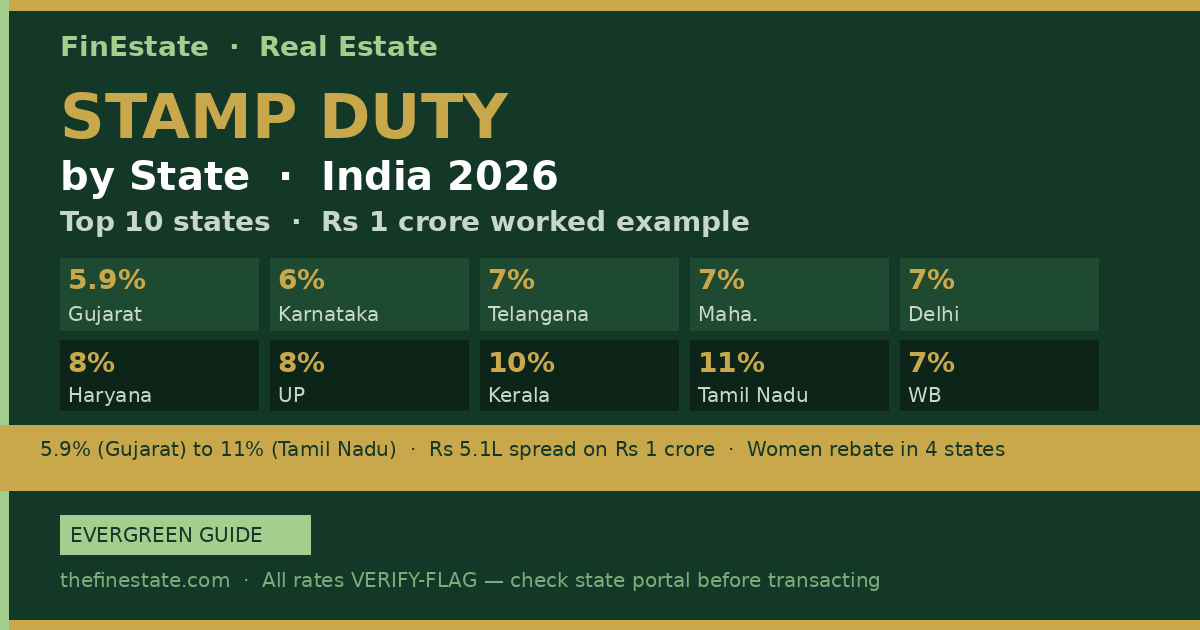
Stamp duty by state in India varies from 5.9% to 11% in 2026 — a Rs 5.1 lakh spread on a Rs 1 crore property across the top 10 markets.
Priya Menon — a composite illustrative profile of the kind of buyer this guide is written for — is a 34-year-old product manager at a Bengaluru tech company who received a transfer offer to Chennai in early 2026. She had Rs 1.05 crore earmarked for her purchase: Rs 1 crore for the property and Rs 5 lakh for “all the fees.” She had bought her Bengaluru flat in 2023 at 5% stamp duty plus 1% registration. She assumed Chennai would be roughly similar.
It was not. Tamil Nadu charges 7% stamp duty plus an unusually high 4% registration fee — bringing the combined state levy to 11%, or Rs 11 lakh on her Rs 1 crore apartment. Her Bengaluru model had priced in Rs 6 lakh. The Rs 5 lakh shortfall meant either downsizing her property target or draining her emergency fund hard — and that was before the society transfer fees and legal verification costs.
Priya’s experience is not unusual. Stamp duty is the largest upfront transaction cost in Indian real estate — larger than brokerage, often larger than the first year of home loan interest — and yet most buyers anchor their estimate to whichever state they bought in last. The rates are state-determined and vary from 5.9% to 11% on a combined stamp-plus-registration basis across India’s top 10 property markets.
This guide covers all 10 states, the women-buyer concessions map, the hidden costs most buyers miss, and — from a project finance perspective — the builder deed structures that affect what you actually pay and when.
- Stamp duty + registration costs range from 5.9% to 11% across India’s top 10 states in 2026. On a Rs 1 crore property, that is a Rs 5.1 lakh difference between cheapest and most expensive — more than most buyers budget for in advance.
- Women buyers get a 1–2 percentage-point rebate in at least 4 of the top 10 states (Maharashtra, Delhi, Haryana, UP). On a Rs 1 crore property in Delhi, a woman buyer saves Rs 2 lakh vs a male buyer. Five states offer rate parity regardless of buyer gender.
- Cheapest combined stack: Gujarat (4.9% + 1% = 5.9%). Most expensive: Tamil Nadu (7% stamp + 4% registration = 11%). Kerala is second at 10% (8% + 2%). The Rs 4.1 lakh Gujarat-vs-Kerala spread on a Rs 1 crore property is larger than most home renovations.
- Stamp duty is paid at registration, not through your home loan. You pay it from your own funds — typically by e-stamp, banker’s cheque, or demand draft — at the sub-registrar office on the day of deed execution. Budget this as a hard cash requirement, not a loan-covered cost.
How Stamp Duty Actually Works
The legal mechanism. Stamp duty is a state-level tax levied under the Indian Stamp Act, 1899, as modified by each state’s own Stamp Act. It is charged on the instrument of transfer — the sale deed, agreement to sell, gift deed, or lease deed — not directly on the property itself. The duty is determined by the higher of two values: the actual transaction consideration as declared, or the state’s circle rate (called guidance value in Karnataka, ready reckoner rate in Maharashtra, or collector’s guideline value in Tamil Nadu). Understating the transaction consideration below the circle rate does not reduce the duty — the state’s valuation mechanism overrides it, and the discrepancy may constitute under-reporting under state stamp law.
Who collects it and how. Payment is made to the state revenue department through the office of the Sub-Registrar, which is under the Inspector General of Registration for each state. The three payment modes vary by state: e-stamping (now mandatory in most major states), franking machines at authorised banks, and in some states a Physical Non-Judicial Stamp Paper purchase. Maharashtra shifted fully to e-SBTR (Electronic Secured Bank and Treasury Receipt) in 2023. Registration charges are paid separately as a fee at the sub-registrar office.
When you pay. Stamp duty must be paid before or at the time of presenting the deed for registration. An unregistered sale deed — even if stamped — has no legal evidentiary value in a property dispute under Section 49 of the Registration Act, 1908. This means: if you have a stamped but unregistered agreement with a builder who goes insolvent, your claim in NCLT proceedings will be weaker than that of a fully registered deed holder.
What it is not. Stamp duty is not refundable after deed execution. If a transaction falls through before the deed is executed and stamped paper was purchased, most states allow partial refund of stamp value (minus a deduction, typically 10-20%) through an application to the Collector of Stamps. Once the deed is registered, no refund is available regardless of what happens to the property later. It is also not covered by your home loan — your bank disburses loan proceeds directly against the property value; stamp duty and registration are your out-of-pocket liability at the registry.
Stamp Duty Maharashtra, Karnataka, Tamil Nadu & Top 10 States — Rates at a Glance 2026
The table below uses indicative rates sourced from state government authority sites and secondary press as of May 2026. All rows carry a verification caveat — rates change with state budgets and executive orders. Confirm the current applicable rate at the state portal before transacting.
| # | State | Stamp Duty (Men) | Stamp Duty (Women) | Reg Charges | Combined (Men, Rs 1 cr) |
|---|---|---|---|---|---|
| 1 | Gujarat | 4.9% (incl. surcharge) | 4.9% + 0% reg (waiver) | 1% | 5.9% (men) / 4.9% (women) |
| 2 | Karnataka | 5% (slab-based) | 5% | 2% (from 31 Aug 2025) | 7% = Rs 7L |
| 3 | Telangana | 4% + 1.5% transfer duty | Same | 0.5% | 6% = Rs 6L |
| 4 | Maharashtra | 6% | 5% | 1% | 7% = Rs 7L |
| 5 | Delhi (NCT) | 6% | 4% | 1% | 7% = Rs 7L |
| 6 | West Bengal | 6% (≤Rs 1 cr) | Same | 1% | 7% = Rs 7L |
| 7 | Haryana | 7% | 5% | 1% | 8% = Rs 8L |
| 8 | Uttar Pradesh | 7% | 6% (partial) | 1% | 8% = Rs 8L |
| 9 | Kerala | 8% | 8% | 2% | 10% = Rs 10L |
| 10 | Tamil Nadu | 7% | 7% | 4% | 11% = Rs 11L |
Reading the table. Three states tie for the Rs 7L combined cost on a Rs 1 crore male-buyer transaction: Maharashtra (6% + 1%), Delhi (6% + 1%), and Karnataka (5% + 2% registration after the 31 August 2025 hike). The apparent similarity conceals structural differences. Karnataka’s recent registration-fee doubling has pushed Bangalore from the cheapest of the major tech-hub cities into a Rs 7L middle tier alongside Mumbai and Delhi. Telangana’s separate 1.5% transfer duty applies only to non-agricultural urban property — it is not a stamp duty but is effectively non-avoidable for residential apartment purchases, taking Hyderabad’s total to a comparatively cheaper Rs 6L. Maharashtra’s LBT abolition and metro surcharge history mean the 6% headline rate has changed multiple times in the last five years. Delhi’s rates are among the most gender-differentiated in India, with a 2-percentage-point gap — the largest women’s rebate in the top 10.
Tamil Nadu is the highest combined stack, not Kerala. Common assumption pegs Kerala as the most expensive at 10%, but Tamil Nadu at 7% stamp + 4% registration = 11% combined is technically the highest. The 4% registration charge in TN is an outlier — most other states cap registration at 1-2%. On a Rs 1 crore Chennai apartment, the TN registration fee alone (Rs 4 lakh) exceeds Gujarat’s entire stamp duty bill (Rs 4.9 lakh combined). This is the data point most ClearTax and 99acres comparison articles miss.
Worked Example: Rs 1 Crore Property in Three Cities
| Cost Component | Mumbai (Maha.) | Bangalore (Karna.) | Hyderabad (Telangana) |
|---|---|---|---|
| Property value | Rs 1,00,00,000 | Rs 1,00,00,000 | Rs 1,00,00,000 |
| Stamp duty (male buyer) | Rs 6,00,000 (6%) | Rs 5,00,000 (5%) | Rs 5,50,000 (4% + 1.5% transfer) |
| Stamp duty (female buyer) | Rs 5,00,000 (5%) | Rs 5,00,000 (5%) | Rs 5,50,000 (no rebate) |
| Registration charges | Rs 1,00,000 (1%) | Rs 2,00,000 (2%) | Rs 50,000 (0.5%) |
| Total — male buyer | Rs 7,00,000 | Rs 7,00,000 | Rs 6,00,000 |
| Total — female buyer | Rs 6,00,000 | Rs 7,00,000 | Rs 6,00,000 |
| Saving: joint with woman | Rs 1,00,000 | Nil | Nil |
Hyderabad is now the cheapest of the three major tech-hub cities at Rs 6 lakh combined (4% stamp + 1.5% transfer duty + 0.5% registration), regardless of gender. Karnataka’s 2% registration fee (effective 31 August 2025) pushed Bangalore from Rs 6 lakh to Rs 7 lakh — putting it level with Mumbai’s male-buyer rate. Mumbai still saves Rs 1 lakh if the primary buyer is a woman (5% vs 6%). Telangana offers no gender concession on stamp duty at this price point, but the transfer duty component (1.5%) is a structural floor that cannot be optimised around for residential urban property.
Women Buyer Concessions — State by State
Delhi NCT — Largest rebate: 2 percentage points. Male buyers pay 6% stamp duty; female buyers pay 4%. On Rs 1 crore, a woman buyer saves Rs 2 lakh. Joint ownership (one male + one female buyer) attracts an intermediate 5% rate. The Delhi concession is the largest gender differential in the top-10 list. It applies when the primary registrant on the sale deed is a woman. Verify the exact joint-ownership condition at revenue.delhi.gov.in before relying on it for your transaction.
Maharashtra — 1 percentage point. Men: 6%, Women: 5% (Mumbai urban). Rs 1 lakh saving on Rs 1 crore. The Maharashtra concession has been in effect since 2021 and has been confirmed in successive state budgets. The rebate applies on the stamp duty component only — the 1% registration charge applies equally regardless of buyer gender. Outside Mumbai (Pune, Thane, Nagpur), the base rate is 1 percentage point higher: 7% for men and 6% for women. Confirm the exact urban-area rate at igrmaharashtra.gov.in for your specific sub-registrar zone.
Haryana — 2 percentage points. Men: 7%, Women: 5%. Rs 2 lakh saving on Rs 1 crore on the stamp duty component. Joint registration (man + woman) qualifies at 6%. Registration fee is 1% but capped at Rs 50,000 — so on a Rs 1 crore property, the registration cost is Rs 50,000, not Rs 1 lakh (effectively 0.5%). The Gurugram (Gurgaon) market — increasingly a primary market for Delhi-NCR tech employees — is subject to Haryana rates, not Delhi rates. Buyers relocating to the NCR commonly assume they are in Delhi’s stamp duty jurisdiction; Gurugram is in Haryana.
Uttar Pradesh — Partial concession. Women buyers in UP get a 1-point reduction (6% vs 7% for men), but the concession is capped and most beneficial for lower-value properties. Verify the current cap at igrsup.gov.in. The Noida and Greater Noida markets, which see heavy tech-employee demand, are in UP’s stamp duty jurisdiction.
Gujarat — Registration fee waiver for women. Gujarat applies the same 4.9% stamp duty for men and women, but waives the 1% registration fee entirely for women buyers — a saving of Rs 1 lakh on a Rs 1 crore property. The mechanism is different from Maharashtra/Delhi/Haryana/UP (which discount the stamp duty itself), but the net cash impact is similar. Verify at garvi.gujarat.gov.in before relying on it.
States with rate parity: Karnataka, Tamil Nadu, Telangana, West Bengal, Kerala. These five states apply the same stamp duty rate regardless of buyer gender and do not offer a structural registration-fee waiver to women. Joint ownership with a woman family member does not reduce stamp duty in these states, though it may have other structural advantages for inheritance and property title.
The concession is real and it is used, but there is an operational trap in it that catches a lot of couples, and it catches them at the registration counter rather than at the planning stage. In Maharashtra the 1 per cent rebate applies when the residential property is registered in a woman’s sole name. Add a male co-owner — a husband, a father, often for perfectly sensible reasons like loan eligibility or succession — and the concession is gone; the transaction attracts the standard rate. On a Rs 1 crore property in Pune that is the difference between 6 and 7 per cent, or Rs 1 lakh. In Mumbai, between 5 and 6 per cent, again Rs 1 lakh.
What makes this expensive is the sequencing. The loan is usually sanctioned before the agreement is registered, and lenders frequently want both earning spouses on the title to support eligibility. By the time anyone raises stamp duty, the ownership pattern has effectively been decided by the credit process. Nobody in that chain is being obstructive — the bank is optimising for its exposure and the sub-registrar is applying the rule as written — but the buyer ends up paying an extra Rs 1 lakh for a decision they never consciously made.
One piece of good news worth knowing: the earlier restriction that barred resale within fifteen years of claiming the concession has been removed, so a woman buying in her sole name is no longer locking herself into a holding period. That removes the main historical objection to using it. The planning point is simply to decide the ownership pattern before the loan is structured, not after — and if a male co-owner is genuinely required for eligibility, price the extra 1 per cent into the budget rather than discovering it at registration.
The Costs Buyers Usually Forget
RERA registration fee (builder pass-through). Under RERA, builders must register their project with the state RERA authority and pay a fee proportional to the project’s land area. Many builders pass this cost through in the form of a separate line item or inflate the “incidental charges” in the buyer’s cost sheet. Verify whether the project’s RERA registration fee is included in the declared consideration or charged separately — stamp duty is levied on the declared consideration, so a separately-charged RERA fee inflates your out-of-pocket cost without changing the duty base.
GST on under-construction property. For under-construction properties (where the builder has not received the Occupancy Certificate at the time of sale), GST at 5% (affordable housing: 1%) is levied on the sale consideration, in addition to stamp duty and registration. This GST is NOT charged on the land portion (which is outside GST scope), so builders typically present a split between land value and construction value — the ratio affects your total GST outgo. A Rs 1 crore under-construction flat with a 40:60 land-to-construction split means GST applies to Rs 60 lakh, adding Rs 3 lakh to your cost before stamp duty.
Municipal transfer fees. Several municipalities levy a separate property transfer tax — typically 0.5–1% — in addition to the state stamp duty. Mumbai’s properties attract a local body transfer charge that changes with MCGM notifications. Verify whether your specific property falls under a municipality that levies this separately.
Society transfer fees (Mumbai cooperative housing societies). In Mumbai’s cooperative housing society (CHS) segment — which covers a large portion of the resale flat market — the society charges a transfer fee when a flat changes hands. The legal maximum is Rs 25,000 per Maharashtra Co-operative Societies Act, but in practice many societies collect informal “donations” ranging from Rs 1–3 lakh. This is technically illegal but widely practiced. Factor it into your budget even if it does not appear on any official cost sheet.
This does not happen often, but when it does, the cost is not a line item somebody forgot to add. It is a number that moved while they were deciding. Stamp duty is levied on the higher of the agreement value and the ready reckoner rate for that locality, and the ready reckoner is revised by the state — in Maharashtra, with effect from 1 April. So a buyer who agrees a price in one financial year and registers in the next has not simply deferred a payment. They have accepted whatever the new reckoner says, on a base they no longer control.
The arithmetic is unforgiving because stamp duty is a percentage of a large number. On a Pune property valued at Rs 1 crore at 7 per cent, the duty is Rs 7 lakh. If the reckoner for that locality is revised up 5 per cent and the reckoner is the binding figure, the duty becomes Rs 7.35 lakh — Rs 35,000 more for doing nothing except waiting. At an 8 per cent revision it is Rs 56,000 more; at 10 per cent, Rs 70,000. For a buyer who has already stretched to the down payment and the first EMI, an unbudgeted Rs 50,000 arriving on registration day is not a rounding error. It is the interiors budget.
There are legitimate reasons to push a registration across a financial year — timing a capital gain, aligning a sale and a purchase, waiting for a disbursement. My only point is that the deferral is not free, and the cost is not visible on the day you decide. If you are shifting a registration into the next financial year, check whether the reckoner in that locality is due for revision, and hold a contingency for it. Ask the question in February, not in April.
How to Optimise: Four Levers
Stamp duty optimisation has legal consequences beyond pure cost minimisation. The strategies below are general structural options that Indian property buyers commonly use — they are not a prescription for your specific transaction. Consult a qualified property lawyer or Chartered Accountant who knows your state’s current law before structuring your deed or ownership arrangement.
- Joint ownership with a woman family member (in eligible states). In Maharashtra, Delhi, Haryana, and UP, registering the property in a woman’s name — or with a woman as primary registrant in joint ownership — attracts the lower duty rate. In Delhi, a male-female couple registering jointly with the woman listed first typically attracts the 4% rate. Where eligible under current state law, this structuring may result in Rs 1–2 lakh lower duty on a Rs 1 crore property. Confirm eligibility conditions for your state with a property lawyer before relying on this saving.
- Gift deed vs sale deed for family transfers. Transferring property within a family (parent to child, spouse to spouse) via a gift deed rather than a sale deed attracts a lower stamp duty in many states. Maharashtra, for example, exempts or significantly reduces stamp duty on gifts to blood relatives. However, a gift deed creates gift tax implications under the Income-tax Act if the value exceeds Rs 50,000 (property transfers from specified relatives are exempt). Your CA needs to evaluate the transaction structure holistically — not just the stamp duty angle.
- Timing around state budget cycles. State budgets (typically in February–March) occasionally revise stamp duty rates. Maharashtra has twice in the past decade announced temporary stamp duty reductions — once during COVID (2020) and once to stimulate the market. Following state budget announcements and timing your registration to capture an announced reduction has been used by some buyers in past cycles, subject to the gazetted effective date of any rate change, provided the reduction is gazetted and the transaction is genuinely timed for market reasons rather than to evade a higher rate that was in force at the time of agreement.
- Property valuation and circle rate scrutiny. In states where the circle rate significantly undervalues the market (which is common in tier-2 cities and new corridors), the stamp duty may technically be payable on the circle rate if it is lower than the agreement value — but this creates complications on the Capital Gains computation for the seller (deemed consideration at circle rate) and requires both parties to understand the implications. Do not assume that registering at circle rate is risk-free — it triggers Section 50C provisions for the seller’s capital gains calculation.
The Construction-Insider Angle: How Builders Structure Deeds
The split-deed structure. Many builders — particularly in Maharashtra, Karnataka, and Telangana — structure pre-OC sales as a two-agreement combination: a “Land Sale Agreement” for the undivided share of land, and a “Construction Agreement” for the building work. Stamp duty is computed on the land agreement (lower value) rather than the full consideration. The construction agreement portion, treated as a “service contract,” historically attracted lower or no stamp duty. Post-RERA, this structure has been partially restricted, but remains common in practice.
Why this matters for buyers in a builder insolvency. A construction agreement has weaker legal standing than a registered sale deed. In the event of builder insolvency proceedings before the NCLT, homebuyers with a fully executed and registered sale deed hold a creditor position superior to those who hold only an “Agreement to Sell” or an unregistered construction agreement. The stamp duty “saving” during purchase can become an expensive liability if the builder defaults and you are trying to claim your flat through NCLT or RERA proceedings.
The “builder pays stamp duty” marketing claim. Some builders offer to “cover stamp duty” as a purchase incentive, particularly in slow-moving inventory. In almost every case, this means the builder is paying duty only on the land component — the lower-value portion. The construction agreement portion (the larger fraction of a typical apartment’s consideration) remains your liability or is structured to be duty-exempt. Read the term sheet carefully: “builder pays stamp duty on land component” is not the same as “builder pays all stamp duty.” Budget the full combined cost regardless of builder representations.
From inside the industry, here is how this actually plays out. At the negotiation stage every sales team quotes the stamp duty and registration cost as part of the total outgo — it is a standard line in the cost sheet, not something concealed. What varies is the timing of registration, and that is driven far more by the buyer than by the developer. A buyer who is funding the purchase from the sale of another asset will often want the registry to fall in the next financial year to align a capital gain. In most cases the price is already agreed verbally, and the parties hold to it on goodwill through the gap.
That goodwill is not sentiment, and it is worth understanding why it holds. Developers work on tight cash flows — construction spending is continuous while collections are milestone-linked — so what a developer wants above almost everything else is money arriving when the plan says it will. A buyer who is straightforward about timing and then delivers is more valuable than one who negotiates a slightly higher price and then slips. That is the whole mechanism behind the flexibility buyers sometimes experience and misread as generosity.
The practical consequence for a buyer is that timing is negotiable, and it is one of the few things in the transaction that genuinely is. But get the agreed position in writing, including what happens if the ready reckoner moves between agreement and registration, and be clear about who absorbs the difference. Verbal understandings survive well between reasonable parties and badly between changing ones — sales teams turn over, project heads move. The buyer carries the risk of a gap they agreed to, so the buyer should be the one insisting it is documented.
—
Stamp duty is the largest fixed transaction cost in Indian real estate and among the least budgeted. The Rs 5.1 lakh spread between Gujarat’s 5.9% and Tamil Nadu’s 11% on a Rs 1 crore property is not an edge case — it is the difference between a straightforward purchase and a liquidity crunch on signing day. The operational checklist before any transaction: verify the current rate stack at the state portal (not a brokerage website), model the full cost including registration and hidden charges, evaluate joint-woman-ownership where eligible, and confirm which deed structure the builder is using and what it means for your legal position.
If you are buying in 2026 and a friend is planning a purchase, the most useful thing you can share is this table. The cost differential between states is larger than most buyers think — and unlike home loan rates, it cannot be refinanced or negotiated down after the deed is registered. If someone you know is buying a home in 2026, this is the one number they need before they sign — forward it.
- Stamp duty combined with registration costs ranges from 5.9% (Gujarat) to 11% (Tamil Nadu) across India’s top 10 states. On Rs 1 crore, the gap is Rs 5.1 lakh — verify your state’s current rate before budgeting.
- Stamp duty is paid at registration from your own funds, not through your home loan. Budget it as a hard cash requirement before signing the Agreement to Sell.
- Women buyers save Rs 1–2 lakh on a Rs 1 crore property in Maharashtra, Delhi, Haryana, and UP. Delhi’s 2-percentage-point rebate is the largest in the top 10. Joint registration with a woman as primary buyer typically qualifies.
- Tamil Nadu’s 11% combined (7% stamp + 4% registration) is the highest in the top 10 — driven by the unusually high 4% registration charge. Not all comparison tools flag this correctly.
- A fully registered sale deed is legally superior to an Agreement to Sell or a split land+construction agreement structure in builder insolvency proceedings. Pay the full stamp duty and execute the complete deed.
- IGR Maharashtra — igrmaharashtra.gov.in (Stamp Duty Ready Reckoner)
- Inspector General of Registration Karnataka — kaigr.karnataka.gov.in
- Tamil Nadu Registration Department — tnreginet.gov.in
- Telangana Registration & Stamps — registration.telangana.gov.in
- Revenue Department Delhi — revenue.delhi.gov.in
- IGRS Uttar Pradesh — igrsup.gov.in
- Revenue Department Haryana — revenueharyana.gov.in
- GARVI Gujarat — garvi.gujarat.gov.in
- West Bengal Registration — wbregistration.gov.in
- Kerala Registration — keralaregistration.gov.in
- Indian Stamp Act, 1899 — India Code (indiacode.nic.in)
- FinEstate — Home Loan 2026: EBLR, Section 24 & 80EEA Tax Rules (internal)
If you have bought property across state lines — or know someone who got caught by an unexpected stamp duty bill — tell us which state and what they missed. Drop it in the comments below.
Get FinEstate updates on tax rules, EPF, and RBI policy straight to your inbox.
Keep reading
This article is part of our real estate guide — the full set of explainers for salaried Indians, in the order you actually meet them.