Several taxpayers have received Advance Tax e-Campaign emails tagged “significant transactions” that contained incorrect high-value transaction data; tax-press reports indicate the Income Tax Department has acknowledged the error. If you received one: do not pay or respond in panic. First verify the flagged transactions against your own AIS on the e-filing portal (e-File → View AIS) — if the data is wrong, submit AIS feedback on the entry. Compute your advance-tax liability from your actual income, not from the email. We will update this note when the Department’s official clarification is published.
Advance Tax 1st Installment: What’s Due on 15 June 2026 and Whether You Owe It
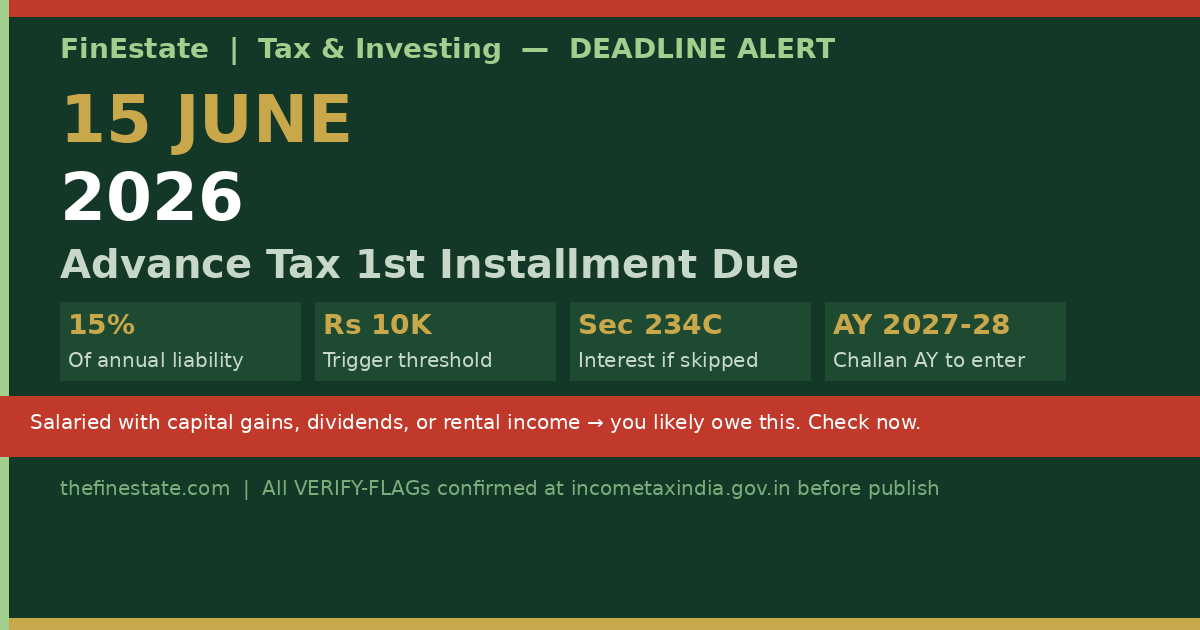
Advance tax applies if your total tax after TDS exceeds Rs 10,000 in a financial year. The first installment — 15% of the estimated tax — is due 15 June; a shortfall triggers simple interest of 1% per month under Section 234C.
Advance Tax — 1st Installment Deadline (15% of estimated annual liability)
If your employer deducts TDS (tax deducted at source) every month and nothing else is going on in your financial life, you can read this article and stop worrying — you are probably covered. But if you sold equity mutual funds or stocks in FY 2026-27 (April 2026 onwards), received dividends, earned rental income, or made any money outside your salary in this financial year, you need to read this carefully before 15 June.
The 1st installment of advance tax for FY 2026-27 is due on 15 June 2026. It is 15% of your estimated total tax liability for the current year. Miss it, and interest under Section 234C starts accruing at 1% per month on the deferred amount.
First, a clarification that trips up everyone this time of year. Advance tax is for this year’s income — FY 2026-27 (April 2026 to March 2027). The ITR you are filing or planning to file by 31 July 2026 is for last year’s income — FY 2025-26 (AY 2026-27). Two separate obligations, same season, often confused.
- Who owes it: Anyone whose estimated tax liability for FY 2026-27 is Rs 10,000 or more (after reducing the TDS already deducted) must pay advance tax.
- What’s due 15 June 2026: 15% of your total estimated annual liability for FY 2026-27. If your only non-TDS income is capital gains that arose after 15 June, they may be deferred to the September installment — see Section 234C timing relief below.
- Who’s exempt: Resident senior citizens aged 60 or above who have no business or professional income are fully exempt from advance tax (Section 207). Salaried employees whose TDS covers their full liability owe nothing. Everyone else in the net must pay.
- How to pay: Online via the Income Tax e-filing portal — go to e-Pay Tax, select Challan 280, Assessment Year 2027-28, “Advance Tax” under Type of Payment. Keep the challan receipt.
What Advance Tax Is — and Why Salaried People Get Surprised by It
Advance tax is India’s system of pre-paying income tax during the financial year rather than in a lump sum at the end. The logic is simple: the government collects tax as income is earned, not 12 months after the fact.
For pure salaried employees, TDS handles this automatically — the employer deducts tax at source every month and deposits it with the government on your behalf. If your employer’s TDS precisely matches your total tax liability for the year, you owe nothing extra. The advance tax system doesn’t touch you.
The system starts applying the moment you have income that isn’t TDS’d — or isn’t TDS’d accurately. The most common triggers in 2026:
Capital gains. If you sold listed equity, equity mutual funds, or any other asset with a capital gain in FY 2026-27, no TDS is typically deducted at source on that gain. The tax on that gain accumulates as a liability you must pay through advance tax.
Dividends and interest. Bank interest is usually TDS’d at 10% only if it exceeds Rs 40,000/year. If your actual tax rate is higher (20% or 30% under your applicable slab), the shortfall creates an advance tax liability. Dividend TDS is also incomplete for most filers.
Rental income. If you have a tenant, TDS should be deducted — but often isn’t, especially for non-commercial leases. Any rental income with no TDS generates an advance tax obligation.
Freelance and side income. Platform payments, consulting fees, content revenue — these often have no TDS at all, or 10% flat which may not match your effective rate.
Tech employees with vested RSUs and ESOPs are the most frequently surprised category. RSUs vest and the employer deducts TDS on the FMV-at-vesting as salary income — that part is covered. But when the employee sells the vested stock, they generate STCG (short-term capital gains) under Section 111A (20% rate, FY 2026-27). No TDS is deducted on that sale. The capital gain accumulates as an advance tax liability through the year. A tech employee who books a short-term gain of about Rs 73,000 on vested stock sold in Q1 FY 2026-27 (April–June 2026) owes roughly Rs 15,200 of advance tax (20% + 4% cess) on that gain — due at the 15 June installment. Most find out at ITR season instead, compounding the liability with 234C interest.
The Installment Schedule — FY 2026-27
Advance tax is paid in four installments across the financial year. Each installment is cumulative — meaning by 15 September you should have paid 45% of your total estimated annual liability, not just 45% of the remaining amount.
| Installment | Due Date | Cumulative % of Annual Liability | Action Required |
|---|---|---|---|
| 1st | 15 June 2026 | 15% | Estimate your FY 2026-27 income NOW; pay 15% of net tax |
| 2nd | 15 September 2026 | 45% | Revise estimate; pay to bring cumulative to 45% |
| 3rd | 15 December 2026 | 75% | Revise again; pay to 75% |
| 4th | 15 March 2027 | 100% | Clear the balance |
How to use the schedule in practice. Estimate your total FY 2026-27 tax liability today. Subtract the TDS your employer will deduct for the full year (check your monthly TDS certificate or form 16 from last year as a guide). The remainder is your advance tax liability. Pay 15% of that remainder by 15 June. You can revise the estimate at each subsequent installment if your income situation changes.
The Worked Example — Salary + STCG
Ravi Sharma (composite illustrative profile) is a salaried software engineer earning Rs 9,25,000. His employer deducts TDS throughout the year. In April 2026, he sold Rs 3,00,000 of equity shares held for less than 12 months — generating Short-Term Capital Gains under Section 111A.
| Component | Amount | Tax |
|---|---|---|
| Gross salary | Rs 9,25,000 | — |
| Standard deduction (New Regime) | − Rs 75,000 | — |
| Net salary (slab-rate income) | Rs 8,50,000 | — |
| Slab tax on Rs 8,50,000 | — | Rs 25,000 |
| Section 87A rebate (salary ≤ Rs 12L → eligible) | — | − Rs 25,000 |
| Net slab tax after rebate | — | NIL |
| STCG (Section 111A) — Rs 3,00,000 at 20% | — | Rs 60,000 |
| Health & Education Cess at 4% | — | Rs 2,400 |
| Total estimated annual tax (FY 2026-27) | — | Rs 62,400 |
| Less: TDS on salary (employer deducts) | — | − Rs 0 (87A wipes slab tax) |
| Net advance tax liability | — | Rs 62,400 |
| 1st installment due 15 June 2026 (15%) | — | Rs 9,360 |
Note: Rs 62,400 is the same figure as the demand notice in our Section 87A article — because that is exactly what happens when the advance tax is not paid during the year. The demand notice is CBDT computing what should have been paid as advance tax. Paying advance tax proactively avoids the demand notice entirely, plus saves 234B and 234C interest.
Note the Section 87A interaction: the Rs 25,000 slab tax on Ravi’s salary is completely eliminated by the 87A rebate (which applies to slab-rate income; total income Rs 11.5L is below the Rs 12L eligibility threshold). But the Rs 62,400 STCG tax is not reduced by 87A — it sits outside the rebate’s reach per CBDT Circular 13/2025. This means a taxpayer with salary below Rs 12L and STCG has zero slab tax (87A covers it) but full STCG tax — and their entire advance tax liability is the STCG component. It is a precise, predictable liability that arrives every time equity is sold within 12 months. Budget for it at the point of sale, not at ITR season.
The Capital-Gains Timing Relief — What Generic Coverage Gets Wrong
Section 234C of the Income-tax Act has a specific proviso for capital gains and other casual income that most articles skip over. Here is what it actually says:
The standard rule: If you pay less than the cumulative percentages (15%/45%/75%) by each installment date, you pay 1% per month simple interest on the shortfall under Section 234C.
The timing relief: If a capital gain arises AFTER a given installment date, the advance tax on that specific gain is not required in that installment — it can be included in the next installment without attracting 234C interest. Specifically, if you pay the entire advance tax on the gain in the installment(s) falling due after the gain arose, no 234C interest applies to that gain.
In practice:
Case 1 — STCG in April 2026 (before 15 June). The gain has already arisen. You must include it in the June installment. Ravi’s April STCG creates a Rs 9,360 June obligation. No relief available.
Case 2 — STCG in July 2026 (after 15 June, before 15 September). The June installment can ignore this gain. The full STCG tax must be included starting from the September installment (45% cumulative). If you catch up by September, no 234C interest on the STCG component.
Case 3 — STCG in January 2027 (after 15 December, before 15 March). The first three installments can ignore this gain. The entire STCG tax must be paid by 15 March. If you clear it by 15 March, no 234C interest.
The capital-gains timing relief is the most practically useful provision in the advance tax chapter — and the most consistently under-explained in mainstream coverage. It means that if you are an active equity investor who makes gains throughout the year, you are not required to predict all 12 months of gains by 15 June. You pay as you earn, quarter by quarter. The consequence of this: review your capital gain position before each installment date and update your advance tax payment accordingly. A quarterly review of realised vs unrealised gains — 10 minutes of work per quarter — keeps you perfectly current on advance tax with zero risk of 234C interest.
How to Pay — Online in 5 Steps
- Log in to the Income Tax e-filing portal at incometax.gov.in using your PAN and password.
- Navigate to e-Pay Tax under the “e-File” menu. Click “New Payment.”
- Select Challan 280 (Income Tax on Companies for companies; for individuals, select “Other than Companies”). Under “Type of Payment,” select Advance Tax (100).
- Enter Assessment Year 2027-28 (not 2026-27 — advance tax for FY 2026-27 is assessed in AY 2027-28). Enter the tax amount, surcharge (if applicable), and cess to compute automatically.
- Pay via net banking, UPI, or debit card. Download and save the payment challan (BSR code, challan serial number, date). You will need these to pre-fill the ITR for FY 2026-27 when you file it by 31 July 2027.
What to enter for Assessment Year: This is the most common error. Advance tax for the current financial year FY 2026-27 goes against Assessment Year 2027-28. The ITR you’re filing now (for last year’s income, FY 2025-26) is Assessment Year 2026-27. Do not mix these up on the challan.
The Penalty for Skipping
Section 234C — deferment interest. If you pay less than the required cumulative percentage by any installment date (15%, 45%, 75%), you pay 1% simple interest per month on the shortfall — three months each for the June, September and December installment shortfalls, and one month for the March installment. For the March installment and any final shortfall, Section 234B applies.
Section 234B — default in payment. If you have paid less than 90% of your total tax liability through TDS and advance tax combined by the end of the financial year (31 March), Section 234B interest applies at 1% per month from April 1 until the date of actual payment. (Both Section 234B and Section 234C carry interest of 1% per month; what differs is the trigger — 234C for paying an installment short, 234B for the year-end default.) This is the “you forgot to pay advance tax entirely” penalty, as opposed to 234C which is the “you paid late in the year” penalty.
Practical numbers. On a Rs 62,400 advance tax liability: failing to pay the June installment (Rs 9,360) triggers roughly Rs 281 in 234C interest over three months (Rs 9,360 × 1% × 3 = Rs 281). Not ruinous — but avoidable. On larger liabilities (Rs 5L+ STCG generating Rs 1,00,000+ in tax), the 1%/month deferment interest becomes meaningful, especially compounding across multiple missed installments.
The common mistake we see every ITR season: salaried investors file their ITR for last year, discover the STCG tax they owe, pay it as self-assessment tax in July — and think they are done. They are not. For FY 2026-27 (the current year), if they have realised capital gains between April and June 2026, advance tax was due on 15 June. Filing for last year does not absolve the current year’s advance tax obligation. The two clocks run simultaneously. This is why we are writing this article on 9 June rather than 9 July.
Advance tax is not a trap. It is the income tax system’s way of saying: if you are earning money outside your salary, pay the government as you earn, not all at once. The 15 June 1st installment (15% of estimated annual liability) scales with your gains — it can be a few thousand rupees on a small capital-gains position, or more on a larger one (Rs 9,360 in our worked example). The system is forgiving: you can revise your estimate at each installment date, and capital gains that arise after a given date don’t need to be included until the next one.
The Rs 10,000 threshold is the key gate — if your entire advance tax liability after TDS is below Rs 10,000, you owe nothing. If it is above, the four-installment schedule applies. Check this now, before 15 June, not after. Five minutes of calculation today saves a month of interest starting 16 June.
- Advance tax (FY 2026-27) is separate from the ITR you are filing for last year (FY 2025-26). Two obligations, same season.
- If your tax liability after TDS exceeds Rs 10,000 for FY 2026-27, you must pay advance tax. Resident senior citizens (60+) without business income are exempt.
- The 1st installment (15% of annual liability) is due 15 June 2026. The schedule: 15% June, 45% September, 75% December, 100% March.
- Capital gains get a timing relief (Section 234C proviso): advance tax on a gain is due only in the installment after the gain arises. Gains after 15 June can be deferred to the September installment.
- STCG on listed equity under Section 111A is taxed at 20% for FY 2026-27 (not 15%) per Finance (No. 2) Act 2024. Section 87A does not apply to this STCG tax even if total income is below Rs 12L per CBDT Circular 13/2025.
- Pay via Challan 280 at the e-filing portal. Assessment Year to enter: 2027-28 (not 2026-27). Keep the challan BSR code and serial number.
- Income-tax Act 1961, Section 234C — Interest for deferment of advance tax (1% per month, one per cent)
- CBDT Tutorial — Provisions Relating to Payment of Advance Tax [As amended by Finance Act 2025] — installment schedule 15/45/75/100% VERIFIED
- Income-tax Act 1961 — Section 207 (senior citizen exemption), Section 208 (Rs 10,000 threshold), Sections 209-211 (installment schedule), Section 234B (1%/month), Section 234C (1%/month)
- CBDT Advance Tax FAQ — incometaxindia.gov.in (verify current installment schedule and threshold)
- Finance (No. 2) Act 2024 — STCG under Section 111A revised to 20%, effective 23 July 2024
- Finance Act 2025 — Section 87A rebate (Rs 60,000, New Regime, total income ≤ Rs 12L)
- CBDT Circular No. 13/2025 (19 Sep 2025) — Section 87A applies to slab-rate income only; CG at special rates excluded
- Income Tax e-filing Portal — e-Pay Tax / Challan 280 (incometax.gov.in)
- FinEstate — Section 87A + STCG: The Rs 62,400 Demand Notice Explained
- FinEstate — ITR Filing AY 2026-27 Step-by-Step Guide
Tax deadlines, real estate analysis, RBI policy — straight to your feed. No noise.
Keep reading
This article is part of our income tax guide — the full set of explainers for salaried Indians, in the order you actually meet them.