RBI USD 5B Swap Auction May 2026: Rupee Defence Explained
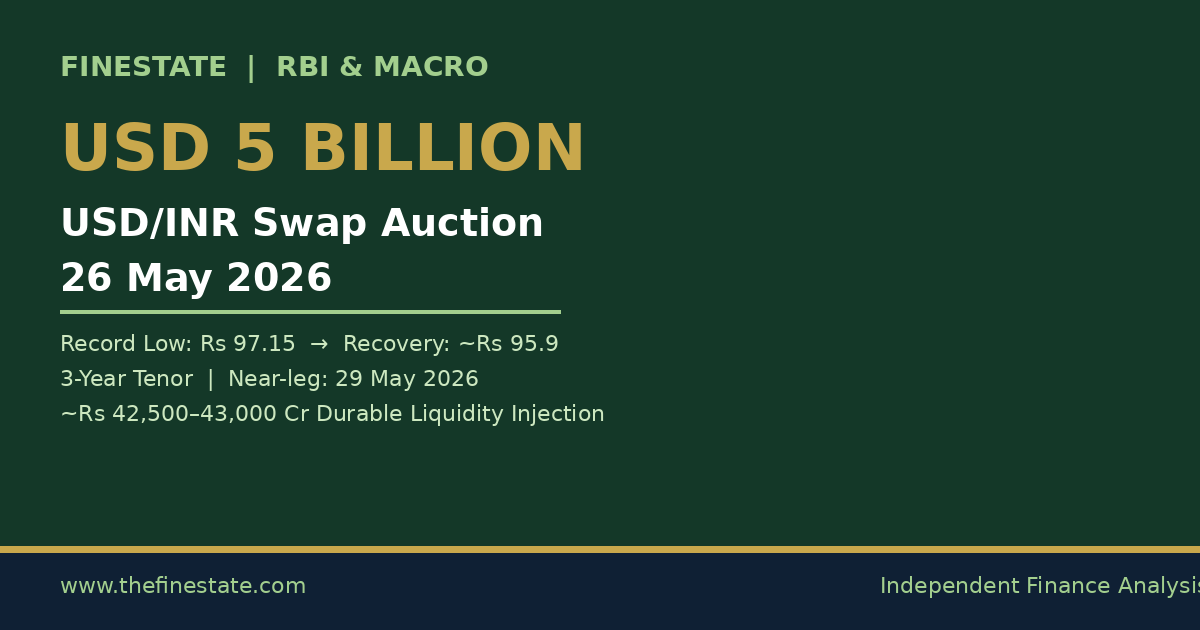
On 26 May 2026, the Reserve Bank of India conducted a USD 5 billion buy-sell USD/INR foreign exchange swap auction — one of the largest single liquidity-injection operations in recent RBI history. The rupee had hit a historic low of Rs 97.15 on 19 May 2026; by 22 May it had clawed back to approximately Rs 95.9, a Rs 1.25 recovery in three trading sessions, aided by concerted RBI intervention and the swap announcement. This piece explains what happened, how the mechanism works, and what it means for investors and households.
- RBI auctioned USD 5 billion in a buy-sell USD/INR swap on 26 May 2026 — direct intervention to defend a rupee that had hit Rs 96.90 in mid-May. The near leg settles 29 May; the far leg matures three years out, with RBI buying the dollars back at a pre-agreed forward rate.
- Forex reserves fell USD 7.5 billion in a single week to USD 681.38 billion (22 May 2026 WSS) — reflecting both rupee defence and dollar valuation moves. Reserve adequacy still strong at approximately 10 months of import cover, well above the three-month threshold.
- The June MPC faces a tightrope: April CPI at 3.48% argues for a rate cut on inflation grounds, but a fragile rupee complicates that calculus. A cut that weakens the currency further works against the goal the swap was designed to achieve. See our RBI MPC June 2026 analysis for the outcome.
What Just Happened
On 26 May 2026, the Reserve Bank of India conducted a USD 5 billion buy-sell USD/INR foreign exchange swap auction — one of the largest single liquidity-injection operations in recent RBI history. The auction ran from 10:30 to 11:30 IST, open only to Authorised Dealer Category-I banks, with a minimum bid of USD 10 million. The near leg settles 29 May 2026 (T+3); the far leg, when banks return the dollars and receive their rupees back, settles 29 May 2029, making this effectively a three-year durable liquidity operation.
The move is the RBI’s most aggressive single-day intervention since the rupee pierced a historic low of Rs 97.15 per US dollar on 19 May 2026 — a level that rattled importers, foreign portfolio investors, and households with overseas financial commitments. By 22 May, following concerted RBI dollar sales and the swap announcement, the currency had clawed back to approximately Rs 95.9 per dollar, a recovery of roughly Rs 1.25 in three trading sessions. For the full context of the rupee’s slide, see our earlier piece: Rupee at Rs 96.90: India’s Currency Slide and Your Wallet.
What Is a Buy-Sell USD/INR Swap Auction?
Most central bank interventions involve the RBI simply selling dollars from its reserves to calm rupee demand — a one-way transaction that permanently reduces the reserve balance. A buy-sell swap is structurally different and, for the RBI, considerably more powerful as a policy instrument.
- Near leg (29 May 2026): AD Category-I banks hand over US dollars to the RBI. In exchange, RBI credits them with the rupee equivalent at the auction’s agreed swap rate. Rupee liquidity immediately enters the banking system.
- Intervening three years: Banks hold the rupee funds. This durable liquidity supports credit creation, keeps short-term rates from spiking, and reduces the cost of rupee borrowing for businesses and households.
- Far leg (29 May 2029): The trade reverses. Banks return the rupee funds to the RBI; RBI returns the dollars at the same swap rate (adjusted for the forward premium agreed at auction).
Why this matters for rupee management. When RBI simply sells dollars, foreign exchange reserves fall permanently. A swap creates a temporary liability — RBI owes the dollars back in 2029 — but does not reduce reserves in the same way as outright sales. The key distinction is that the rupee liquidity created is durable (lasting three years) while the reserve impact is temporary. It is a two-for-one tool: currency stabilisation plus banking system liquidity, managed within a single instrument.
The Scale: USD 5 Billion in Context
India’s foreign exchange reserves stood at USD 681.38 billion as of the week ended 22 May 2026, according to the RBI’s Weekly Statistical Supplement released 29 May 2026. (WSS data refreshed against the 29 May 2026 release; subsequent updates published Fridays.) At that level, a USD 5 billion swap represents approximately 0.7% of total reserves — not a crisis-level drawdown but a meaningful signal of intent.
The broader reserves picture is more instructive. India’s forex reserves reached a peak of USD 728.494 billion in the week ended 27 February 2026. By the week ended 15 May, the reserves balance had fallen to USD 681.38 billion — an implied decline of approximately USD 47.1 billion. That figure reflects both RBI’s documented foreign exchange interventions and valuation effects on the multi-currency reserve basket (gold, SDRs, and non-dollar reserve currencies all move with exchange rates). Market observers, citing secondary sources, have estimated that RBI deployed upward of USD 38 billion in direct dollar sales since the February peak — though this figure cannot be wholly attributed to intervention alone, as valuation effects account for a portion of the decline.
The swap itself injects an estimated Rs 47,700–47,900 crore of durable rupee liquidity into the banking system, based on the prevailing FBIL USD/INR reference rate of approximately Rs 95.5 per dollar at the time of the auction. (This is a calculation derived from the auction size, not a figure directly stated by the RBI; the exact rupee equivalent will be determined by the reference rate applied at settlement on 29 May 2026.)
Why Now? The Rupee’s Slide and the Forces Behind It
The Indo-US trade tariff escalation was the proximate trigger for the rupee’s slide in May. Renewed uncertainty over trade terms — at a time when India runs a significant merchandise trade deficit — reignited fears of a current-account blowout and accelerated foreign portfolio investor outflows. NSDL data showed net FPI selling across equity and debt segments in the weeks preceding the 19 May record low, with cumulative outflows pressuring the rupee from both the capital account and the forward markets.
Crude oil remained an aggravating factor. India imports approximately 85% of its crude oil requirements; a weaker rupee directly raises the rupee cost of every barrel, worsening the trade deficit in a feedback loop. The West Asia conflict backdrop kept crude prices elevated in May, compounding the pressure on the current account and the currency simultaneously.
Banking-system liquidity tightened sharply in the week of 19–23 May, complicating the RBI’s response. The system’s rupee liquidity surplus dropped from approximately Rs 1.51 trillion on 20 May to approximately Rs 58,876 crore on 21 May — a near-total absorption in one trading session, driven partly by advance tax outflows and partly by RBI’s own dollar sales draining rupee liquidity as a mechanical side-effect. A Variable Rate Repo auction of Rs 81,590 crore at a 5.26% cut-off on 22 May provided temporary relief; the USD 5 billion swap now addresses the structural liquidity gap on a three-year horizon.
What It Means for Investors and Households
Overseas education and travel costs. A rupee at Rs 97 means a USD 50,000 annual university fee costs Rs 48.5 lakh — roughly Rs 2.5 lakh more than it would at Rs 84, the exchange rate that prevailed a year ago. Each Rs 1 of rupee weakness on a sustained basis adds approximately Rs 85,000 to that annual bill. The swap’s contribution to rupee stabilisation at Rs 95–96 is directly visible in these calculations. If the intervention holds the currency at current levels, the marginal cost of overseas commitments stabilises; if it fails and the rupee resumes its fall, each rupee of additional weakness translates directly to higher EMIs on foreign-currency education loans.
Import-heavy sectors. Oil marketing companies — HPCL, BPCL, IOC — absorb rupee depreciation directly on their crude import bills. With crude priced in dollars and retail fuel prices politically sensitive, sustained rupee weakness compresses their marketing margins and creates a case for either retail price hikes or government compensation. The electronics and consumer durables sectors face similar pass-through dynamics: component imports become costlier, and original equipment manufacturers must choose between margin compression and price increases. For the macro context on wholesale prices, see our analysis of how home loan rates are responding to RBI’s macro stance in 2026.
FPI sentiment and equity market positioning. Foreign portfolio investors who hold Indian equities denominated in rupees face a double jeopardy when the rupee weakens: equity market returns in dollar terms are eroded by the currency move. An FPI who earned 12% in rupee terms in a calendar year that also saw the rupee fall 8% against the dollar nets only 4% in their home currency. This dynamic explains why FPI outflows and rupee weakness tend to reinforce each other — and why RBI’s intervention to stabilise the currency is also, indirectly, a signal to FPIs that the floor is being defended.
Banking system liquidity and short-term borrowing costs. The direct beneficiary of the swap’s Rs 47,700–47,900 crore rupee injection is the banking system’s durable liquidity position. Tighter liquidity pushes up short-term inter-bank rates (call money, TREPS), which eventually transmit to commercial lending rates, raising the effective cost of working capital for businesses. By injecting durable three-year liquidity, RBI ensures the banking system does not face a structural squeeze that could tighten credit conditions independently of the policy repo rate. This is especially important ahead of the June MPC meeting.
The June MPC Complication
The RBI’s Monetary Policy Committee met in June 2026, and the swap auction added a layer of complexity to the rate-cut calculus. On one side of the ledger: CPI at 3.48% in April 2026 is the lowest reading in several years, well below the 4% midpoint of RBI’s target band, creating theoretical space for rate cuts to support growth. The India-Pakistan ceasefire and associated geopolitical de-escalation had also reduced one source of risk premium on Indian assets.
On the other side: active forex intervention — and now a large-scale USD/INR swap — signals that RBI is prioritising currency stability. A rate cut that weakens the rupee further would work against the very goal the swap is meant to achieve. The RBI faces two competing signals simultaneously: a benign inflation print that argues for easing, and a fragile currency that argues for caution. The June MPC outcome turns on whether the RBI reads the current rupee stabilisation as durable (enabling a cut) or as contingent on continued intervention (arguing for a pause). See our full RBI MPC June 2026 analysis for the detailed breakdown.
Risks and Counterpoints
Prolonged depreciation pressure. A single swap auction — even at USD 5 billion — cannot address the structural drivers of rupee weakness if they persist. If the Indo-US trade standoff deepens, FPI outflows continue, or crude oil prices spike further, the rupee could resume its decline despite RBI’s intervention. In that scenario, the swap provides temporary stability, not a lasting floor.
The reserve drawdown rate warrants monitoring. A decline of approximately USD 39.6 billion from the February peak — even partially driven by valuation effects — is not trivial. India’s import cover, a key metric of reserve adequacy, has narrowed. At USD 681.38 billion and an import bill of roughly USD 68–70 billion per month (approximate FY2025-26 run rate), India maintains approximately 10 months of import cover — comfortably above the conventional three-month adequacy threshold, but the trend bears watching if intervention continues at the current pace.
Far-leg obligation in 2029. By design, the banks will return the rupee funds and reclaim their dollars in May 2029. If the rupee is significantly weaker in 2029 than today, the forward premium embedded in the swap rate will determine the net cost to the banking system. This is a manageable risk under normal conditions but is worth flagging as a structural liability that the RBI carries on its forward book.
Global dollar strength as a wildcard. Much of the rupee’s recent weakness reflects a broad dollar rally driven by Federal Reserve policy, US economic outperformance, and risk-off flows globally. RBI can defend the rupee against domestic factors; it cannot meaningfully offset a sustained global dollar appreciation. If the DXY (Dollar Index) continues its upward trajectory, RBI’s intervention may slow the rupee’s fall without reversing it.
The RBI’s USD 5 billion swap auction on 26 May 2026 is its most powerful single liquidity operation of the current rupee defence cycle. It does two jobs simultaneously: stabilises the rupee by recycling dollar supply through the banking system, and injects approximately Rs 47,700–47,900 crore of durable three-year liquidity to prevent the banking system from tightening independently of MPC policy.
The intervention does not eliminate the structural pressures on the rupee — trade deficit, FPI outflows, crude oil pricing — but it buys time and signals RBI’s readiness to act at scale. Whether the June MPC can follow with a rate cut without undermining the currency will be the next test of India’s macro policy tightrope.
- RBI’s 26 May 2026 USD/INR buy-sell swap is a direct, large-scale rupee defence — absorbing Rs 47,700–47,900 crore of three-year liquidity while injecting dollar supply into the banking system.
- Forex reserves at USD 681.38 billion (22 May WSS) provide approximately 10 months of import cover — still well above the three-month adequacy threshold, but down USD 47.1 billion from the recent peak.
- Swap mechanics are not “lost” reserves. RBI sells USD now and contractually buys back at the maturity date; net liquidity impact reverses at three years.
- Investor signal: RBI has demonstrated active intervention capacity at scale. Bond markets stable, equity markets calm post-announcement, but persistent rupee volatility risk remains given trade deficit and FPI flows.
- June MPC outcome turns on durability of rupee stabilisation. A rate cut that re-weakens the currency works against the goal of the intervention. Watch the MPC statement on policy framing as much as the rate decision itself.
- RBI Press Release — USD/INR swap auction announcement (26 May 2026): Find via RBI Press Release Archive — search for “USD/INR Buy/Sell Swap” dated 26 May 2026.
- RBI Weekly Statistical Supplement — Foreign Exchange Reserves
- RBI Reference Rate Archive — USD/INR daily reference rates
- FBIL — Financial Benchmarks India Pvt Ltd (USD/INR reference rates)
- US Federal Reserve H.10 — Foreign Exchange Rates (India)
- NSDL FPI Data — Foreign Portfolio Investment flows
Get FinEstate updates on tax rules, EPF, and RBI policy straight to your inbox.
Keep reading
This article is part of our RBI and macro guide — the full set of explainers for salaried Indians, in the order you actually meet them.