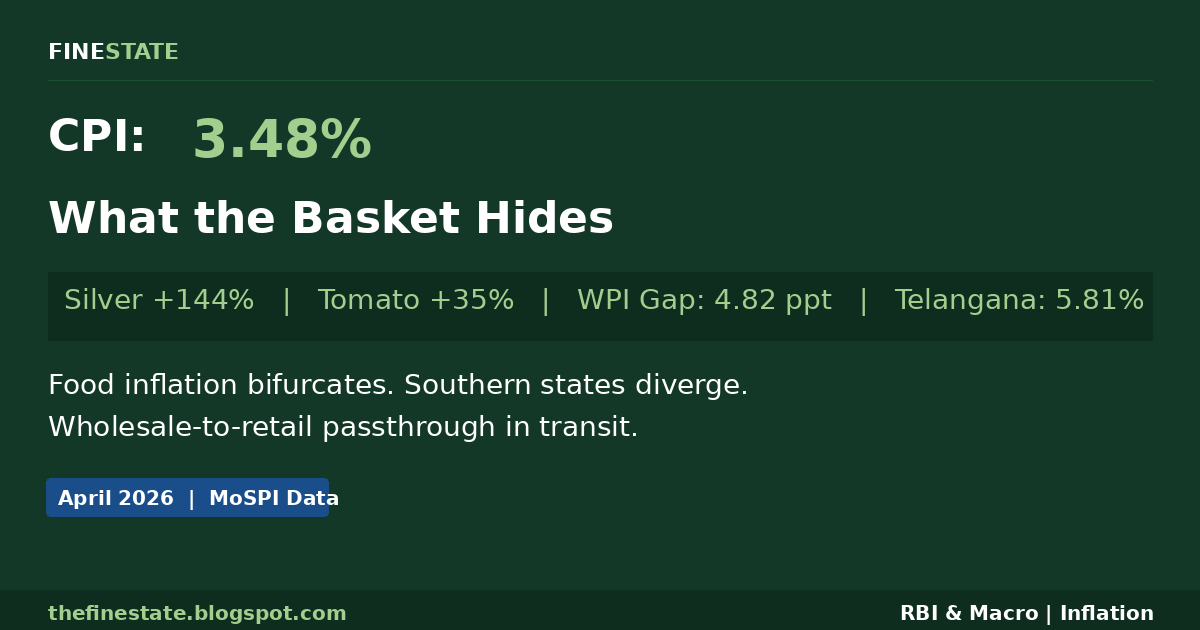
Food prices bifurcate, southern states surge to 5.81%, and a 4.82-point WPI–CPI gap signals the pressure still in transit.
| Headline CPI (April 2026, provisional) | 3.48% YoY — up from 3.40% in March 2026 |
| Food inflation (CFPI) | 4.20% YoY vs 3.87% in March |
| Urban CPI / Rural CPI | 3.16% / 3.74% |
| Housing inflation | 2.15% (Urban 1.96%, Rural 2.65%) |
| Highest state CPI | Telangana: 5.81% | AP: 4.20% | TN: 4.18% |
| Silver Jewellery (highest item) | +144.34% YoY — MoSPI eSankhyiki |
| Tomato / Cauliflower | +35.28% / +25.58% YoY |
| Potato / Onion | −23.69% / −17.67% YoY |
| WPI April 2026 | 8.30% (42-month high) — WPI–CPI gap: 4.82 ppt |
| Current repo rate | Held at April 2026 MPC; verify the precise level at rbi.org.in |
| CPI base year (revised) | 2024=100 — not comparable with older 2012=100 figures |
| Primary source | MoSPI CPI Press Release, 12 May 2026 |
Quick Answer — April 2026 CPI
- The number: Headline retail inflation (CPI) was 3.48% in April 2026 (provisional) — below the RBI’s 4% target for a third straight month, keeping the rate-cut door open for the June MPC.
- Beneath the headline: The basket is bifurcated — silver jewellery +144%, tomato +35%, cauliflower +26%, while potato −24% and onion −18% drag it lower. Telangana runs hottest at 5.81%.
- What’s coming: The 4.82-point WPI–CPI gap (WPI at 8.30%) means wholesale pressure is still in transit; watch the August–October 2026 prints for the fuel passthrough.
Introduction: The Headline Number and What Sits Below It
India’s retail inflation came in at 3.48% for April 2026 — a benign number on the surface. It is below the Reserve Bank of India’s 4% midpoint target, marginally above March’s 3.40%, and consistent with a central bank that has room to act at its next Monetary Policy Committee meeting on 3–5 June 2026. For borrowers on repo-linked home loans, the near-term signal is clear: EMIs are stable, and the macro backdrop supports a possible rate cut.
But the aggregate number tells only part of the story. Open the basket and the picture becomes considerably more nuanced. Silver jewellery is up 144% year-on-year. Tomatoes have risen 35%. Cauliflower is up 26%. Meanwhile, potatoes are nearly 24% cheaper and onions have shed 17%. The basket is not moving uniformly — it is moving in sharp, concentrated pockets that affect different households in very different ways.
This article unpacks those pockets: what the April data actually shows across the basket’s major categories, why southern states are running more than two percentage points above the national headline, and what the 4.82-point gap between wholesale and retail inflation means for the price pressures still in transit.
Background: What CPI Measures, and the Base Year Change
India’s Consumer Price Index (CPI) is compiled by the Ministry of Statistics and Programme Implementation (MoSPI) using a weighted basket of goods and services calibrated to household expenditure patterns. The largest component is food and beverages — approximately 46% of the basket — followed by housing (approximately 10%), with the remainder spread across fuel and light, clothing, footwear, and miscellaneous services including education and healthcare.
One important note before comparing these figures with older data: MoSPI revised the CPI series to a 2024=100 base year. Earlier reports may reference figures from the previous 2012=100 series; the item weights and methodology differ materially. The April 2026 print of 3.48% is from the 2024=100 revised series published in MoSPI’s press release of 12 May 2026.
The RBI targets CPI inflation at 4%, with a statutory tolerance band of 2%–6%. When CPI consistently prints below 4%, as it has over the past three months, the Monetary Policy Committee has room to consider a rate adjustment without departing from its inflation mandate.
The Numbers in Full: April 2026 Category Breakdown
Food inflation (Consumer Food Price Index, CFPI) edged up to 4.20% in April from 3.87% in March — a modest acceleration driven by a sharp divergence within the sub-basket.
High-inflation items. The most striking readings come from precious metals. Silver jewellery posted 144.34% year-on-year inflation — reflecting global safe-haven demand and precious metals repricing, not a conventional consumption signal. Gold, diamond, and platinum jewellery followed at +40.72%. Within fresh produce, tomato rose 35.28% and cauliflower 25.58%, driven by seasonal supply disruptions and elevated post-harvest transit costs.
Deflating items. On the other side, potato fell 23.69% year-on-year and onion dropped 17.67%. Both staples carry meaningful basket weights and are actively dragging the headline lower. This vegetable deflation is real household relief — but it may not persist post-monsoon if crop conditions deteriorate.
Urban vs rural. Urban CPI (3.16%) prints below Rural CPI (3.74%) for the third consecutive month. Urban consumers benefit from organised retail supply chains that dampen vegetable price volatility; rural households face greater exposure to local food price swings. Housing inflation moderated to 2.15% nationally (Urban 1.96%, Rural 2.65%), consistent with subdued urban rent growth.
The 3.48% headline averages out fundamentally different sub-stories. Vegetable deflation is being driven by supply-side normalisation after a strong winter crop. Precious metals inflation is a global repricing story, almost entirely disconnected from Indian household consumption. Reading the headline without the basket-level texture misses both stories — and the policy implications that flow from each.
— Utkarsh Garg, FinEstate
Wholesale price inflation is running at 8.30% while retail CPI sits at 3.48%. The gap is one of the widest in recent history — and it is narrowing not by WPI falling, but by CPI rising to meet it.
State-Level Variation: Why Telangana Is at 5.81%
The national 3.48% headline papers over a significant regional split. Telangana is the outlier at 5.81% — nearly 2.3 percentage points above the national average and well above the RBI’s 4% comfort zone. Andhra Pradesh (4.20%), Tamil Nadu (4.18%), and Karnataka (4.00%) round out the top four states, all in the southern tier. For a household in Hyderabad or Chennai, the lived inflation experience is materially different from what the national number implies.
Part of the structural explanation lies in services inflation driven by IT-sector wage growth. But the food dimension is equally significant: southern states show consistently higher CFPI relative to the national average, driven by a basket weighted toward protein-rich and perishable foods where supply chains are more price-volatile than the grain-dominated northern diet.
The uptick in food inflation across southern states is largely driven by a structural shift in dietary patterns — from traditional grain-based meals toward protein-rich and more diversified diets. Urban South India (Hyderabad, Chennai, Bengaluru) has seen rising consumption of chicken, fish, eggs, and processed dairy products as IT-sector wage growth lifts household spending. Demand is outpacing the pace at which organised supply chains can scale — a direct driver of elevated CFPI readings in Telangana and Andhra Pradesh. Northern India, where diets remain more traditional — anchored in wheat, rice, and fluid milk — has shown more stable food inflation, consistent with lower readings in Uttar Pradesh and Rajasthan.
— Utkarsh Garg, FinEstate | Source: MoSPI HCES 2022-23 (household food expenditure patterns)
The WPI–CPI Divergence: A 4.82-Point Gap and What It Signals
The most consequential macro signal in the April 2026 data is not the CPI number itself — it is the gap between CPI and WPI. Wholesale price inflation (WPI) came in at 8.30% for April 2026, a 42-month high driven primarily by crude oil and fuel prices (PIB Release ID 2260905, 14 May 2026). Retail CPI came in at 3.48%. The spread: 4.82 percentage points.
This gap exists because wholesale prices take time to transmit to retail. The transmission channel runs through input costs, logistics margins, and manufacturer pricing decisions. For fuel-driven shocks specifically, the lag is typically one to two quarters — meaning the impact of April’s WPI surge is expected to show up in retail prices during the August–October 2026 window.
The Rs 3 per litre petrol and diesel price hike on 15 May 2026 — the first in over four years, implemented by state-owned oil marketing companies IOC, BPCL, and HPCL — marks the point at which the passthrough has formally begun. Fuel and light costs feed into headline CPI through the transport and household-energy sub-components. The May 15 fuel hike will be reflected progressively in the May 2026 CPI release on 12 June and subsequent prints. Read the full WPI breakdown: WPI Hits 42-Month High (8.3%) — April 2026 Breakdown.
The WPI surge is, in part, a signal that industries are absorbing higher input costs — paying more for raw materials, fuel, and logistics before any of that pressure is visible in consumer prices. The southwest monsoon adds another layer: rain-fed crops are price-sensitive and could swing sharply on monsoon quality, compressing the current cushion that vegetable deflation is providing. Full passthrough to household budgets is more likely Q3 2026 (July–September) than the June MPC meeting itself.
— Utkarsh Garg, FinEstate
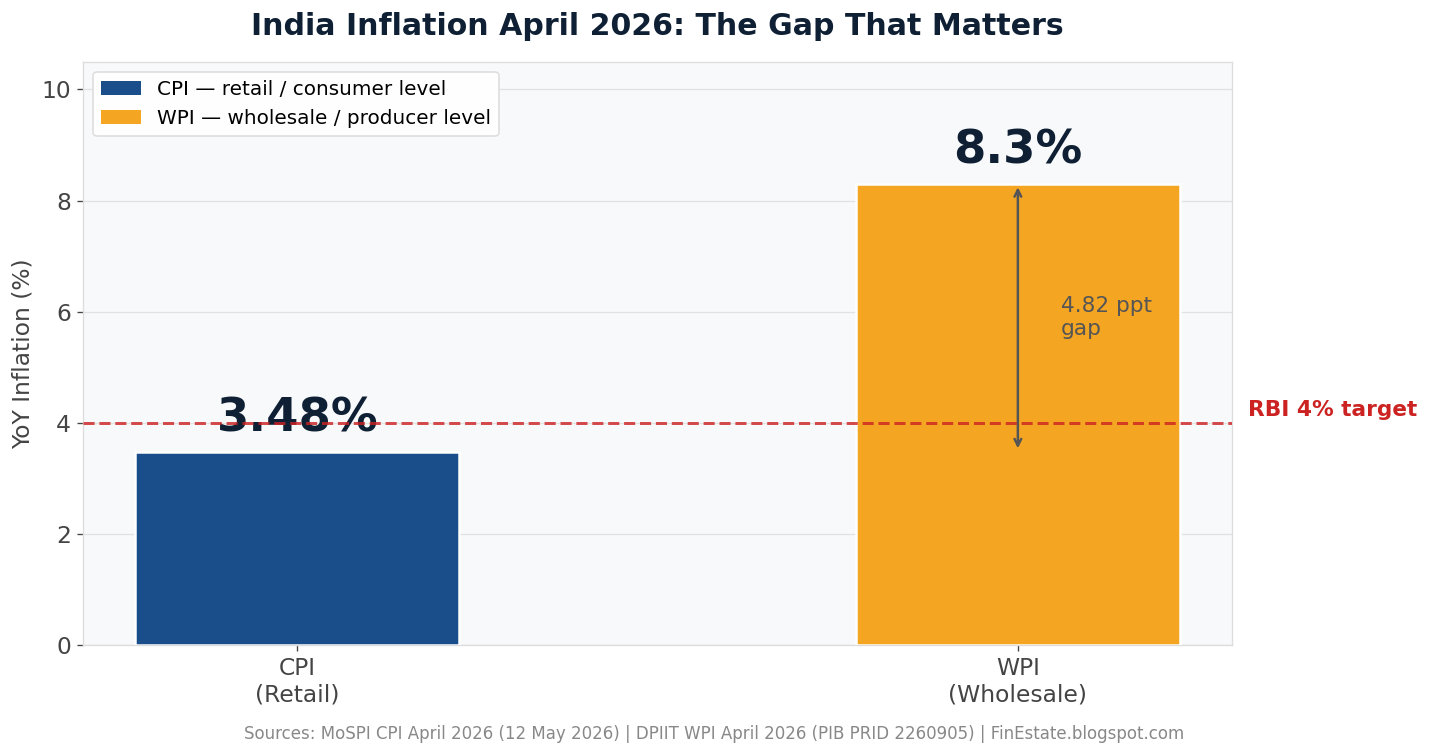
Chart: CPI vs WPI comparison, April 2026. Sources: MoSPI (CPI), DPIIT/PIB (WPI). The 4.82-ppt gap reflects the transmission lag between wholesale and retail price levels.
What This Means for RBI Policy and Your EMIs
With CPI at 3.48% — comfortably below the RBI’s 4% midpoint target — the Monetary Policy Committee enters its 3–5 June 2026 meeting with meaningful room to act. The repo rate has been held over the past two MPC cycles. CPI at 3.48% sits comfortably below the 4% target band, leaving the rate-cut door open and providing a supportive backdrop for a possible cut at the June MPC. The committee’s decision will weigh this against the WPI surge and emerging fuel passthrough.
To be clear: whether the MPC cuts, holds, or signals a shift depends on the full data picture entering June — including the trajectory of the WPI-to-CPI passthrough, the May 2026 CPI print (released 12 June, after the MPC convenes), and the committee’s assessment of second-round fuel-hike effects. This article does not predict the rate decision. See the companion RBI MPC June 2026 preview for the full scenario analysis.
For borrowers on floating-rate home loans linked to the repo rate (EBLR-based products), the near-term picture is stable EMIs. A 25 basis-point rate cut, if it materialises in June, would transmit to EBLR within one quarterly reset — translating to a modest reduction in monthly outgo on a typical Rs 50 lakh, 20-year home loan.
The June MPC matters beyond the headline rate. The committee’s stance and forward guidance language — particularly how it frames the WPI-CPI gap — is the signal worth watching. A hold paired with softer language about future cuts opens different lending conditions than a hold paired with hawkish language about persistent input cost pressure. For readers on floating-rate home loans, the language matters as much as the number.
— Utkarsh Garg, FinEstate
Risks and Counterpoints
Monsoon risk. India’s 2026 southwest monsoon is the single biggest wildcard for the remainder of the year. A below-normal or delayed monsoon would push food inflation — particularly vegetables, pulses, and edible oils — sharply higher in the July–September window. The April print benefits from relatively benign food supply conditions; those conditions are not guaranteed to persist.
Base-effect reversal. The April 2026 CPI reading benefits partly from a low April 2025 base. Year-on-year comparisons become progressively more challenging through May and June 2026. Readers tracking month-on-month sequential change — rather than year-on-year — will get a cleaner signal of current price momentum through the summer.
Oil passthrough. The 15 May 2026 petrol and diesel hike marks the beginning of the fuel passthrough, not the end of it. PPAC data on petrol under-recoveries indicates continued pressure on oil marketing company margins. If pump prices are raised further, the CPI fuel and transport categories would absorb additional pressure, creating upside on the headline in the months that follow.
Precious metals anomaly. Silver jewellery at +144% is the most striking number in the dataset, but the reading reflects global industrial and safe-haven demand dynamics — amplified in India by the geopolitical risk premium during the May 2026 escalation. Readers comparing this with personal investment views should note this is a price-level measurement, not a forward return signal.
CPI at 3.48% is genuinely benign for EMIs and near-term RBI policy — the rate-cut door is open for June. But the basket’s real story is in its extremes: vegetable deflation is masking a more complex picture, precious metals are repricing sharply, southern states are running near 6% on a structural diet-shift story, and the 4.82-point WPI–CPI gap means wholesale pressure is still in transit. Watch the August–October CPI prints for the true fuel-passthrough verdict.
Key Takeaways
• CPI April 2026: 3.48% (provisional), up from 3.40% in March. Below the RBI’s 4% midpoint target for the third consecutive month.
• Food inflation (CFPI) rose to 4.20% from 3.87%. Bifurcated basket: precious metals and select vegetables higher; potatoes and onions providing meaningful relief that may not survive the monsoon.
• Silver jewellery +144%, tomato +35%, cauliflower +26% are the pain points. Potato −24% and onion −18% are holding the headline down — treat this as a temporary buffer, not a structural trend.
• Southern states running well above the national average: Telangana 5.81%, AP 4.20%, TN 4.18%. Structural driver: diet diversification toward protein-rich foods where supply is yet to catch up with demand.
• The 4.82-ppt WPI–CPI gap (WPI 8.30%) signals wholesale pressure not yet fully transmitted to retail. Full passthrough more likely Q3 2026 (July–September) than immediate.
• CPI below 4% keeps the rate-cut door open for June MPC. Near-term EMIs stable; watch the June 5 announcement not just for the rate number but for the stance signal on bank lending conditions.
Frequently Asked Questions
India’s headline CPI inflation in April 2026 was 3.48% year-on-year (provisional), per MoSPI’s press release dated 12 May 2026. This compares with 3.40% (final) in March 2026 and remains below the RBI’s 4% midpoint inflation target.
The 144.34% reading for silver jewellery in April 2026 reflects global silver repricing — driven by elevated industrial demand, safe-haven flows during the India-Pakistan escalation period, and the broader precious metals bull cycle. It is not a domestic consumer demand signal in the conventional sense, and investors should not treat it as a forward return indicator for silver positions.
CPI measures price changes at the retail level — what a household pays for goods and services. WPI measures price changes at the wholesale/producer level — what businesses pay when buying in bulk. The RBI uses CPI as its primary inflation benchmark. In April 2026, the 4.82-point gap between WPI (8.30%) and CPI (3.48%) reflects the transmission lag — wholesale price pressure typically takes one to two quarters to fully reach retail consumers.
A CPI of 3.48% — well below the 4% target — provides a supportive backdrop for a rate cut at the June 3–5 MPC meeting. Whether the MPC actually cuts depends on the full data picture, including WPI passthrough and the 15 May fuel hike’s second-round impact. See the companion RBI MPC June 2026 preview for the full scenario analysis.
Telangana posted 5.81% CPI in April 2026 vs the 3.48% national average. The divergence reflects a structural shift toward protein-rich diets in South India’s urban centres (driven by IT-sector wage growth), combined with higher local food price volatility in markets serving these changing consumption patterns. All four southern states are running above the national average.
Sources
→ MoSPI CPI April 2026 Press Release (12 May 2026)
→ MoSPI eSankhyiki — Item-level and state-level CPI data
→ PIB WPI April 2026 (PRID 2260905, 14 May 2026)
→ RBI Monetary Policy Statements — April 2026 MPC
→ PPAC — Fuel pricing and under-recovery data
→ MoSPI HCES 2022-23 — Household food expenditure patterns (dietary shift data)
→ MPEDA / APEDA — Aquaculture and agricultural export data (cited in Editor’s Analysis)
Get India’s most important finance stories, explained simply — straight to your inbox.
Keep reading
This article is part of our RBI and macro guide — the full set of explainers for salaried Indians, in the order you actually meet them.