Quick Answer
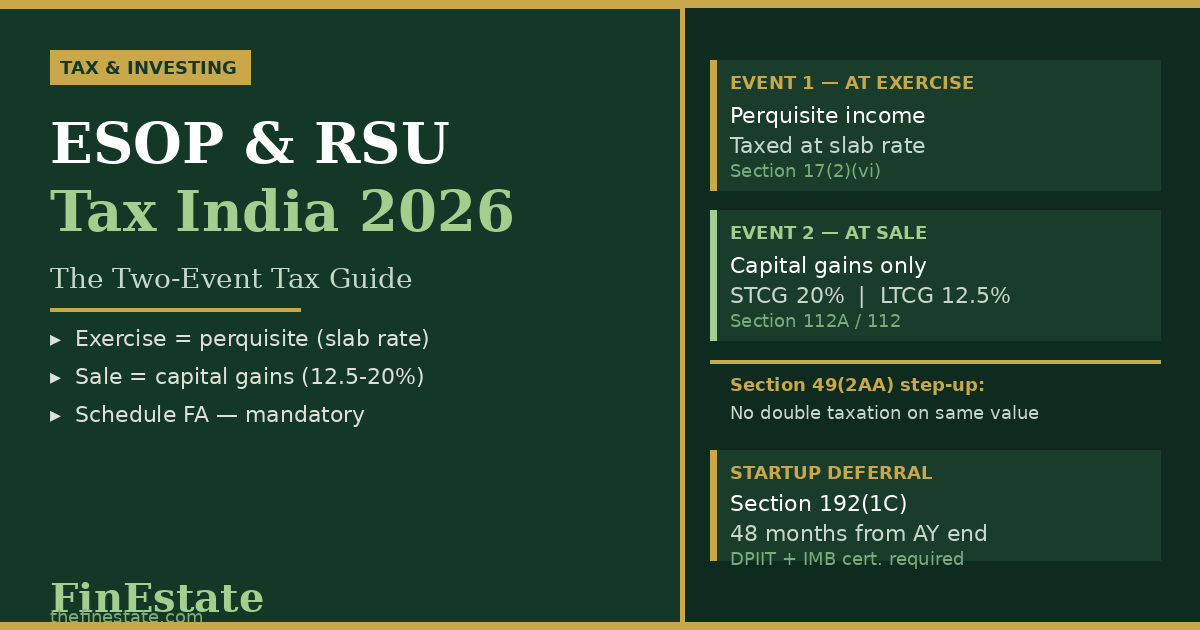
ESOPs and RSUs are taxed twice, and the two events are separated by years. First at exercise or vest, when the gain is added to your salary and taxed at slab rate — your employer withholds it, which is why one month’s take-home collapses. Then again at sale, as capital gains, but only on the appreciation after that first event. If your shares are in a foreign parent, a third obligation applies that has nothing to do with tax: Schedule FA disclosure, with a penalty measured in lakhs per year.
This applies to you if
- You hold ESOPs or RSUs from an Indian employer, a multinational, or a US-parent company.
- You have exercised, vested, or sold in any year and are unsure which event taxed what.
- You hold shares in a foreign company — in which case Schedule FA applies to you regardless of value, including a single fractional share.
- Two taxable events, years apart: perquisite at exercise or vest, capital gains at sale.
- The perquisite is the difference between fair market value and what you paid, taxed at your slab rate and withheld by your employer.
- At sale you are only taxed on appreciation after the exercise date — the step-up provision prevents double taxation.
- Rates differ by year and by exchange, and the citation depends on which Act governs your year.
- Foreign RSUs carry a 24-month long-term threshold, a foreign tax credit that expires if filed late, and Schedule FA with no minimum.
- Schedule FA reports what you hold, not what you can sell — and if you missed it, there is an amnesty closing 31 December 2026.
- Startup deferral needs two certificates, and DPIIT recognition alone is not one of them.
- Employer TDS covers the perquisite. It does not cover your capital gains.
The two-event ESOP and RSU tax framework
Exercise and sale are separate taxable events with different rates, different collection mechanisms and often years between them. Almost every ESOP mistake comes from treating them as one.
At exercise (or at vest, for RSUs) the gain is salary. It is added to your income for that month, taxed at your slab rate plus cess and any surcharge, and your employer withholds it. You have no choice about the timing and no cash has necessarily arrived.
At sale the gain is capital gains. It is your responsibility, not your employer’s, and the rate depends on how long you held and on which exchange the shares are listed.

The Schedule FA line-builder
Enter your grants, get the rupee figures at the right SBI TTBR for each date.
One email when something changes. No daily digest.
Event one: the perquisite at exercise
Perquisite value = fair market value on the exercise date, minus the exercise price you paid, multiplied by the number of shares. It is salary, taxed at slab rate.
This entire amount is added to your annual salary income and taxed at your applicable slab, plus 4% health and education cess and surcharge where applicable. Your employer deducts TDS on it in the same month as the exercise — which is why take-home salary drops sharply that month.
The governing provision depends on the year. For FY 2025-26 and earlier it is Section 17(2)(vi) of the Income-tax Act, 1961. From FY 2026-27 the perquisite provisions sit at Section 17 of the Income-tax Act, 2025, and the TDS obligation moves from Section 192 of the 1961 Act to Section 392 of the 2025 Act. See our guide to the Income-tax Act, 2025 transition for the wider renumbering, and note the trap: several section numbers exist in both Acts with entirely different subject matter, so any citation without an Act named is ambiguous.
Editor’s Analysis
The mistake I would flag is the same one a fresh graduate makes with CTC, arriving a decade later in a more expensive form. Equity granted at joining gets counted as income and spent against — people size a rent, a car EMI or a home loan against a number that includes a grant which has not vested, may never vest at that valuation, and cannot be sold on the day the household actually needs it. CTC in India is quoted as total employer cost, and equity is the part of it that sits furthest from cash. Nothing improper has happened. It was simply never explained that the number contains a claim on the future rather than money.
The tax makes that gap sharper rather than softer. The perquisite is taxed at exercise or vest, on the value on that date, and the employer withholds against it — so the tax event can arrive before any cash does, and in an unlisted company it can arrive years before there is a market to sell into. The employee then funds a real bill out of real salary, against wealth that exists only on paper.
The working rule is the unglamorous one. Plan the household against what reaches your bank account, and treat everything else as upside. If a monthly commitment only works because the grant is counted in, the commitment is too big.
Event two: capital gains at sale, and why you are not taxed twice
Your cost of acquisition is the fair market value on the exercise date — not the exercise price. So the appreciation you already paid perquisite tax on is never counted again.
This is the most important provision most ESOP holders never read. Under Section 49(2AA) of the Income-tax Act, 1961 — and Section 73 of the Income-tax Act, 2025, which carries the cost-of-acquisition rules from FY 2026-27 — the FMV on your exercise date becomes your cost base. Only the movement from that FMV to your eventual sale price is a capital gain.
A worked example makes the mechanics obvious. Exercise price Rs 100, FMV at exercise Rs 400, sale price Rs 700. The Rs 300 between exercise price and exercise FMV was taxed as salary at Event one. The Rs 300 between exercise FMV and sale price is your capital gain at Event two. The Rs 600 total gain is taxed once in each of its two halves, not twice over.
The rates, by year and by exchange
The holding period and the rate both depend on where the shares are listed — and the section number depends on which financial year you are dealing with.
| Shares | Holding period | Rate | 1961 Act | 2025 Act |
|---|---|---|---|---|
| Indian listed equity (STT paid) | 12 months or less | 20% | 111A | 196(1)(i) |
| Indian listed equity (STT paid) | More than 12 months | 12.5% above Rs 1,25,000 | 112A | 198(2)(a) |
| Foreign-listed equity (no STT) | 24 months or less | Slab rate | — | — |
| Foreign-listed equity (no STT) | More than 24 months | 12.5% without indexation | 112 | 197(1)(b) |
Two points that catch people out. The Rs 1,25,000 exemption on listed-equity long-term gains applies on the aggregate for the year, not per transaction — an express proviso, and a common error in online calculators. And there is no rebate available against short-term gains on listed equity: the rebate is denied on special-rate income, which was Section 87A of the 1961 Act and is now Section 156 of the 2025 Act. If you sold shares and expected a nil-tax outcome because your salary was below the threshold, that is the demand notice we wrote about separately.
Foreign RSUs: three things that differ
Vesting is the perquisite event, the long-term threshold is 24 months rather than 12, and the foreign tax credit is forfeited if Form 67 is filed after your return.
Vesting is the trigger. For Indian residents employed by US-parent companies, RSU vesting triggers the same perquisite calculation. The FMV on the vesting date converted to rupees, minus anything you paid, is added to salary and taxed at slab rate by the employer.
Sell-to-cover and the foreign tax credit. On vesting, most US employers automatically sell a portion of the shares to cover US federal withholding — the “sell-to-cover” mechanism. That US tax is creditable against your Indian liability under the India-US Double Taxation Avoidance Agreement, claimed via Form 67 on the e-filing portal. Form 67 must be filed before you submit your return; missing that sequence forfeits the credit for the year. Articles 10 and 13 of the DTAA govern dividends and capital gains respectively; Article 23 provides the relief mechanism.
The 24-month threshold. Foreign-listed equity has a 24-month long-term holding period, not the 12 months that applies to Indian listed shares. Beyond 24 months the gain is taxed at 12.5% without indexation — Section 112 of the 1961 Act, Section 197(1)(b) of the 2025 Act. It falls outside the listed-equity provisions because no securities transaction tax is paid on a foreign exchange, which also means the Rs 1,25,000 exemption does not apply.
One more thing that is not a tax at all, and catches the most people: sell-to-cover creates a sale. Shares sold on your behalf to fund withholding are a disposal, and the resulting gain or loss is yours to report. Employees frequently report the vest and forget the automatic sale that accompanied it.
Schedule FA: what to report, and the amnesty if you missed it
Schedule FA reports the shares you hold, not the shares you can sell. Unvested awards are not held assets; vested shares are, whether or not a lock-in prevents you selling them.
If you are a resident and ordinarily resident taxpayer and you held any foreign asset at any point in the relevant period — including a single partially-vested RSU — Schedule FA disclosure in ITR-2 or ITR-3 is mandatory. There is no minimum value threshold. A fractional share worth Rs 400 triggers the same obligation as a Rs 50 lakh portfolio, and filing ITR-1 while holding foreign assets is a compliance error in itself. Our step-by-step ITR filing guide covers the form-selection logic, and Form 67 is filed on the department’s e-filing portal before the return itself.
The reporting question that comes up most often is whether to report total vested shares or only the sellable ones. Report what you hold. A vested share subject to a trading window or a lock-in is still an asset you own. An unvested award is a contractual expectation, not an asset. If your equity portal shows a single blended number, ask for the vested balance separately.
A related question: does the perquisite need Schedule FSI as well? Schedule FSI is for income from a source outside India. The RSU perquisite is Indian salary income paid by your employer, so it does not belong there — but dividends on those shares, and gains on their sale, are foreign-source income and do. The two schedules answer different questions.
Failure to disclose carries a penalty of Rs 10 lakh per year under Section 43 of the Black Money (Undisclosed Foreign Income and Assets) and Imposition of Tax Act, 2015. Per year — so three unreported years stack.
If that describes you, there is a time-limited route out, and it closes soon. A one-time disclosure scheme opened on 16 August 2026 with a last date of 31 December 2026, and someone whose employer already deducted perquisite tax on the vest is very likely on its flat-fee track rather than its 60% one. We have covered it in detail: foreign RSUs you paid tax on but never put in Schedule FA. There is also a reported penalty floor below which Section 43 does not apply at all — relevant if your holding is modest, and set out in that article with its verification caveats.
Startup deferral: two certificates, not one
DPIIT recognition alone does not qualify your employer. A separate Inter-Ministerial Board certificate is required, and only a small fraction of recognised startups hold one.
For employees of eligible startups, TDS on the ESOP perquisite can be deferred — Section 192(1C) of the Income-tax Act, 1961. Instead of withholding at exercise, TDS is deposited only on the earliest of three triggers: sale of the shares, cessation of employment, or the lapse of 48 months from the end of the assessment year in which shares were allotted.
Shares allotted in FY 2025-26 fall in AY 2026-27, which ends 31 March 2027; adding 48 months gives a deadline of 31 March 2031. TDS must be deposited within 14 days of the trigger, computed at the rates applicable in the year of allotment, not the year of the trigger. For shares allotted on or after 1 April 2026 under the Income-tax Act, 2025, the deferral window extends to 60 months.
The dual gate. The startup must satisfy two independent requirements: DPIIT recognition, and a valid Section 80-IAC certificate from the Inter-Ministerial Board. Separate applications, separate timelines. India has roughly 1.97 lakh DPIIT-recognised startups; only around 4,000 hold IMB certification. Do not assume deferral applies — ask HR or finance for the IMB certificate number before planning around it.
Advance tax: what your employer does not cover
Employer TDS covers the perquisite. Capital gains at sale are entirely yours, and if residual liability exceeds Rs 10,000 you owe advance tax in instalments.
The four instalment dates are 15 June (15% cumulative), 15 September (45%), 15 December (75%) and 15 March (100%). Miss them and interest accrues, which is a needless cost on a liability you knew about the day you sold.
This is the most common ESOP filing failure after Schedule FA: the employee assumes that because the exercise was withheld against, the sale is covered too. It is not.
Editor’s Analysis
ESOPs and RSUs are among the most tax-intensive parts of a technology employee’s compensation, and the two-event structure is by design rather than an accident of drafting. The perquisite event is non-negotiable: it arrives at exercise, whether or not cash does. The capital-gains event is where the planning actually lives.
For foreign RSU holders, Schedule FA and Form 67 are not formalities. The penalty for non-disclosure is measured in lakhs per year, and the foreign tax credit is real money that disappears if Form 67 is filed after the return rather than before it.
The startup deferral is genuine money for the few thousand IMB-certified companies, but it does not apply by default to every DPIIT-recognised startup. Verify the certificate. Build the perquisite tax into your exercise timing, hold Indian listed shares beyond twelve months where the investment case allows, and never file ITR-1 if you hold any foreign equity — even a single share.
What to do next
If it is one employer and one grant type
File it yourself, online
TaxBuddy runs a fixed-fee plan for salaried returns with equity compensation — the perquisite already in Form 16, the capital gain at sale, and Schedule FA where the shares are foreign. Enough for most single-employer positions.
This is an affiliate link. If you file through it, FinEstate earns a commission at no extra cost to you. We link to it because it is one of the few Indian platforms with a plan built for equity compensation, not because of the commission. Disclaimer.
If any of this describes you
Speak to a chartered accountant
A startup deferral with two certificates, a sell-to-cover you cannot reconcile against Form 16, grants from more than one employer, shares held through a foreign broker you have never disclosed, or an exercise after you left — each of these changes the computation, not just the paperwork.
No fee for the introduction. What you agree with the CA afterwards is between you and them. We do not see your documents and we receive no part of their fee.
Key Takeaways
- Two events: perquisite at exercise or vest, taxed as salary at slab rate and withheld by your employer; capital gains at sale, which is your responsibility alone.
- The exercise-date fair market value becomes your cost base, so the gain taxed as salary is never taxed again as a capital gain.
- Indian listed equity: 20% short-term at 12 months or less, 12.5% long-term above Rs 1,25,000 beyond that. The exemption is annual and aggregate, not per transaction.
- Foreign-listed equity: the long-term threshold is 24 months, the rate is 12.5% without indexation, and the Rs 1,25,000 exemption does not apply.
- Sell-to-cover is a sale. Report the disposal, not just the vest.
- Schedule FA reports what you hold, including vested-but-locked shares. Unvested awards are not assets. No minimum threshold applies.
- Non-disclosure carries Rs 10 lakh per year under Section 43 of the Black Money Act, 2015 — and a disclosure scheme closes 31 December 2026.
- Startup TDS deferral needs both DPIIT recognition and an IMB Section 80-IAC certificate. Only about 4,000 of 1.97 lakh recognised startups have the second.
- Employer TDS does not cover capital gains. Advance tax applies if residual liability exceeds Rs 10,000.
Frequently Asked Questions
For Schedule FA, do I report total vested shares or only the sellable ones?
Report what you hold. A vested share is an asset you own even if a lock-in or trading window prevents you selling it today, so it belongs in Schedule FA. An unvested award is a contractual expectation rather than a held asset and does not. If your equity platform shows one blended figure, ask for the vested balance separately — that is the number the schedule wants.
My RSUs vested in 2026 and the perquisite was taxed in FY 2025-26. Do I also need Schedule FSI?
Not for the perquisite. Schedule FSI covers income from a source outside India, and the RSU perquisite is Indian salary income paid by your employer — it is reported as salary. But dividends on those shares, and any capital gain when you sell them, are foreign-source income and do belong in Schedule FSI, with Form 67 filed before your return if you are claiming credit for foreign tax.
I never declared RSUs in a past return. What is the exposure and can I fix it?
The exposure is Section 43 of the Black Money Act, 2015 — Rs 10 lakh for each year the disclosure was missed, so it stacks across years. A one-time disclosure scheme is open until 31 December 2026, and if your employer already deducted perquisite tax on the vest you are very likely on its flat-fee track rather than the punitive one. Our detailed guide to that scheme covers which track applies, how the valuation works, and a reported penalty floor that may mean you have no exposure at all.
Am I taxed twice on the same ESOP shares?
No, when the law is applied correctly. The fair market value on your exercise date becomes your cost of acquisition for capital-gains purposes — Section 49(2AA) of the 1961 Act, Section 73 of the 2025 Act. The appreciation already taxed as a perquisite is never counted again. Only the movement from exercise-date value to sale price is a capital gain.
Does my employer deduct all the tax on my ESOPs?
Only the perquisite at exercise or vest, via TDS in that month. Capital gains at sale are not covered, and if your residual liability after all TDS exceeds Rs 10,000 in a financial year you must deposit advance tax yourself across the four instalment dates. Assuming the employer has handled everything is the second most common ESOP filing error, after Schedule FA.
What is the long-term holding period for my US RSUs?
24 months from vesting, not 12. Foreign-listed shares sit outside the Indian listed-equity provisions because no securities transaction tax is paid on a foreign exchange. Beyond 24 months the gain is taxed at 12.5% without indexation, and the Rs 1,25,000 annual exemption that applies to Indian listed equity is not available.
Primary sources
- Income-tax Act, 1961 — Sections 17(2)(vi) perquisite, 49(2AA) cost step-up, 111A and 112A and 112 capital gains, 192 and 192(1C) TDS and startup deferral, 80-IAC startup certification, 87A rebate. Governs FY 2025-26 and earlier.
- Income-tax Act, 2025 — the corresponding provisions from FY 2026-27: Section 17 perquisite, Section 73 cost of acquisition, Sections 196, 197 and 198 capital gains, Section 392 TDS, Section 156 rebate.
- Section 43, Black Money (Undisclosed Foreign Income and Assets) and Imposition of Tax Act, 2015 — the Rs 10 lakh per year Schedule FA penalty.
- India-US Double Taxation Avoidance Agreement — Articles 10 dividends, 13 capital gains, 23 relief from double taxation. Form 67 is the procedural route to the credit.
Secondary sources and commentary
- DPIIT and Inter-Ministerial Board startup counts (approximately 1.97 lakh recognised, approximately 4,000 IMB-certified) — government and press reporting. Verify your own employer’s certificate directly rather than relying on the aggregate.
- Schedule FA reporting period: the article follows the commonly stated calendar-year basis for foreign assets. We have not verified this against the current ITR instructions — confirm the applicable period for your assessment year before filing.
- The Section 43 penalty floor referenced in the amnesty section is secondary analysis, set out with its caveats in the linked article.
The Bottom Line
Treat exercise and sale as two separate transactions, because the law does. The first is salary, withheld by your employer, and you have no control over its timing. The second is capital gains, entirely yours to compute and pay, and the rate turns on how long you held and which exchange listed the shares.
If the shares are foreign, the compliance obligation matters more than the rate. Schedule FA has no minimum threshold and its penalty is measured per year. And if you have missed it, the window to fix that cheaply closes on 31 December 2026 — which makes it the most time-sensitive item on this page.
One email when something is published. No daily digest, no tips.
Subscribe freeThe Schedule FA line-builder
Enter your grants, get the rupee figures at the right SBI TTBR for each date.
One email when something changes. No daily digest.
Disclosure and method
This article explains the taxation of employee equity for educational purposes and is not tax advice. It does not recommend exercising or selling at any particular time. Rates and provisions are given by financial year because two Acts are live — the Income-tax Act, 1961 for FY 2025-26 and earlier, the Income-tax Act, 2025 from FY 2026-27 — and several section numbers exist in both with different subject matter. The points where being wrong costs most are the Schedule FA reporting period, which we flag as unverified above, and startup deferral eligibility, which depends on your employer holding a current IMB certificate. For DTAA interpretation, foreign tax credit claims and Schedule FA disclosures, consult a chartered accountant.
Researched and drafted with AI assistance and reviewed before publication. Statutory provisions are cited to the Act and section; anything drawn from press or aggregate reporting is labelled secondary above.
Keep reading
This article is part of our income tax guide — the full set of explainers for salaried Indians, in the order you actually meet them.