Pune Real Estate Market 2026: The City Markets Decode — What the Data Actually Says
Arjun Mehta — a composite illustrative profile of the buyer this guide is written for — spent three weekends in April 2026 visiting sites in Hinjewadi and Kharadi. His Bengaluru colleague had just paid Rs 1.55 crore for a 1,200 sqft flat in Whitefield. Arjun found a comparable property in Kharadi at Rs 1.1 crore. Same IT-corridor address, same quality builder, five-year-newer product. The Rs 45 lakh difference is not the result of market mispricing. It is structural — and it is Pune’s most underappreciated competitive advantage in 2026.
Pune’s residential market entered 2026 in what ANAROCK calls a “disciplined growth phase” — sales moderating after a 2024 peak, prices stable rather than surging, and a very deliberate shift in where supply is being built. The headline numbers (launches down 9%, sales down 10% quarter-on-quarter in Q1 2026) are not cause for alarm. They are the market doing what mature markets do after a boom: exhaling.
This guide covers the verified data from six research reports spanning Q1 2025 to Q1 2026, triangulated against project-finance analysis of what that data actually means for buyers and investors in different micro-markets.
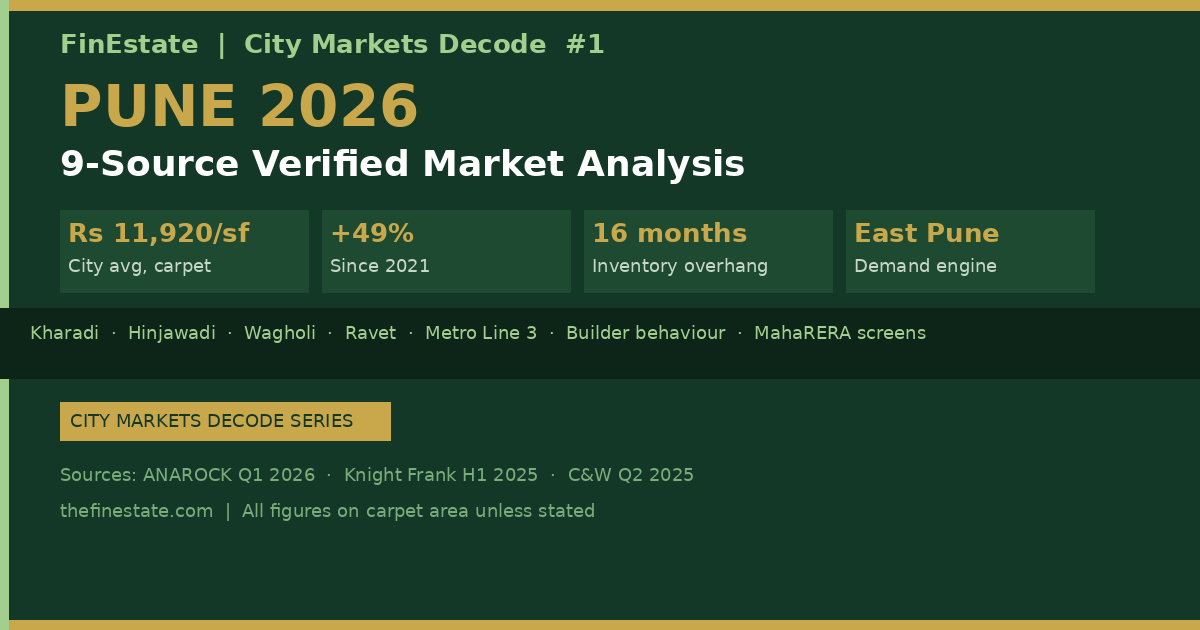
- Rs 11,920 per sqft — Pune city-average base selling price, Q1 2026, quoted on carpet area, i.e. the usable floor space inside your walls (ANAROCK). Up 5% year-on-year, up 2% quarter-on-quarter. Price appreciation is +49% since Q1 2021 from Rs ~8,000/sqft. All figures in this article use carpet-area basis unless stated.
- 84,200 units available inventory; 16-month overhang — below the pan-India average of 18 months (ANAROCK Q1 2026). Pune is one of the larger residential markets among India’s top 7 cities (about 15% of top-7 sales), with 15,300 units sold in Q1 2026.
- East Pune is the growth engine. The East zone accounts for ~25% of city sales in Q1 2026. East Pune was the only zone to record growth on both quarterly and annual bases. West (Hinjewadi) still leads in absolute supply but the demand momentum has shifted east.
- 25-35% cheaper than Bengaluru for comparable IT-corridor product — and the gap is structural, not temporary. Pune’s infrastructure management, newer launch quality, and planning environment give the city a sustained edge over Bengaluru’s congested corridors.
The City That IT Built — and Manufacturing Kept Honest
Pune’s residential demand rests on two pillars. The first is IT/ITeS — two major corridors, each with a distinct character. The western corridor anchors at Hinjewadi Rajiv Gandhi Infotech Park (Phases I, II, III, 200+ companies, ~100,000+ employees), extending into Wakad, Ravet, and Tathawade. The eastern corridor is anchored by EON IT Park (Kharadi), World Trade Centre (Kharadi), Viman Nagar, and Magarpatta City. The two corridors serve different buyer profiles: Hinjewadi pulls from the broader mid-income band (Rs 8–25L CTC, i.e. annual package); Kharadi increasingly captures the premium mid-to-senior segment (Rs 20L–50L+ CTC) as GCC leasing grows.
The second pillar is manufacturing — Pimpri-Chinchwad Municipal Corporation (PCMC), home to Bajaj Auto, Tata Motors, Volkswagen, Force Motors, and a dense auto-ancillary ecosystem. PCMC employment provides the structural demand floor for North and West Pune’s affordable-to-mid segment (Rs 40L–80L ticket). Pune without PCMC would look like Bengaluru: almost entirely IT-dependent, with no manufacturing demand buffer.
Office market as a leading indicator. Pune recorded 5.1 million sqft of gross office leasing in H1 2025, its strongest first-half performance in over a decade, up 17% year-on-year per Knight Frank India H1 2025. The more important signal is the occupier mix: GCC (Global Capability Centre) expansion was a notable driver of Pune’s H1 2025 leasing (Knight Frank H1 2025). GCCs house mid-to-senior professionals — the exact demographic that drives the upper-mid residential segment (Rs 80L–1.5Cr), which comprised 58% of Q1 2026 new launches per ANAROCK.
The decade-long shift toward larger homes is not a preference; it has become a structural reality. Demand for 1 BHK units in Pune’s IT corridors has effectively vanished over the last ten years — a product category that once anchored affordable IT-corridor supply now represents just 7% of Wagholi’s total supply and 12% in Ravet (ANAROCK Dec 2025, Feb 2026). Developers have responded rationally: no large developer launches a 400–500 sqft 1 BHK in an IT corridor anymore, because the buyer has voted for space. The 2 BHK at 630–800 sqft (carpet) is now the market’s floor product. This shift has consequences for the supply profile: every unit launched is larger, more expensive, and appeals to a narrower buyer band — which is exactly why the affordable segment has structurally declined and the average ticket has moved toward Rs 1.5 Cr.
Infrastructure: What Is Actually Moving in 2026
Pune Metro Phase 1 (operational). Two lines are running: Line 1 (PCMC to Swargate, 17 km) and Line 2 (Vanaz to Ramwadi, 15 km). The east-west corridor (Line 2) has added measurable accessibility to areas around Kharadi and along Nagar Road.
Metro Line 3 (Hinjewadi to Shivajinagar, ~23 km) — the market’s defining catalyst. ANAROCK’s Q1 2026 Pune report describes this line as “nearing completion” as of Q1 2026. When operational, it will directly connect Hinjewadi IT Park to Shivajinagar, the central rail station, and existing metro interchange — eliminating the single most chronic pain point for Hinjewadi employees: the NH-48 bottleneck that turns a 12 km commute into a 45–60 minute ordeal during peak hours.
Metro Line 3 is a genuine market catalyst, not just a developer talking point. A functional metro changes the daily calculus for residents and makes the Hinjewadi corridor more attractive to mid-senior professionals who currently choose Kharadi or Baner to avoid road dependence. The property premium near station alignments is real — some has been priced in already, more will follow once trains run. Verify the current MahaMetro project status at mahametro.org.in before making any station-adjacency bet. Infrastructure in India typically runs 12-18 months beyond announced completion targets — model that slippage when evaluating pre-metro pricing.
Pune Ring Road. Ongoing in phases. The 32.4 km Khed Shivapur–Ravet service road (noted in ANAROCK’s Ravet Feb 2026 report) addresses NH-48 congestion and is one of several PCMC road projects improving internal connectivity in the North corridor. Ring Road sections open peripheral growth corridors in Talegaon, Chakan, and Urse — the next wave of North Pune residential supply nodes for the 2027-29 period.
Ravet’s connectivity moat. Ravet sits at the strategic intersection of the Mumbai–Pune Expressway and NH-48. Its 20-minute access to Hinjewadi and 2-hour connectivity to Navi Mumbai (via the newly operational Navi Mumbai International Airport corridor) makes it genuinely multi-modal. For buyers who split time between Pune and Mumbai, Ravet carries a real lifestyle premium that the raw per-sqft comparison misses.
Who Is Actually Buying — and What
The ANAROCK Q1 2026 supply segmentation resolves the “who is buying” question: 58% of all new launches are in the Rs 80L–1.5Cr (upper-mid) bracket, followed by 28% in Rs 40–80L (lower-mid). Affordable housing (below Rs 40L) is down to 5% of new supply — not because affordable buyers have disappeared but because land costs and construction inflation have made affordable development economically unviable for large developers. This is a supply-side structural shift, not a demand shift.
The 1 BHK has effectively disappeared from IT corridors. In Wagholi — East Pune’s largest supply corridor — 1 BHK units represent just 7% of total supply launched since 2021, against 54% for 2 BHK and 34% for 3 BHK (ANAROCK Wagholi Dec 2025). In Ravet/Tathawade, 1 BHK is 12%, 2 BHK 58%, 3 BHK 29% (ANAROCK Ravet Feb 2026). The buyer has voted definitively for more space. Developers who launched entry-level 1 BHKs a decade ago have structurally repositioned toward 2 and 3 BHK configurations. This product-mix shift narrows the buyer pool at entry level and pushes the average transaction upward.
Ticket-size translation (ANAROCK Wagholi Dec 2025, carpet-area basis): a 2 BHK (630-800 sqft carpet) in East Pune runs Rs 62–79 lakh average; a 3 BHK (900–1,100 sqft carpet) runs Rs 88L–1.07 Cr. This maps to a salaried professional earning Rs 12–28L CTC — the modal buyer profile. The dual-income couple (combined Rs 25–50L CTC) dominates the Rs 1–1.5Cr segment.
Rental demand as a demand health indicator. Across Pune’s tracked micro-markets in Q1 2026, rental growth was consistent but modest — +1–2% quarter-on-quarter — across every zone per ANAROCK. This is the right kind of rental market signal: steady, not speculative. A 2 BHK in Hinjewadi rents for Rs 24,200–34,500/month; Kharadi area commands similar or slightly higher given IT-park proximity and better social infrastructure. Wagholi trails at Rs 20,000–30,500/month — the affordability pull that still makes it attractive for IT employees priced out of Kharadi.
ANAROCK note on methodology: The pan-India Q1 2026 comparative table quotes Pune at Rs 8,220/sf using Built-Up Area (BUA) basis. The city-specific report quotes Rs 11,920/sf on carpet area. These are not contradictory — they are the same market measured with different denominators. RERA mandates carpet-area pricing on agreements, so Rs 11,920/sf (carpet) is the directly relevant figure for a buyer. This article uses carpet-area figures throughout.
Q1 2026 Supply: Zones, Segments, and Key Launches
Total Q1 2026 launches: 16,000 units (−9% QoQ, −5% YoY) per ANAROCK. Pune contributed ~13% of pan-India Q1 2026 launches across the top-7 cities. The moderation is intentional — ANAROCK notes developers “calibrated timelines to match prevailing demand conditions” as geopolitical headwinds (Middle East conflict, oil prices, NRI sentiment) hit buying appetite in February–March 2026.
| Zone | Key Locations | Launch Share | QoQ | YoY | Sales Share |
|---|---|---|---|---|---|
| East | Kharadi, Wagholi, Hadapsar, Kalyani Nagar | 32% | +100% | +30% | 25% |
| West | Hinjewadi, Wakad, Baner, Bavdhan | 34% | -15% | +11% | 32% |
| North | PCMC, Moshi, Ravet, Punawale, Chakan | 26% | -27% | -26% | 32% |
| South | Undri, Kondhwa, Sinhgad Road | 8% | declining | declining | 10% |
| Central | Shivaji Nagar, Deccan, Kasba | minimal | — | — | minimal |
The East zone’s 100% QoQ launch surge is the quarter’s headline signal. Combined with the East zone accounting for ~25% of city-wide sales, this confirms that the demand centre of gravity is shifting east. New launches in East Pune are increasingly better-planned: larger unit sizes, more community infrastructure, and pricing that has more room to grow than saturated West Pune corridors.
The market’s centre of gravity is moving east — and the driver is not just affordability but product quality. New East Pune launches are showing better planned layouts, more generous carpet areas, and more Pune-native lifestyle programming: larger community spaces, school proximity, green cover, and the kind of walkable social infrastructure that Hinjewadi’s purely IT-facing western corridor still lacks. The West built its reputation on proximity to the tech park gate; the East is building a reputation on how the city actually feels to live in. A Kharadi or Wagholi buyer in 2026 is not settling for the affordable option — in many cases, they are choosing superior product at a lower per-sqft entry. As the quality gap narrows, the price differential becomes increasingly hard to justify. That arbitrage window exists now and will close over the 2026-28 window as metro connectivity and Ring Road access complete East Pune’s infrastructure story.
Key Q1 2026 project launches (ANAROCK Pune Q1 2026):
Godrej Ivara — Kharadi — 2,792 units — Rs 17,200/sqft. The quarter’s largest single launch by unit count. Note: ANAROCK categorises this within the East Pune (Wagholi) zone in their aggregated data, but the project is located in the Kharadi submarket. Rs 17,200/sqft is meaningfully above the city average of Rs 11,920/sqft (carpet, ANAROCK Q1 2026) and above Kharadi’s own range, positioning this as a premium-segment play in a corridor that has historically been mid-market. Godrej Properties has an established delivery track record in Pune. For any premium launch priced well above the corridor average, absorption versus reliance on incentive schemes typically becomes visible in subsequent MahaRERA registration data — a metric buyers can track over Q2–Q3 2026.
Hiranandani Everlyn — Hinjewadi — 929 units — Rs 11,000/sqft. Mid-premium positioning for Hinjewadi. Hiranandani has an established delivery track record across Mumbai and Pune with multiple completed townships.
Kakade Avian Valley Solaire — Bhugaon (West) — 843 units — Rs 9,999/sqft. Bhugaon is a peripheral Western node — newer than Baner, not yet fully established. The Rs 9,999/sqft pricing positions it as a value play for buyers who want West Pune connectivity at East Pune pricing.
Micro-Market Pricing — Pune Q1 2026 (by source; area basis noted)
All values below are base selling prices on carpet area per ANAROCK Q1 2026 for the five tracked micro-markets, supplemented by Knight Frank H1 2025 and C&W Q2 2025 for additional zones. Different sources use different area bases — do not cross-compare per-sqft figures across sources without adjusting for area basis.
| Micro-Market | Zone | Avg BSP (Rs/sf carpet) | QoQ | 2 BHK Rent/month | Source |
|---|---|---|---|---|---|
| Hinjewadi | West | 11,033 | +2% | Rs 24,200–34,500 | ANAROCK Q1 2026 |
| Wakad | West | 12,079 | +2% | Rs 25,500–33,000 | ANAROCK Q1 2026 |
| Wagholi | East | 8,941 | +2% | Rs 20,000–30,500 | ANAROCK Q1 2026 |
| Undri | South | 8,738 | +2% | Rs 17,300–25,000 | ANAROCK Q1 2026 |
| Talegaon Dabhade | North | 6,403 | +2% | Rs 12,000–17,000 | ANAROCK Q1 2026 |
| Ravet / Tathawade | North | 10,300 | +47% (2021–25) | Rs 18,000–25,000 | ANAROCK Feb 2026 |
| Kharadi | East | 10,660–11,004 | +1% YoY | — | Knight Frank H1 2025 |
| Baner | West | 14,406–16,350 | +7% YoY | — | Knight Frank H1 2025 |
| Aundh | West | 14,647–15,986 | +2% YoY | — | Knight Frank H1 2025 |
| Hadapsar | East | 9,204–9,750 | +4% YoY | — | Knight Frank H1 2025 |
Table notes: ANAROCK Q1 2026 figures are carpet area BSP for Q1 2026. Knight Frank H1 2025 figures are H1 2025 data on a different methodology. C&W Q2 2025 shows Aundh-Baner high-end at Rs 12,000–14,200/sf and Kharadi/Wagholi mid at Rs 7,200–8,600/sf — the lower C&W figures reflect mid-segment stock only (Rs 45L–1Cr units). Do not average across sources. Table compiled by FinEstate from the cited reports; not reproduced from any single source table.
The affordability picture in Pune’s primary IT-corridor markets has fundamentally changed. Based on FinEstate’s analysis of the current launch profile — with upper-mid (Rs 80L–1.5Cr) at 58% and high-end (Rs 1.5Cr+) at 9% of new supply — the effective average ticket in Pune’s tracked markets is trending toward approximately Rs 1.54 Cr. (This is FinEstate’s market estimate from the current supply composition, not a directly reported ANAROCK figure.) The RBI has cut the repo rate by a cumulative 125 basis points to 5.25% as of June 2026 (the H1 2025 Knight Frank report captured the first 100 bps of that easing), and that relief is real at the EMI level. But property prices have appreciated approximately 49% over the same period since 2021. Rate cuts reduce the monthly repayment on an existing loan balance; they do not reduce the entry price. The buyer who needed prices to fall to afford the market got rate cuts instead — meaningful support, but not sufficient to bridge a 49% price gap. Home ownership in Pune’s IT corridors is becoming structurally expensive for all but the top income quartile.
Builder Behaviour — The Project-Finance Lens
The most structurally significant developer-behaviour signal in Pune 2026 is one most buyers never think to look for: prominent developers are moving from channel-partner (broker) distribution toward organic and direct sales. For years, Pune residential sales depended heavily on channel partners — brokers and DSAs who moved inventory for commissions of 2–4% of the sale value. When a developer can sell directly to buyers through their own digital presence, experience centres, and site-visit funnel, it signals something fundamental: the brand is strong enough that buyers seek them out. The developer’s credibility has reached a point where it sells without intermediation.
This channel-partner-to-direct shift has two implications worth understanding as a buyer. First, developer margins improve as saved commissions flow back into the project — which can mean better construction quality, faster completion, or both. Second, the buyer base becomes more informed: direct buyers who came through a developer’s own channels have done their own research rather than relying on a broker’s presentation. This reduces the information asymmetry that historically allowed aggressive pricing in under-construction launches. A developer who can sell 2,000+ units directly is a developer with genuine market pull — and genuine market pull is the strongest forward indicator of construction momentum.
For buyers, the credibility check is still: (1) MahaRERA registration current and no major complaint history; (2) construction-linked bank or NBFC financing confirmed — ask for the lender’s name and verify it; (3) developer’s delivery track record on past Pune projects. Among named Q1 2026 launchers: Godrej Properties (Kharadi), Hiranandani Group (Hinjewadi), and Kolte-Patil (Hinjewadi — Life Republic, ongoing) each have publicly verifiable completion histories in Pune. Gera Developments holds 12.5 acres in Wagholi (ANAROCK Dec 2025) and publishes its own Pune market research (the Gera Pune Residential Realty Report) — making it one of the more data-transparent developers in the city.
Note on East Pune land: ANAROCK’s Wagholi Dec 2025 report documents six developers who collectively acquired approximately 82 acres in Wagholi between 2023 and 2025 for a combined estimated value of approximately Rs 3,000 Cr. This committed land bank means Wagholi supply will remain structurally elevated for multiple years — a relevant context for yield-investors considering the corridor. The separate Godrej Ivara project (Kharadi) is a distinct launch from Godrej’s Wagholi land holding.
Q1 2026 brought a macro headwind that tested developer discipline across India. ANAROCK’s Pan-India Q1 2026 report observes that “developers have begun to offer financing options such as bank and developer subvention schemes and even stamp duty discounts and waivers in order to push sales.” For buyers, a subvention scheme — where the developer services the EMI during construction — can be a genuine cost advantage, but it carries counterparty risk: if developer cash flows tighten, subvention payments stop and the buyer is exposed. Whether to choose subvention over a standard payment plan is worth analysing carefully before signing. FinEstate will cover this decision in a dedicated article.
Wagholi and Ravet — Two Corridors, Two Risk Profiles
Wagholi: the supply-led corridor. 15,000 units launched 2021–Q3 2025, representing 23% of East Pune’s total supply. Prices have appreciated 74% from 2021 to Q3 2025 — 30% faster than the East Pune average — but that price performance was achieved with 91% of inventory still under construction. Liquidation time: 19 months per ANAROCK Dec 2025. The six-developer land bank (~82 acres) commits another 3-5 years of supply regardless of current sales velocity. For end-users buying to live, Wagholi’s Rs 8,941/sf (Q1 2026) entry point is among the lower in East Pune — a factor to weigh against its multi-year supply pipeline. For yield investors: the supply pipeline is a real headwind to price appreciation and rental growth over 2026-28.
Ravet/Tathawade: the value-infrastructure play. Rs 10,300/sf (2025, carpet area) with 47% appreciation since 2021, 8% premium over North Pune average. 95% UC inventory, 17-month liquidation (ANAROCK Ravet Feb 2026). Ravet’s case rests on infrastructure — the Mumbai-Pune Expressway access, the 32.4 km service road, the PCMC road projects, the upcoming metro extension. But 95% under-construction inventory is a concentration risk: if any major developer on this corridor runs into funding issues, delivery timelines slip and buyers bear the cost. The value case is strong; the delivery execution risk needs to be priced in.
12-Month Outlook and Risks
ANAROCK’s Q1 2026 Pune outlook: “Poised to enter a more disciplined growth phase in 2026, shifting from earlier rapid expansion toward stability and sustainability. Core demand drivers remain intact — IT ecosystem, manufacturing, steady end-user participation.”
ANAROCK Pan-India context: Pune was the only top-7 city to register an annual sales decline (−5% YoY in Q1 2026). This reflects two things: the elevated Q1 2025 base (near-peak), and the Q1 2026 pan-India headwind from geopolitical uncertainty. Pune’s NRI exposure is lower than MMR or Hyderabad, so the Middle East demand moderation hits it less acutely. As geopolitical conditions normalise, Pune’s domestic end-user demand — which ANAROCK describes as structurally intact — should resume.
Price forecast: Modest. The 5% YoY appreciation seen in Q1 2026 is likely the operating range through 2026. Double-digit appreciation requires either a sharp demand surge (possible if Metro Line 3 delivers) or a supply shock (not visible in current data). The supply moderation in North Pune is a positive signal for price stability, but East Pune’s 82-acre committed land bank limits appreciation velocity in Wagholi.
Emerging micro-markets to watch — Ring Road corridors. As the Pune Ring Road progresses in phases, it sequentially unlocks new residential corridors. Manjri Budruk (East, natural extension of the Hadapsar/Magarpatta belt), outer Wagholi (deepened connectivity to PCMC reducing dependence on the Nagar Road bottleneck), and Chakan (North, manufacturing-workforce driven) are the corridors most directly in line as Ring Road sections open. These are medium-horizon plays — the appreciation happens once sections are operational, not on the announcement. C&W Q2 2025 specifically flags “upcoming Pune Ring Road connecting major highways is expected to unlock new micro-markets and catalyse corridor-based growth” as a structural positive for the North submarket.
Risks to monitor: Metro Line 3 delivery slippage (12-18 month typical infrastructure delay in India); North Pune affordable-segment oversupply if PCMC employment growth slows; developer funding tightening in the 95% UC Ravet corridor; pan-India inventory building above 6 lakh units for the first time (ANAROCK Q1 2026 pan-India) — if launches continue exceeding sales nationally, developer sentiment will shift from supply to absorption.
Infrastructure is what is doing the lifting, and the Ring Road is the biggest piece of it. It has reached roughly 40 per cent completion, with Phase 1 of the western stretch operational and work running across nine segments including Hinjewadi, Chakan, Mulshi and Urse. That is already re-pricing the corridors along it — Wagholi in the east, Pirangut and Mulshi in the west, Chakan and Talegaon in the north, Manjri in the south-east. Add the eastern connectivity work around Kharadi-Mundhwa and the Manjri side, and you have a set of micro-markets whose price moves are being driven by journey times rather than by product. Both organic and channel-partner volumes have risen through this, which is what you would expect when the constraint being relieved is access rather than affordability.
—
Trying to model your Pune home-loan affordability or compare Old vs New Tax Regime impact?
Pune in 2026 is in a consolidation phase after a strong 2023-24 cycle. Prices are firm, inventory is manageable, and the structural demand drivers — IT, GCCs, manufacturing, in-migration — are intact. The market has not broken; it has paused.
Three structural factors a buyer comparing Pune and Bengaluru in the Rs 80L–1.5Cr band may want to weigh: the price discount for comparable IT-corridor product (illustratively 25-35%, as in the Kharadi-vs-Whitefield example above), the Metro Line 3 catalyst that is physically nearing completion, and Pune’s infrastructure-execution record. On the data reviewed, Pune’s newer launch stock and planning environment compare favourably; buyers should verify against their own site visits.
East Pune is where the 2026 momentum is. Buyers weighing Kharadi typically prioritise tighter supply and resale liquidity (Rs 1.1–1.5Cr band); those weighing Wagholi typically prioritise a lower entry price (Rs 65L–1Cr) and accept higher long-term supply and appreciation risk. Which fits depends on your hold period and risk tolerance — a framework, not a recommendation. Before signing anything, run the MahaRERA check, confirm the construction-linked bank financing exists, and do your Section 24(b) regime comparison. Stamp duty plus registration runs about 7% all-in in Maharashtra (6% stamp duty + 1% registration for male buyers; 5% + 1% for women) — plan for it as a hard-cash requirement separate from your down payment.
If you are tracking Pune or comparing it to another city — drop which one in the comments. The City Markets Decode series for the next city is informed by where readers are actually buying.
- City-average price: Rs 11,920/sf (carpet area, Q1 2026, ANAROCK) — up 49% since 2021, up 5% YoY. Steady appreciation in a balanced market, not a speculative spike.
- East Pune is the momentum zone: the East zone = ~25% of city sales in Q1 2026; East was the only zone with both quarterly and annual sales growth. The quality of new launches in the East is improving.
- Wagholi: 74% price appreciation since 2021, but 82+ acres of developer land committed = 3-5 years of elevated supply ahead regardless of quarterly demand. End-user buy: rational. Yield-investor buy: supply risk acknowledged.
- Metro Line 3 is a genuine catalyst. When operational, it fundamentally changes the Hinjewadi commute. Proximity to its alignment commands a real premium — already partially priced in, more to come once the line runs.
- For any under-construction purchase: MahaRERA check + construction-linked bank financing confirmation = two mandatory due-diligence steps. Presence of a monitored lender is the single strongest delivery certainty signal.
- ANAROCK Research — Pune Residential Market Viewpoints Q1 2026 (March 31, 2026)
- ANAROCK Research — Pune Wagholi Micro Market Report (December 2025)
- ANAROCK Research — Pune Ravet Micro Market Report (February 2026)
- ANAROCK Research — Pan-India Residential Market Viewpoints Q1 2026 (March 31, 2026)
- Knight Frank India — India Real Estate: Office and Residential Market H1 2025 (June 30, 2025)
- Cushman & Wakefield — Pune Residential MarketBeat Q2 2025 (June 30, 2025)
- MahaRERA — Maharashtra Real Estate Regulatory Authority (project verification)
- FinEstate — Stamp Duty by State India 2026 (Maharashtra breakdown)
- FinEstate — Home Loan 2026: EBLR, Section 24 & 80EEA Tax Rules
Tracking Pune or comparing against another city? Drop your city and budget range in the comments — the next City Markets Decode is shaped by where readers are actually buying.
Get FinEstate updates on tax rules, EPF, and RBI policy straight to your inbox.
Keep reading
This article is part of our real estate guide — the full set of explainers for salaried Indians, in the order you actually meet them.