RBI Holds Repo Rate at 5.25%: What the 3rd Consecutive Pause Means for Your EMI, FDs, and Savings
The RBI MPC June 2026 decision is in: Governor Sanjay Malhotra announced at 10:00 AM IST on 5 June 2026 that the Monetary Policy Committee voted unanimously to keep the repo rate unchanged at 5.25% — the third consecutive hold since the RBI paused its easing cycle in February 2026. The benchmark rate that determines whether your home-loan EMI falls or rises stayed flat. Your EBLR-linked EMI did not change today.
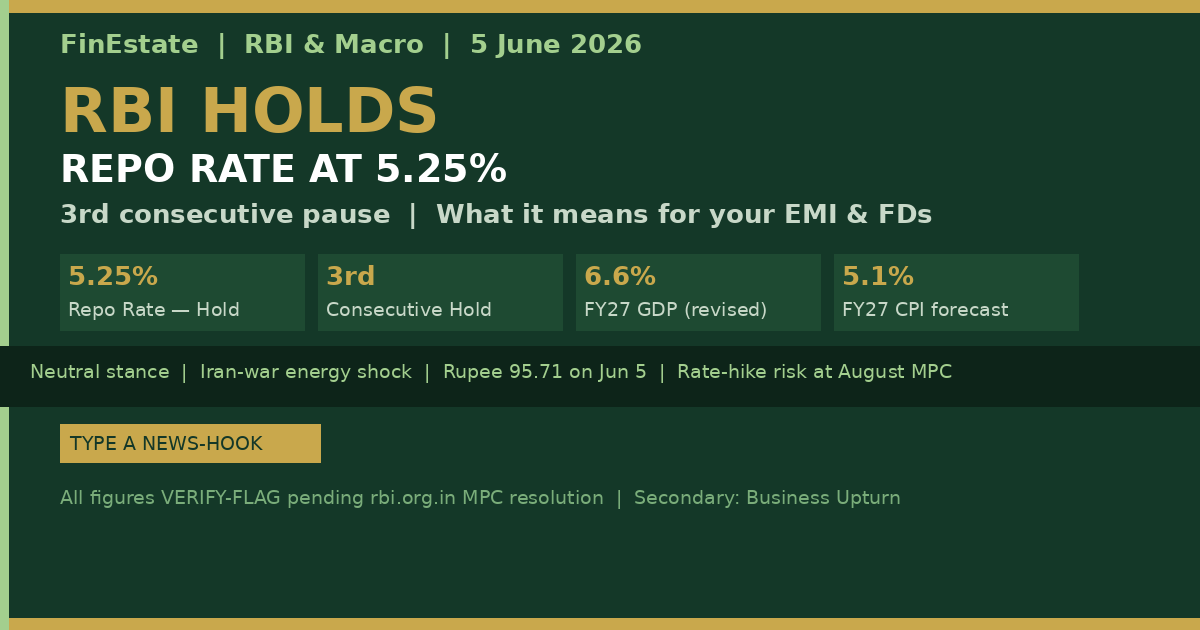
In brief: the RBI’s Monetary Policy Committee held the repo rate at 5.25% on 5 June 2026 — the third consecutive pause — and kept a neutral stance. It raised the FY27 CPI projection to 5.1% (peaking 5.9% in Q3) and cut FY27 GDP growth to 6.6% from 6.9%.
For EBLR-linked home-loan borrowers across India, the immediate read is simple: nothing moves this quarter. For savers and FD holders, it means bank rates hold where they are for now. For equity investors, it is a relief from the rate-hike risk that markets had begun pricing in given the West Asia energy shock and a rupee that touched ₹97 per dollar in May.
- Repo rate: 5.25%, unchanged. Third consecutive hold; the MPC voted unanimously (RBI Press Release 2026-2027/385). The RBI has now paused its easing cycle for three straight meetings (Feb, Apr, Jun 2026). The 125 bps of cuts delivered Feb–Dec 2025 remain in the system.
- Stance: Neutral. The MPC maintained the neutral stance — meaning neither an explicit easing nor tightening bias. This keeps future rate decisions open in both directions.
- FY27 projections updated: GDP growth forecast revised down to 6.6% (from 6.9%) as the West Asia supply shock weighs on near-term outlook; CPI inflation forecast raised to 5.1% (from 4.6%), with Q3 FY27 seen peaking at 5.9%.
- For your money: EBLR-linked home loans — no EMI change. FD rates — stable. Rupee — around ₹96 on June 5 morning, recovering from a record low near ₹97 in May.
What RBI Did — and Why It Held
The June 2026 decision was widely expected by markets. After cutting the repo rate by a cumulative 125 basis points through 2025 — bringing it from 6.5% to 5.25% — the MPC has been in a deliberate wait-and-watch mode for the last three meetings.
The case for holding. The RBI’s dilemma at the June meeting was textbook monetary policy under supply-shock conditions. Here is the key nuance: current retail inflation is actually below target — headline CPI was 3.5% in April 2026 (3.4% in March), with core inflation steady at 3.7% over January–April, per the RBI’s June resolution (PR 2026-2027/385). The MPC held not because inflation is high now but because it is projected to rise — hitting 5.9% in Q3 FY27. This is a forward-looking, pre-emptive hold. The West Asia conflict that escalated in late February–March 2026 — which the RBI describes as lingering amidst a fragile truce — pushed crude oil prices sharply higher. India imports approximately 85% of its oil. Since May 2026, retail fuel prices have been raised cumulatively by 7.4% for petrol and 8.4% for diesel — a direct impact of about 36 basis points on headline CPI, per the RBI resolution. Higher crude feeds directly into fuel prices, freight costs, and ultimately into food and manufactured goods inflation. The RBI’s updated CPI projection of 5.1% for FY27, with a Q3 peak of 5.9%, signals meaningful near-term inflation risk. Cutting rates into an inflation surge would have been indefensible.
The case against cutting. Growth signals are mixed. The FY27 GDP forecast has been revised down to 6.6% from 6.9%, reflecting the supply-chain disruptions from the West Asia conflict, though the RBI notes GST rationalisation and steady services momentum continue to support urban consumption. Net FPI (Foreign Portfolio Investor) outflows of US$ 13.7 billion (1 April–2 June 2026, per the RBI Governor’s Statement) have pressured the rupee to a record low near ₹97 per dollar in May — a weaker rupee makes imports more expensive, which feeds back into inflation. Rate cuts in this environment would have added depreciation pressure on the currency.
The case for cutting that RBI resisted. The 125 bps of cuts are in the system but transmission has been uneven — MCLR-linked borrowers (still a significant share of the loan book) have seen slower pass-through than EBLR-linked borrowers. Growth needs support. But the RBI’s neutral stance signals they are not yet ready to resume cutting with inflation above 5%.
Your EMI: What Changed and What Didn’t
If your home loan was taken after October 2019, it is almost certainly EBLR-linked (External Benchmark Lending Rate, mandatorily linked to the repo rate). When the repo rate moves, your EBLR moves by the same amount at your next reset date. Since the repo rate was held today, no change to EBLR — and no change to your EMI on the next reset.
The 125 bps of cuts from Feb–Dec 2025 were already passed through. If you had a Rs 50 lakh loan at 8.75% that has been correctly reset after all three rounds of cuts, you are already at roughly 7.5% today, and your EMI has already come down. Transmission has been uneven, though — the RBI notes that against the 125 bps repo cut, the weighted average lending rate (WALR) on fresh rupee loans fell 83 bps (and 89 bps on outstanding loans) up to April 2026 (Governor’s Statement). If your bank has passed through less, your EMI may not have fully adjusted, so verify your current rate on your loan statement. The June hold does not reverse the relief already delivered — it simply means no further relief this quarter.
| Scenario | Rate | Monthly EMI (approx.) | vs Pre-Cut Baseline |
|---|---|---|---|
| Pre-cut (Feb 2025 baseline) | 8.75% | ~Rs 44,100 | — |
| Post-125 bps cuts (current) | ~7.50% | ~Rs 40,300 | −Rs 3,800/month |
| If 25 bps cut had happened today | ~7.25% | ~Rs 39,500 | −Rs 4,600/month |
| June 2026 outcome (hold) | ~7.50% | ~Rs 40,300 | No change from current |
Illustrative only. Actual rates depend on your lender’s spread, credit risk premium, and reset date. Verify your current rate with your lender. EBLR-linked rates vary by bank.
MCLR-linked borrowers. If your loan was taken before October 2019, you may be on MCLR (Marginal Cost of Funds-based Lending Rate), which is set by the bank based on its cost of funds and resets annually or semi-annually. MCLR transmission from the 2025 repo cuts has been slower than EBLR. The June hold does not change MCLR either, but if you haven’t switched to an EBLR-linked product, you may still not have received the full benefit of the 125 bps cuts. Check your loan agreement. See our upcoming guide on switching from MCLR to EBLR for the steps and cost implications.
I would push back on the framing. Transmission is not weak; it is selective, and the selection is not random. On an external-benchmark loan the cut reaches you mechanically — but it reaches you on your reset date, not on the day the MPC meets, and if your loan sits on an older benchmark or carries a spread negotiated in a tighter market, it does not reach you at all until somebody asks. New borrowers get repriced at origination. Existing borrowers have to go and claim it. That is the whole gap, and from the outside it looks like weak transmission.
You can see the proof in what borrowers are actually doing, which is queueing for balance transfers. A transfer is simply the existing borrower forcing the repricing the cut did not deliver to them — and paying somewhere between roughly 0.35 and 1 per cent of the loan for the privilege, plus legal and valuation charges and fresh MODT stamp duty. On a Rs 50 lakh balance, a 1 per cent switching cost is Rs 50,000 spent to reach a rate the market has already moved to.
Which is why the first call is not to a new lender. It is to the existing one, asking them to reprice the spread on your current benchmark. That conversation is free, the bank already has a number in mind for a borrower with your record, and it is the step almost everybody skips on the way to paying a fee.
—
FDs, Savings, and What Savers Should Do
For FD holders, the hold is unambiguously good news in the near term. FD rates have already been revised down from their 2024-25 highs — fresh-deposit rates have fallen about 85 bps in response to the 125 bps repo cuts, per the RBI — but the June hold means no further reductions this cycle. Banks typically take 2-4 weeks to revise FD rates after a repo change — since no repo change happened today, your FD rate is stable at least until the next MPC meeting (August 2026).
What this means if you are considering a long-term FD. If rate cuts resume once inflation moderates after the Q3 FY27 peak — which market consensus sees as the likely path, though the RBI has given no forward guidance — FD rates would fall again. Some savers weighing a 2-3 year FD factor in that rates are stable for now, while others prefer to keep deposits laddered; which suits you depends on your own liquidity needs. Major banks are currently advertising roughly 6.8–7.3% on 2-3 year FDs (indicative; verify current rates with your lender). This is general information, not a recommendation.
Savings account rates similarly hold for now. The repo corridor (repo rate minus the SDF — Standing Deposit Facility — floor) determines the range within which overnight rates trade, and this is unchanged.
The Macro Context: West Asia Conflict, Rupee, FPI
West Asia conflict and crude oil. The West Asia conflict that escalated in early 2026 has been the single most disruptive macro variable for the RBI’s policy calculus. Higher crude directly raises India’s import bill, widens the current account deficit, and pushes the rupee lower — which further raises import costs in a self-reinforcing loop. The RBI’s CPI forecast revision from 4.6% to 5.1% directly reflects this energy-shock channel.
Rupee at ₹97. The rupee touched approximately ₹97 per US dollar in May 2026 — its weakest level on record. By June 5 morning it had recovered to approximately ₹96, partly on expectations of the MPC hold and possible FPI inflow measures. A weaker rupee makes imported goods more expensive (oil, electronics, gold) and adds to inflation pressure — which reinforces the case for holding rates.
FPI outflows. Net FPI outflows reached US$ 13.7 billion between 1 April and 2 June 2026 (RBI Governor’s Statement) — among the heaviest in recent years. India’s foreign exchange reserves stood at a healthy US$ 682.3 billion as on 29 May 2026 — about 11 months of import cover — a buffer the RBI cited as underpinning its capacity to manage rupee volatility. Alongside the policy, the RBI announced measures to attract fixed-income inflows — expanding the Fully Accessible Route to long-tenor government securities and easing FPI investment limits — to draw foreign capital into the government bond market.
Risks — What Could Go Wrong from Here
The rate-hike risk is real. Every MPC hold is not symmetric — the neutral stance means the committee could move in either direction. If crude oil stays elevated — the Indian basket averaged about US$110/barrel in April–May 2026 per the RBI — and the rupee breaks below ₹97 again, bond markets have begun pricing some probability of a rate hike at the August meeting (yields rose in May 2026); the RBI itself has signalled no such direction. A rate hike would reverse some EMI relief and significantly raise borrowing costs for new loans.
Monsoon and food inflation. The RBI’s CPI forecast already incorporates El Niño monsoon risks. A below-normal monsoon would push vegetable and food prices higher through Q2-Q3 FY27, potentially making 5.9% a floor rather than a peak for CPI. In that scenario, the RBI stays on hold through December and hike risk increases.
Global growth and FPI. A severe global slowdown from trade disruptions (US-India tariff tensions, China slowdown) could give the RBI room to cut despite domestic inflation — but this is the lower-probability scenario given current conditions.
The June 2026 hold is the correct call given the West Asia energy shock and CPI trajectory. The RBI has done the hard work — 125 bps of cuts in 2025. The pause is not a reversal; it is prudence. For borrowers: your rate relief is in the system, the hold means no new relief but no reversal either. For savers: FD rates are stable this quarter, so there is no urgency either way — how you balance a longer FD against keeping funds flexible is a personal decision based on your own liquidity needs, and this is general information, not a recommendation. For investors: the rate-hike risk is the overlooked risk that needs to be watched at the August meeting.
The single most important number from this policy: CPI forecast raised to 5.1%, Q3 peak at 5.9%. That is the ceiling that keeps the RBI’s hands tied on cuts through at least Q3 FY27. If Q3 data comes in below 5.9%, a December 2026 cut window could open, per current market consensus. If it comes in above — rate hike becomes the next headline.
- Repo rate held at 5.25% — 3rd consecutive hold. No change to EBLR-linked EMIs this quarter.
- FY27 GDP forecast cut to 6.6% (from 6.9%); CPI forecast raised to 5.1% (from 4.6%) with Q3 peak at 5.9%.
- EBLR borrowers have already received the 125 bps of 2025 cuts. MCLR borrowers should verify their current rate and consider switching.
- FD investors: current rates are stable for at least this quarter. Market consensus sees the next rate-cut window no earlier than December 2026, conditional on CPI declining from its Q3 peak.
- Rate-hike risk is non-trivial. If crude stays high and the rupee weakens below ₹97 again, the August meeting could surprise. MPC minutes are due 19 June 2026; the next meeting is 3–5 August 2026.
- RBI — Monetary Policy Statement 2026-27, Resolution of the MPC, 5 June 2026 (Press Release 2026-2027/385)
- RBI — Governor’s Statement, 5 June 2026 (Press Release 2026-2027/386)
- Business Upturn — RBI MPC June 5, 2026: Repo Rate Unchanged at 5.25% (secondary, 10:04 AM IST)
- Business Upturn — RBI raises FY27 inflation forecast to 5.1%, Q3 peak 5.9% (secondary, 10:18 AM IST)
- Business Upturn — RBI cuts FY27 GDP growth forecast to 6.6% from 6.9% (secondary)
- FinEstate — Home Loan 2026: EBLR Rate Cuts, Section 24 & 80EEA Guide
- FinEstate — Advance Tax 1st Installment Due 15 June 2026
Get FinEstate updates on tax rules, EPF, and RBI policy straight to your inbox.
Keep reading
This article is part of our RBI and macro guide — the full set of explainers for salaried Indians, in the order you actually meet them.