Term Insurance for Salaried India 2026: How Much Cover, Which Riders, and the Tax Truth
If you have a life insurance policy in India, there is a fair chance it is not term insurance. It may be a ULIP — part-investment, part-insurance — or an endowment plan that promises to return your premiums if you survive. Both cost four to fifteen times more than a pure term plan for the same Rs 1 crore cover. Both generate substantially more commission for the distributor who sells them. And both leave you under-insured relative to your actual income-replacement need.
This is not a market failure. It is a structural feature of how insurance is distributed in India — and understanding it is the first step to making the right decision for your family.
What Term Insurance Actually Is
The logic is the same as every other protection product: you buy car insurance without expecting to crash. A term plan is a seatbelt — its value is in not needing it. The “loss” of premium if you survive is not a loss; it is the price of certainty that your family is protected every year of the policy term.
The clean framework is buy term, invest the rest: use the cheapest instrument for protection (term insurance), and use transparent, low-cost instruments for wealth creation (equity mutual funds, PPF, NPS). Mixing both functions in a single product almost always results in both being done suboptimally.
How Much Cover Do You Actually Need
The income-multiple rule. Most Indian financial planners recommend 10 to 20 times your annual gross income as a starting point. A salaried earner with Rs 12 lakh annual income needs a minimum of Rs 1.2 crore cover; with a home loan, a dependent, and a child’s education goal on the balance sheet, Rs 2–2.5 crore is more realistic.
The HLV (Human Life Value) method. A more precise calculation: (annual income replacement need × remaining working years) + (outstanding loans and financial goals) − (existing liquid assets and any existing life cover). For a 35-year-old with Rs 12 lakh income, one dependent, a Rs 50 lakh home loan, and a 25-year working horizon, this framework typically arrives at Rs 2.5–3 crore before further adjustments.
The common mistake. Most Indian families are substantially under-insured. The typical error is buying a Rs 25–50 lakh endowment plan through a bank relationship manager and believing it provides adequate cover. For a primary earner in a single-income household, it rarely does. India carries one of Asia’s widest life-insurance protection gaps — Swiss Re Institute studies have estimated the mortality protection gap at over 80% of the country’s protection need — driven substantially by households holding low-cover investment-linked policies in place of adequate term cover.
As a working target: if your annual income is between Rs 8 lakh and Rs 25 lakh, your cover need is likely in the Rs 1.5–4 crore range. Use a financial calculator to confirm for your specific numbers.
Term vs ULIP vs Endowment — The Premium Economics
| Feature | Term Insurance | ULIP | Endowment |
|---|---|---|---|
| Annual premium (Rs 1 cr cover, 30-yr-old, non-smoker) | Rs 12,000–15,000 | Rs 80,000–1,00,000 | Rs 1,50,000–2,00,000 |
| Share of premium going to actual life cover | ~95–98% | 50–70% (balance = charges) | 40–60% |
| Maturity value | Nil | Market-linked (variable) | Fixed (low IRR) |
| Protection efficiency | Highest | Low | Low |
Buy term, invest the rest — illustrated. A 30-year-old who buys a Rs 1 crore term plan at Rs 12,000/year and redirects the Rs 68,000/year saving (vs a ULIP at Rs 80,000/year) into a diversified equity SIP at an assumed 10% CAGR would accumulate an estimated Rs 1.2–1.5 crore additional corpus over 30 years — alongside the Rs 1 crore death cover remaining intact throughout. ULIP returns depend heavily on charge structure and fund performance. These are illustrative projections; actual results will vary and are not guaranteed.
I would put this differently from the way it is usually put. Term insurance is not so much mis-sold as displaced. In most cases nobody argued against term cover at all — it simply never came up, because the product that got sold was an insurance-linked investment and the buyer never saw the two side by side. And the reason that pitch keeps landing is generational rather than technical. The generation before ours genuinely believes insurance is both protection and a sound savings instrument, and that belief is not irrational given the world they saved in. LIC still holds about 36.6 per cent of individual new business premium and roughly 56.7 per cent of first-year premium income industry-wide in FY 2026, which tells you how deep the habit runs.
Look at it from the other side of the table and the arithmetic explains itself. A Rs 1 crore term plan for a healthy 30-year-old non-smoker costs somewhere around Rs 9,500 to Rs 12,000 a year. An endowment on the same life absorbs Rs 50,000 a year and keeps absorbing it for twenty years. Distribution is paid as a share of premium, so those two conversations are not worth the same amount of anyone’s time. Nobody in the chain has to behave badly for the outcome to be predictable — the product that funds the conversation is the product that gets had. The buyer’s own instinct, that money spent on pure protection is wasted if nothing happens, does the rest.
So the useful test at the point of sale is not whether the person opposite you is trustworthy. It is whether what you are being shown separates the protection from the investment. If it does not, you are not comparing term insurance against anything. You are being offered a substitute for it.
Riders — Which Three Are Worth Adding
Riders are optional add-ons to a base term plan. Most insurers offer four or five. Three pass the value-per-rupee test for a primary earner:
Critical Illness (CI) rider. An additional Rs 800–1,500/year typically adds Rs 25–50 lakh of lump-sum cover triggered by a specified major illness — heart attack, stroke, certain cancers, or renal failure. A CI event often interrupts income for six to eighteen months even when the person survives. The lump-sum covers treatment costs and lost earnings without touching investment savings.
Accidental Death Benefit (ADB) rider. The cheapest rider at approximately Rs 200–500/year for an additional Rs 25–50 lakh on accidental death. The cost-to-cover ratio is the best among all available riders.
Waiver of Premium on Disability. At Rs 100–300/year, this waives all future premiums if you suffer permanent total disability — keeping the base cover in force with no further payment. For the sole earning member of a household, this is the difference between cover surviving a disability and lapsing precisely when it is needed most.
What to skip — Return of Premium (ROP). ROP variants return all premiums paid if you survive the policy term. The cost: annual premium roughly doubles or triples. The problem: that additional premium, invested separately at even a conservative 6–7% return, generates more by maturity than the “returned” lump sum. ROP defeats the fundamental cost efficiency of term insurance.
Claim Settlement Ratio — The Number That Matters More Than Premium
CSR is the percentage of death claims paid by a life insurer relative to all claims received in a year. IRDAI publishes this annually for every registered insurer. It is the closest available proxy for the question that actually matters: will my nominee receive the Rs 1 crore?
Industry-level context: according to IRDAI’s most recent Annual Report (FY 2024–25), both the overall industry and the major insurers settle the large majority of individual death claims — reported death-claim settlement ratios sit in the high-90s. Exact ratios vary by insurer and year, so check the current IRDAI Annual Report or the insurer’s own disclosed CSR before relying on a specific number. A CSR consistently above 95% is the conventional threshold for a reliable insurer. Below that level, examine the specific reasons for claim repudiation before committing to a plan.
The Tax Picture — What the New Regime Changes, and What It Does Not
This is the most misunderstood aspect of term insurance for salaried taxpayers who have switched — or are considering switching — to the New Tax Regime.
What the New Regime removes: Section 80C deduction. Your annual term premium qualifies for Section 80C as part of the combined Rs 1.5 lakh cap. Under the Old Regime, a Rs 12,000 premium in the 30% tax slab yields approximately Rs 3,600 in annual tax saving. Under the New Regime (Section 115BAC, the default from FY 2025–26 onwards), all Chapter VI-A deductions — including Section 80C — are disallowed. That Rs 3,600 annual tax saving is lost.
What the New Regime does NOT remove: Section 10(10D) exemption. The death benefit paid to your nominee is fully tax-exempt under Section 10(10D), regardless of which regime you are in.
Why. Section 10(10D) sits in Chapter III of the Income Tax Act — “Incomes not included in total income.” It is an exemption on the insurance payout, not a deduction against income. Section 115BAC removes Chapter VI-A deductions only. Chapter III exemptions are untouched by it. The statutory language is unambiguous and consistent with CBDT guidance on this point. For how regime choice affects your broader tax arithmetic, see the Old vs New Regime guide.
The Budget 2023 threshold (maturity only, not death). For non-ULIP life insurance policies issued on or after 1 April 2023, if the aggregate annual premium across all such policies exceeds Rs 5 lakh in any year, the maturity benefit becomes taxable as Income from Other Sources. The death benefit remains exempt with no threshold. This Rs 5 lakh non-ULIP threshold (introduced by Finance Act 2023, via CBDT Circular 15/2023 and Rule 11UACA) is unchanged under Finance Act 2025. For ULIPs, the equivalent threshold is Rs 2.5 lakh aggregate annual premium since Finance Act 2021. For most salaried earners paying Rs 12,000–50,000/year in term premiums, neither threshold applies. Also see the ITR filing guide for Section 80C and 10(10D) declaration in AY 2026–27.
GST at 0% — Term Cover Is ~15% Cheaper Than in 2025
At its 56th meeting on 3 September 2025, the GST Council approved a full exemption (0% GST) on all individual life and health insurance premiums, down from 18%. The exemption was effective 22 September 2025. Group insurance policies — employer-sponsored group health and group life — remain taxable at 18% GST: a Kerala High Court ruling of January 2026 held that the exemption is restricted to individual policies. That decision is under appeal before a Division Bench, which has granted interim relief to certain petitioners.
The premium math. A Rs 1 crore term plan with a base annual premium of Rs 12,000:
- Pre-September 2025 (18% GST): Rs 12,000 × 1.18 = Rs 14,160 all-in per year
- Post-22 September 2025 (0% GST): Rs 12,000 all-in per year
- Annual saving: Rs 2,160 (effective reduction: 15.25%)
- Over a 30-year policy term (undiscounted): Rs 64,800 in cumulative savings
For a standard Rs 20,000/year individual health policy, the saving is Rs 3,600/year. For a senior citizen on a Rs 50,000/year family floater, the saving is Rs 9,000/year — meaningful at a premium level that was already straining affordability. Note: if you are covered only through your employer’s group policy, you do not benefit from the exemption. That group cover also typically lapses the day you leave the job — another reason an individual policy matters.
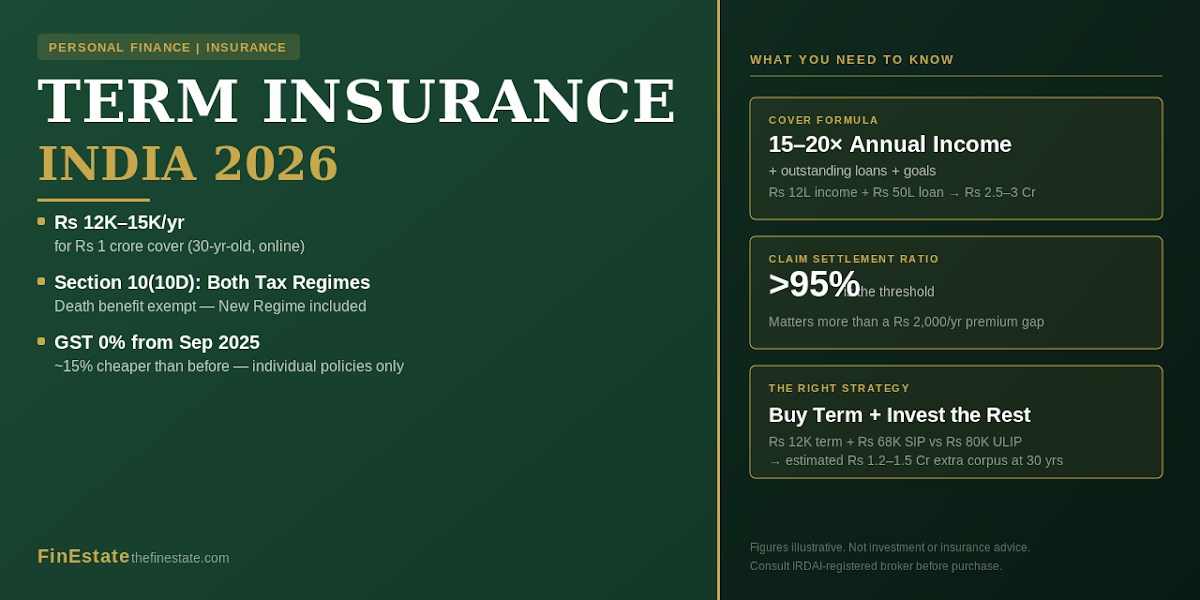
Term insurance does one thing: pays your family’s bills if you are not there. The right cover is 15–20 times your annual income plus outstanding loans — typically Rs 2–3 crore for most salaried earners in India today. The right insurer has a CSR consistently above 95%, which matters more than a Rs 2,000/year premium difference. The right time to buy was yesterday; the next-best time is now, when a standard Rs 1 crore plan costs approximately Rs 2,000 less per year than it did before September 2025.
Section 10(10D) protects your nominee’s payout in both Old and New Tax Regimes. The New Regime removes the Section 80C premium deduction (~Rs 3,600/year in tax at the 30% slab) but nothing more. Your family’s claim is fully exempt regardless of which regime you choose.
- Term insurance costs Rs 12,000–15,000/year for Rs 1 crore cover (30-yr-old, non-smoker, online) — five to fifteen times cheaper than ULIP or endowment for the same cover.
- Cover need = 15–20× annual income + outstanding loans. For Rs 12L income + Rs 50L home loan: target Rs 2.5–3 crore.
- Section 10(10D) death benefit exemption applies in both Old and New Tax Regimes. It is a Chapter III exemption, not a Chapter VI-A deduction — unaffected by Section 115BAC.
- Claim Settlement Ratio above 95% matters more than a Rs 2,000/year premium difference on a Rs 1 crore policy. Choose accordingly.
- GST on individual term and health premiums is 0% effective 22 September 2025 — making individual term cover approximately 15% cheaper than before.
Frequently Asked Questions
Subscribe free
- IRDAI Annual Report FY 2024–25 (claim settlement ratios, insurance penetration) — irdai.gov.in/annual-reports
- Swiss Re Institute — India mortality protection gap estimates
- IRDAI Protection of Policyholders’ Interests Regulations 2017 — irdai.gov.in
- Income Tax Act — Sections 10(10D), 80C, 115BAC (CBDT primary)
- Finance Act 2021 (ULIP Rs 2.5L premium threshold)
- Finance Act 2023 & CBDT Circular 15/2023 (non-ULIP Rs 5L aggregate premium threshold; unchanged under Finance Act 2025)
- 56th GST Council (3 Sep 2025) & CBIC Notification 16/2025-Central Tax (Rate), 17 Sep 2025 — NIL GST on individual life & health, effective 22 Sep 2025
- Kerala High Court, 10 Jan 2026 — GST exemption restricted to individual policies (taxo.online/latest-news/10-01-2026)
- IRDAI Bima Bharosa grievance portal — bimabharosa.irdai.gov.in
Keep reading
This article is part of our personal finance guide — the full set of explainers for salaried Indians, in the order you actually meet them.