
Start here
Personal finance for a salaried Indian does not start with where to invest. It starts with how long you could fund your life if the income stopped tomorrow — and for most people the honest answer is weeks, not months. Build the cash buffer first, then confirm your deposits are covered and your family is insured, then argue about returns. This page routes you to each piece in that order.
Use this page if
- You are salaried, saving something every month, and have never checked how many months you could survive without an income.
- You want to know what is actually guaranteed on your bank balance, and who bears the loss if money leaves your account without your consent.
- You have employer group cover and EPF, and want to know what they do not do.
- The buffer comes before the portfolio, and six to eight months is the target — not three.
- What is actually guaranteed on your bank balance, and who pays when money leaves without your consent.
- Term and health cover, sized to the gap your employer’s policy leaves behind.
- EPF and NPS: your largest forced saving, and the rulebook that changed in 2026.
- Personal finance for salaried India: the order that survives a bad year.
First: the buffer, before any product
If the income stopped tomorrow, how long could you fund your life without borrowing from anyone? Almost nobody has a clean answer, and that answer decides everything that follows.
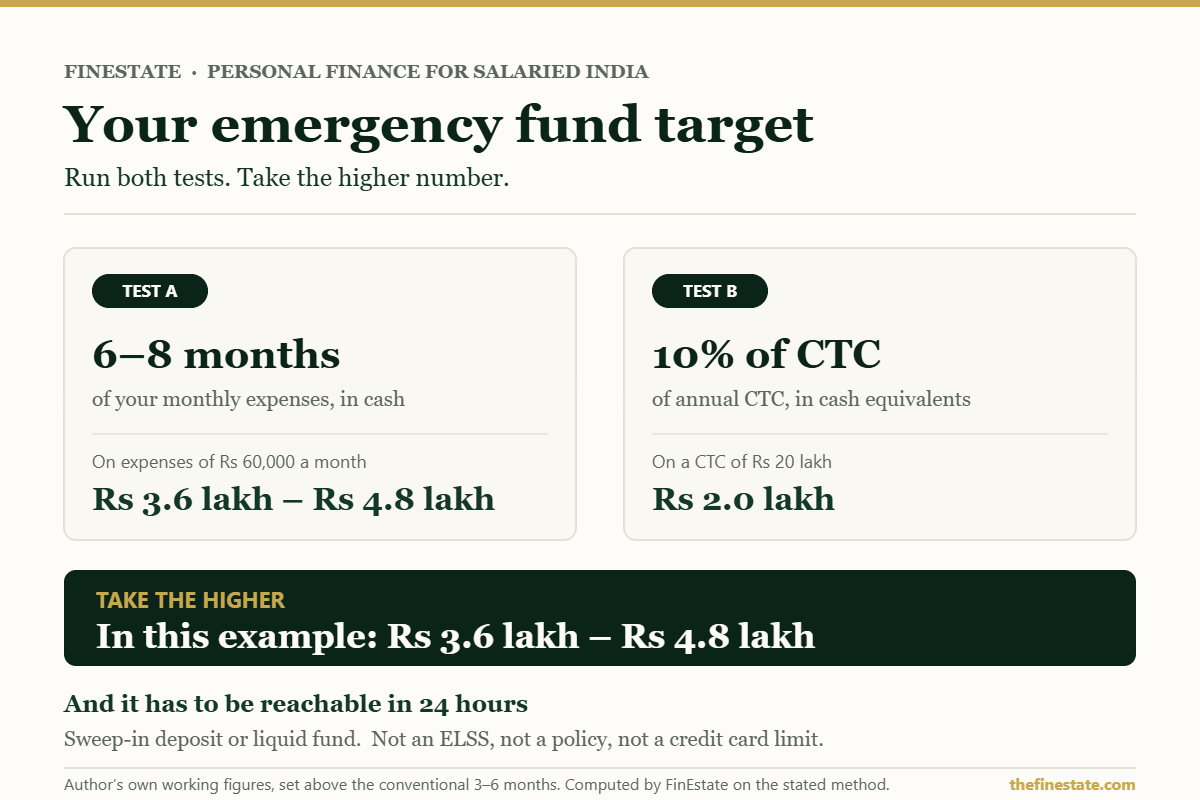
The textbook says three to six months of expenses. The working target here is six to eight months, or as a rough alternative test, at least 10% of annual CTC held in cash or cash equivalents — whichever of the two is higher for your situation. On a metro household running Rs 60,000 a month, that is Rs 3.6 lakh to Rs 4.8 lakh. On a Rs 20 lakh CTC, the 10% test says Rs 2 lakh.
Where it sits matters as much as the number. It has to be reachable in 24 hours — a sweep-in deposit or a liquid fund. An ELSS is not an emergency fund, a policy is not an emergency fund, and a credit card limit is the opposite of one.
The reason for setting a higher bar than the textbook is that the risk has changed. Roughly 30,000 technology jobs were cut in India in May 2026 alone on trade-press tallies, and over 90,000 globally in the first four months of the year. A notice period plus a realistic search is not a fortnight.
What is guaranteed, and who pays for fraud
Rs 5 lakh of your deposits are insured per depositor per bank — not per account — and from 2027 a reporting clock, not the bank’s goodwill, decides who bears the loss on a fraudulent transaction.
Two separate protections sit under a bank balance and people routinely confuse them. One covers the bank failing. The other covers money leaving your account while the bank is perfectly healthy.
- DICGC deposit insurance: how the Rs 5 lakh cover works
The mechanics of the per-depositor, per-bank guarantee — triggered by a real co-operative bank failure — what counts towards the limit, and how to structure deposits around it.
- Online bank fraud: the new RBI rules on customer liability
From 1 January 2027, who bears the loss when your account is defrauded, and the five-day reporting rule that decides it. Bank negligence means you owe nothing; your own negligence means you do.
- RBI bans forced insurance bundling with bank loans
Your bank cannot make a loan conditional on buying its insurance, and mis-selling carries a full refund. What changes at the branch counter, and what to do if it does not.
The wider question of what a bank may and may not do to an ordinary customer sits in our RBI and macro guide, alongside how policy reaches your loan.
Term and health, sized to the gap
Employer cover ends when the job does, and it is usually a small multiple of salary. That is the gap a personal policy exists to fill — and it is priced on your age and health the day you buy it, not the day you need it.
Group cover is not a plan. It is a benefit attached to an employer, and it disappears at precisely the moment — a layoff, a resignation, a health event that ends the job — when it would have mattered most.
- Term insurance 2026: cover, riders, and the tax truth
How much cover you actually need on a Human Life Value basis, which riders earn their premium, why term beats ULIP and endowment on economics, and the tax treatment under the New Regime.
- IRDAI health insurance rules: what is in effect
The 36-month cap on pre-existing-disease waiting, the 60-month moratorium after which a claim cannot be contested on non-disclosure, one-hour cashless pre-authorisation, and the portability credit you keep when you switch insurers.
EPF and NPS: the forced saving, and the 2026 rulebook
EPF is the largest pool most salaried Indians will ever build without deciding to, and the 2026 overhaul changed how you get at it — not how much goes in.
The contribution rate did not move. What moved is the mandatory base, the withdrawal categories, and the rule that applies after a job loss — which is exactly the situation the buffer above is meant to cover.
- EPF Scheme 2026: what changed for your PF account
The G.S.R. 525(E) overhaul — the Rs 1,800 mandatory base, withdrawal categories consolidated from 13 to 3, and the rule that lets you take 75% soon after a job loss with the final 25% only after twelve months of unemployment.
- The EPF wage ceiling and what a move to Rs 25,000 would do
How the Rs 15,000 statutory ceiling shapes your contribution today, and what changes for take-home pay and retirement corpus if it is raised.
- EPF interest 2025-26: when will the 8.25% be credited?
How the rate is set and when it actually lands in the passbook, and how to audit your own account so a missing credit does not go unnoticed for a year.
- NPS Tier 1 vs Tier 2: which account does what
The lock-in, the deduction, and the liquidity difference between the two tiers — and why Tier 2 is not a substitute for the emergency fund even though it looks like one.
Editor’s Analysis — the emergency fund is the gap, not the insurance
The biggest protection gap I see in people in their twenties and thirties is not life cover or health cover. It is that there is no liquid emergency fund at all. The standard advice is three to six months of expenses; my own view is that six to eight months is the right target now, or as a rough alternative test, at least 10 per cent of your annual CTC held in cash or cash equivalents. On a metro household running Rs 60,000 a month, six to eight months is Rs 3.6 lakh to Rs 4.8 lakh. On a Rs 20 lakh CTC, the 10 per cent test says Rs 2 lakh. Take whichever of the two is higher for your situation, and hold it somewhere you can reach in 24 hours — a sweep-in deposit or a liquid fund, not an ELSS, not a policy, and not “I have a credit card limit”.
I am deliberately setting a higher bar than the textbook because the risk has changed. Roughly 30,000 technology jobs were cut in India in May 2026 alone, on trade-press tallies, and over 90,000 globally in the first four months of the year. India’s youth unemployment rate hit 16.2 per cent in June 2026 — the highest since the monthly Periodic Labour Force Survey series began in April 2025, when it stood at 13.8 per cent — and youth labour-force participation fell at the same time, which is the worse half of that number. A notice period plus a realistic search is not a fortnight, and six months of cover is not paranoia against that backdrop. It is roughly one bad quarter plus the time it takes to land somewhere you actually want to be.
The structural evidence points the same way. Indian household net financial savings fell to a multi-decade low before recovering to about 5.1 per cent of gross national disposable income in 2023-24. Gross savings look healthy at around 30 per cent of GDP, but a large share of that is locked in property and gold — assets you cannot sell in a week at a fair price. That is precisely the gap: households are not unsaving, they are illiquid. A person with a house, a car loan, an SIP and no cash is not financially secure. They are one month of no income away from selling something at the wrong time.
Personal finance for salaried India: the order that survives a bad year
Know your numbers, build the buffer, cover the catastrophic risks, and only then argue about where the money goes. A plan that survives one bad year is worth more than one that maximises a spreadsheet.
Most advice starts at step four. That is why it fails — there is no point discussing where to invest with someone who would have to break it in month three.
Editor’s Analysis — what I would actually do with one hour
If someone salaried got one hour with me, I would not open with products, and I would not open with returns. I would open with two questions. First: what do you actually understand about your own finances — not what you earn, but where the money goes, what you owe, and what is already committed. Second: if the income stopped tomorrow, because of a layoff, a lost client or a hospital admission, how long could you fund your life without borrowing from anyone. Almost nobody has a clean answer to the second question, and the answer determines everything that follows. There is no point discussing where to invest with someone who would have to break it in month three.
Only after that would I ask about goals and expected returns, and I would treat the answer sceptically, because most people quote a return they have heard rather than one they need. What matters more is the shape of the earning: how secure the job is, how transferable the skill is, whether the income is likely to double in five years or grow with inflation. A 27-year-old in a sector that is hiring should be advised very differently from a 40-year-old in a sector that is consolidating, even at identical salaries. Most of the hour goes on this — position, obligations, objective and earning trajectory — and that is not preamble, it is the work.
I would keep the last fifteen minutes for the plan, and I would deliberately make it conservative and realistic rather than optimal. A plan that assumes 14 per cent returns, no job gap and perfect discipline is not a plan, it is a forecast. A plan that survives one bad year is worth more than one that maximises a spreadsheet. The order falls out of those two opening questions: know your numbers, build the buffer, and only then argue about where the money goes.
Key Takeaways
- Six to eight months of expenses in cash, or 10% of annual CTC — take the higher. Reachable in 24 hours, or it is not an emergency fund.
- A credit card limit, an ELSS and an insurance policy are not emergency funds. Neither is NPS Tier 2, despite the liquidity.
- DICGC cover is Rs 5 lakh per depositor per bank — the total of savings, current, fixed and recurring at that bank, not per account.
- From 1 January 2027, liability for a fraudulent transaction turns on fault and on a five-day reporting window. Report fast and the loss is not yours.
- Employer group cover ends with the job. A personal term plan is portable and priced on your age and health the day you buy it.
- Health cover: 36-month cap on pre-existing-disease waiting, 60-month moratorium after which a claim cannot be contested on non-disclosure.
- EPF’s 12% rate did not change in 2026. Mandatory contribution is 12% of the Rs 15,000 ceiling — Rs 1,800 — with the rest voluntary, and withdrawals cut from 13 categories to 3.
- After a job loss you can take 75% of the EPF balance soon, with the final 25% only after twelve months of unemployment. That is why the cash buffer exists.
Frequently Asked Questions
How much of my bank deposit is insured if the bank fails?
Deposits in Indian banks are insured by the DICGC up to Rs 5 lakh per depositor per bank, covering the total of your savings, current, fixed and recurring deposits at that bank. The limit is per bank, not per account — so holding accounts across multiple banks raises your total covered amount. The cover applies automatically; you do not pay a separate premium for it.
Who pays if money is stolen from my bank account through online fraud?
From 1 January 2027, under the RBI’s Third Amendment Directions, your liability depends on who was at fault. If the bank was negligent, you owe nothing and the transaction is reversed. If a third party was at fault and you reported it to your bank within 5 calendar days, you again owe nothing. Only where the fraud resulted from your own negligence do you bear the loss — with a limited small-value relief for bona fide losses up to Rs 50,000.
Do I actually need term insurance if I have a job with group cover?
Employer group cover typically ends when you leave the job and is usually a small multiple of salary — often not enough to replace your income for dependents. A personal term plan is portable, priced on your age and health when you buy it, and sized to your Human Life Value, broadly the income your family would need to replace. For most salaried earners with dependents, a personal term plan is the foundation, with group cover as a top-up.
Has the EPF contribution rate changed under the 2026 rules?
No. Under the EPF Scheme 2026, in force 1 July 2026, the 12% contribution rate is unchanged. What is newly clarified is that mandatory contributions are limited to 12% of the Rs 15,000 wage ceiling — Rs 1,800 per month — with anything above that treated as voluntary. Withdrawal categories were consolidated from 13 to 3, and after a job loss you can take up to 75% soon, with the final 25% only after 12 months of unemployment.
Where should I actually keep the emergency fund?
Somewhere you can reach within 24 hours without a penalty that defeats the purpose — a sweep-in fixed deposit or a liquid fund are the usual answers. The test is not the return; it is whether you can get the money on a Sunday when a hospital is asking for a deposit. Anything with a lock-in, a surrender charge or market-timing risk fails that test, which rules out ELSS, insurance policies and, despite the liquidity, NPS Tier 2 as a substitute.
Primary sources
- Deposit Insurance and Credit Guarantee Corporation — the Rs 5 lakh per-depositor, per-bank cover and what counts towards it. dicgc.org.in.
- Reserve Bank of India — the customer-liability framework for unauthorised electronic transactions and the reporting window, effective 1 January 2027; and the Responsible Business Conduct directions restricting product bundling with loans. rbi.org.in.
- IRDAI Master Circular on Health Insurance Business, 29 May 2024 — the 36-month pre-existing-disease cap, the 60-month moratorium on continuous coverage, cashless pre-authorisation timelines and portability credit. irdai.gov.in.
- EPFO — Employees’ Provident Fund Scheme 2026, G.S.R. 525(E), in force 1 July 2026. The Rs 15,000 wage ceiling, the 13-to-3 withdrawal consolidation and the 75%/25% job-loss rule. epfindia.gov.in.
- Periodic Labour Force Survey, monthly series (MoSPI) — the youth unemployment figures for June 2026 and the April 2025 series baseline.
Secondary sources and commentary
- The India and global technology layoff counts for 2026 are trade-press tallies, not official statistics, and are cited as such.
- Household net financial savings at about 5.1% of gross national disposable income in 2023-24, and gross savings at around 30% of GDP, are national-accounts and RBI figures as reported; cited as context rather than re-derived here.
- The six-to-eight-month buffer target and the 10%-of-CTC alternative test are the author’s own working figures, deliberately set above the conventional three-to-six-month guidance. They are not a published standard.
- Worked examples on Rs 60,000 monthly expenses and a Rs 20 lakh CTC are computed by FinEstate on the method stated above.
The Bottom Line
Liquidity is the thing that decides whether everything else you have built survives a bad year. A household with a house, a car loan, a running SIP and no cash is not secure — it is one month of lost income away from selling something at the wrong price.
So the order is fixed: know your numbers, build six to eight months of reachable cash, confirm your deposit cover and buy the two policies that protect against catastrophe, and understand the EPF rules that govern your largest forced saving. Returns are the argument you get to have afterwards.
One email when something is published. No daily digest, no tips.
Subscribe freeDisclosure and method
This is a guide page for general information and is not financial, insurance or tax advice. Two things on this page are most easily got wrong: the DICGC limit is per depositor per bank, not per account, so three accounts at one bank do not give you Rs 15 lakh of cover; and the RBI customer-liability rules described here take effect 1 January 2027, so do not assume the five-day protection is already in force today. Verify current provisions at dicgc.org.in, rbi.org.in, irdai.gov.in and epfindia.gov.in, and consult a qualified professional before any financial decision. The six-to-eight-month buffer target and the 10%-of-CTC test are the author’s own working figures rather than a published standard, and are labelled as such above.
Compiled with AI assistance and reviewed before publication. Statutory and regulatory provisions are cited to their source; layoff counts are labelled as trade-press tallies in the sources above.