
Quick Answer
Six rules bind every health insurer in India, and the one most people get wrong is the five-year moratorium. It does not mean all pre-existing conditions become covered after five years. It means the insurer loses the right to contest your claim on grounds of non-disclosure. An exclusion written into your policy stays an exclusion. The rules below are what your insurer must do — and the three places where the rule stops and your policy wording takes over.
This applies to you if
- You hold any health insurance policy in India — individual, family floater or employer group. The circular binds every insurer, so it reaches whatever policy you have.
- You are about to renew, port, or make a claim, and want to know what the insurer is obliged to do versus what your policy wording permits.
- You have a pre-existing condition and are trying to work out when it is actually covered.
- Six rules bind every insurer, and they were consolidated out of 55 earlier circulars into one document.
- The five-year moratorium stops your insurer contesting a claim — it does not turn an excluded condition into a covered one.
- Porting inside the renewal window carries your 60-month moratorium count forward — switching insurer does not reset it.
- The 36-month clock starts at policy inception, not at your first claim, and portability preserves what you have served.
- Senior-citizen buyers get access to a product; they do not get immediate cover for declared pre-existing conditions.
- The one-hour rule is a floor, and three things sit between it and a frictionless claim.
- Where the rule stops: room rent, co-pay and modern treatments are policy wording, not regulation.
- Room rent sub-limits reduce your entire claim, not just the room charge — the proportionate deduction applies to every line item.
- A co-pay requires you to share every settled claim; combined with a room rent cap, the two deductions multiply.
- Your employer’s cover has a gap, and medical inflation widens it every year.
- The tax deduction has stopped being the reason to buy.
The six rules in force for policyholders
These come from one document: the IRDAI Master Circular on Health Insurance Business dated 29 May 2024, which consolidated and replaced a large body of earlier circulars. It remains in force.
A note on why that last sentence is there. A separate IRDAI master circular was issued on 25 July 2025 covering Rural, Social Sector and Motor Third Party Obligations, and it superseded the 2024 circular on that subject. It does not touch health insurance product rules. The 29 May 2024 health circular stands.
| Rule | What it means for you |
|---|---|
| PED waiting period: maximum 36 months | A condition declared at inception is covered from year four at the latest. Insurers cannot impose longer. |
| Moratorium: 60 months | After five years of continuous coverage the insurer cannot contest a claim for non-disclosure or misrepresentation, except on established fraud. Reduced from 96 months. |
| Cashless: 1-hour pre-auth, 3-hour discharge | Decision on pre-authorisation within one hour of the hospital’s request; final discharge authorisation within three hours. Binding timelines. |
| Entry age cap: removed | Every insurer must offer at least one product with no upper entry age. You cannot be declined solely on age. |
| AYUSH: full sum insured | Ayurveda, Yoga and Naturopathy, Unani, Siddha and Homeopathy covered up to the full sum insured. Sub-limits on AYUSH are non-compliant. |
| Portability: credit preserved | Moving insurer does not reset your PED or moratorium clock. Time already served carries forward. |
Check your own policy in 10 minutes
The 11 things to look for in a policy schedule, and the IRDAI rule behind each one.
One email when something changes. No daily digest.
The moratorium does not mean everything is covered
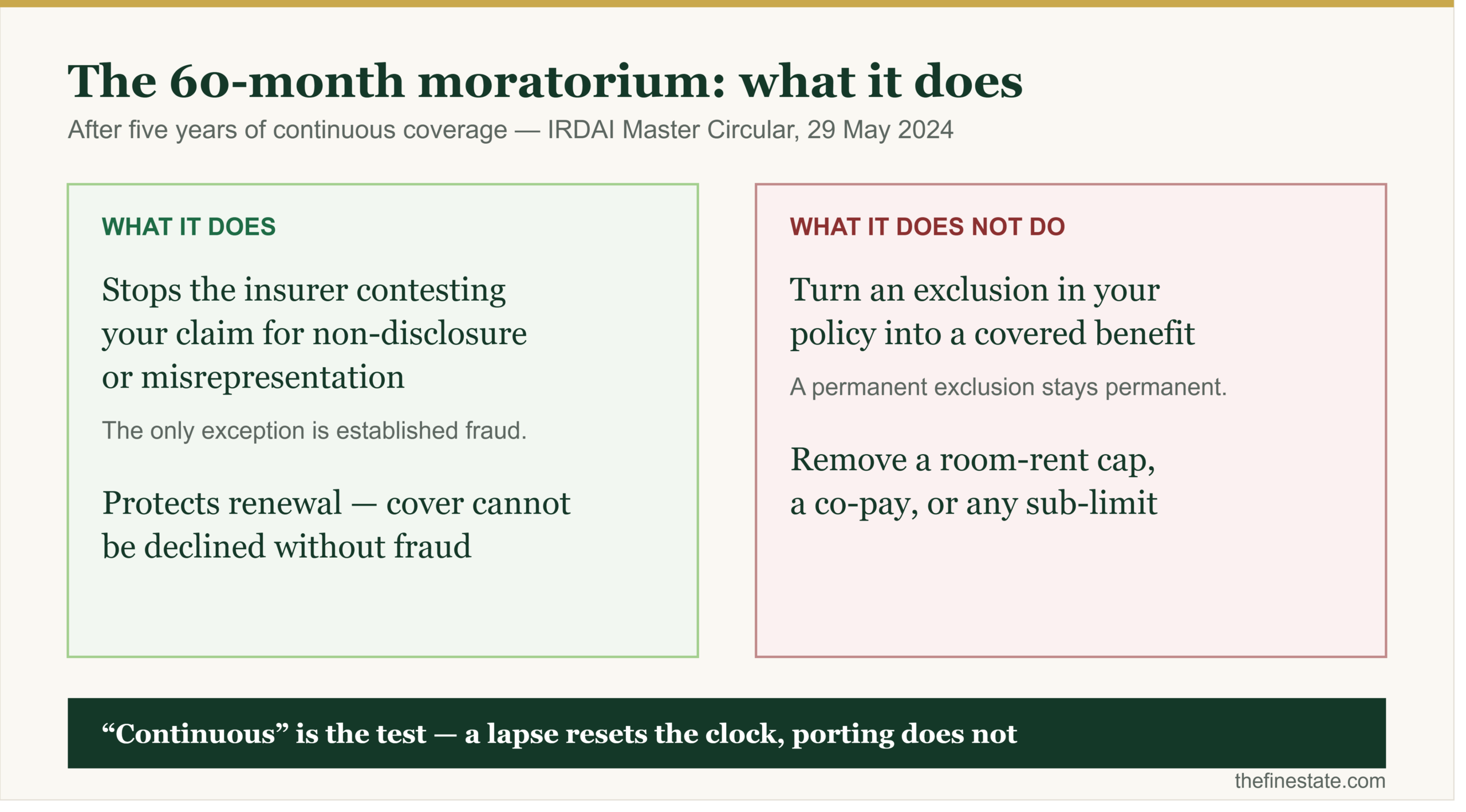
Five years of continuous coverage removes your insurer’s right to contest a claim for non-disclosure. It does not convert an exclusion in your policy into a benefit.
This is the single most common misreading of the circular, and it matters because people rely on it. The moratorium is a rule about contestability, not about scope of cover.
What it does give you: after 60 months of continuous coverage, the insurer cannot reject or contest a claim on the grounds that you failed to disclose something, or misrepresented it, at the time of purchase. The only exception is established fraud. For anyone who bought a policy years ago and has since wondered whether a forgotten detail on the proposal form could be used against them, that is a genuine and valuable protection.
What it does not give you: cover for something your policy excludes. A permanent exclusion stays permanent. A sub-limit stays a sub-limit. A treatment outside the policy’s scope stays outside it. The moratorium does not rewrite the schedule — it stops the insurer reopening the question of what you told them when you bought it.
The word doing the work is “continuous”. The 60 months run on unbroken coverage, and a lapse resets the clock. That is why uninterrupted renewal matters more than which insurer you happen to be with — and why porting inside the renewal window, rather than letting a policy lapse and buying fresh, protects something worth real money.
Porting inside the renewal window does not reset the 60-month clock
The 60-month moratorium counts continuous coverage, not your relationship with any specific insurer. Switching insurer inside the renewal window does not reset it.
Port to a new insurer within the renewal window — typically 30 to 45 days before policy expiry — and your new insurer must credit the moratorium time already run. Your count continues from where it was. The circular’s portability provision makes the 60-month clock a property of the policyholder, not of the insurer.
What resets the clock: a lapse. Let a policy expire and then buy a new one rather than porting, and the 60-month count starts from zero at inception of the new policy. This is the practical case for porting rather than switching: not loyalty to an insurer, but protecting continuity credit that a fresh purchase destroys.
What portability does not transfer: the enhanced benefits, specific riders, or top-up structures from your old policy. A new insurer assesses you at its own product’s terms. Portability ensures continuity of the moratorium and PED waiting period credit; it does not guarantee identical cover on the new policy schedule.
When a pre-existing condition is actually covered
The 36-month clock starts at policy inception, not at your first claim — and it applies to conditions you declared.
If you disclose a condition when you buy, the maximum waiting period the insurer may impose on it is 36 months from inception. So a condition declared at purchase is covered from year four at the latest. This is a cap on the insurer, not a target: many policies impose less.
Two practical points that come up repeatedly:
Entry age cap removed: what it does and does not mean for older buyers
Every insurer must offer at least one product with no upper entry age. That removes the access barrier. The 36-month PED waiting period still runs from inception of any new policy, regardless of how old the buyer is.
Before the circular, many products closed at 65. A 70-year-old who let existing cover lapse had limited options. The entry age cap removal changes that: access to a policy is now guaranteed. What it does not change is the waiting period for pre-existing conditions.
An older buyer is more likely to have declared conditions at inception — hypertension, diabetes, prior cardiac events — than a younger one. Those conditions face the same maximum 36-month wait: covered from year four at the latest under a new policy. Three years without cover for the very conditions that prompted the purchase is the practical consequence of buying fresh rather than porting.
The practical implication: uninterrupted renewal of an existing policy carries far more value than the right to start fresh at a new insurer. Portability preserves the PED waiting period time already served; a fresh purchase after a lapse resets it from zero. The entry age cap removal matters most for buyers who have never had health cover and are starting for the first time at an older age — for whom the three-year window is a known and unavoidable cost.
Some senior-specific products impose shorter waiting periods on certain declared conditions. Check the policy schedule rather than assuming the 36-month maximum applies in every case.
The one-hour rule is a floor, not a guarantee
The timelines are binding and compliance is high, but three things sit between the rule and a frictionless claim — and the most expensive one is invisible at purchase.
Secondary reporting of IRDAI FY2024-25 data puts roughly 87% of cashless pre-authorisation requests inside the one-hour window and roughly 97% of final discharge authorisations inside three hours. That leaves a meaningful tail. Three patterns account for most of it:
- Network restriction. The one-hour rule applies at hospitals empanelled on your insurer’s cashless network. Admission elsewhere means you pay upfront and claim reimbursement, and the mandate does not apply.
- Room-rent caps and sub-limits. If your policy carries a room-rent ceiling and you occupy a room above it, the insurer can proportionately reduce every line item on the bill — not only the room charge. The discharge authorisation still issues within three hours; the deductions follow. The cashless mandate does not prevent them.
- TPA documentation rounds. The Third Party Administrator processes pre-authorisation on the insurer’s behalf. For cardiac procedures, cancer treatment or transplants it may request further clinical documentation, and each round effectively pauses the clock.
One clarification, because the question comes up in this form: the one hour is the insurer’s deadline to decide, not your deadline to notify. It runs from the hospital’s pre-authorisation request. There is no rule requiring you to submit a request within an hour of admission.
For scale, IRDAI reported insurers disallowing Rs 26,000 crore of health claims in FY2024, up 19.10% on the prior year’s Rs 21,861 crore, with a combined rejection rate of about 11% as at March 2024 — figures reported via Business Standard and Moneylife in December 2024, not read by us in the Annual Report itself.
Editor’s Analysis
The 1-hour rule is a floor, not a guarantee of a frictionless claim. The three choke points above — network, sub-limits, TPA documentation rounds — sit between the rule and the actual experience.
Of these, the room-rent cap is the most financially significant and the least visible at purchase time. Most policyholders discover it on the discharge bill, not in the policy document.
Check your policy’s room-rent clause before a planned admission, and confirm your preferred hospital is on the cashless network before an emergency turns that research into a rushed decision.
Where the rule stops and your policy wording starts
Room rent, co-pay and modern treatment limits are policy terms, not regulation. The circular standardises definitions; it does not abolish sub-limits except for AYUSH.
This is the distinction that decides most disputed bills. The circular is a rulebook for insurer conduct — timelines, contestability, entry age, portability. It is not a rulebook for how generous your particular policy is.
So: a room-rent ceiling is permitted, and if you exceed it the proportionate deduction applies across the bill. A co-pay is permitted. What is not permitted is a sub-limit on AYUSH treatment, which must be covered up to the full sum insured.
The same division decides two adjacent questions readers ask constantly. Whether your deposits are protected if a bank fails is a statutory guarantee with a hard per-bank limit, not a policy term. Whether your retirement corpus keeps pace is governed by the EPF rulebook, not by anything you negotiate. Regulation sets the floor in each case; the document you signed decides everything above it.
On modern treatment methods — robotic surgery being the one most asked about — these sit within the standardised inclusions, and a claim cannot be refused because the procedure was performed robotically. Sub-limits on the payout are permitted. AYUSH is the one category the circular protects to the full sum insured; modern treatment methods carry no such protection, and practice varies between insurers. We set out what to check in your own schedule, and what to do when an insurer partially approves, in the robotic surgery sub-limit question, answered.
Room rent sub-limits and the proportionate deduction
Exceeding a room-rent ceiling does not just reduce the room charge — it reduces every line item on the final bill in proportion.
Most health policies cap the room rate at a daily ceiling (for example Rs 3,000 per day) or restrict the room to a category (single non-AC room, single AC room, twin sharing). If you take a room above the ceiling, the insurer does not simply deduct the excess room cost. It applies a proportionate reduction to the entire bill: surgeon fees, anaesthetist charges, ICU costs, medicines, ward equipment — everything is cut by the ratio of your ceiling to the actual room rate.
An illustration: policy ceiling is Rs 3,000 per day and you take a room at Rs 6,000 per day — twice the ceiling. The proportionate deduction is 50%, applied to every line item. A Rs 1 lakh bill settles at Rs 50,000. The insurer pays Rs 50,000; you bear Rs 50,000. Not because of a co-pay, but because of a room-rent clause.
Three actions reduce the risk: check your policy’s room category or daily ceiling before a planned admission; confirm which room categories are available at your cashless network hospital before the date; and if a higher room category is medically required, ask the treating doctor to document the clinical reason — some insurers waive the proportionate deduction in documented medical necessity cases, though this is not a regulatory requirement and depends on the insurer’s internal policy.
Co-pay: how it interacts with room rent sub-limits
A co-pay requires you to bear a fixed percentage of every settled claim. When it combines with a room-rent sub-limit, both deductions apply to the same bill and the total out-of-pocket is higher than either clause implies on its own.
A co-pay of 20% on a Rs 1 lakh claim means you pay Rs 20,000 and the insurer pays Rs 80,000. That is the visible cost at purchase.
The compounding effect operates as follows. If a room-rent sub-limit has already reduced the settled amount to Rs 50,000 (as in the example above), the 20% co-pay then applies to that Rs 50,000 — not the original Rs 1 lakh. The insurer pays Rs 40,000. Your total out-of-pocket is Rs 60,000: Rs 50,000 from the proportionate reduction plus Rs 10,000 from the co-pay.
One caveat on that sequence. Applying the co-pay to the already-reduced amount is the usual construction, but the order of operations is set by your policy wording rather than by the circular, and insurers do not all apply it identically. If both clauses are in your policy, ask your insurer in writing which amount the co-pay attaches to before you need to rely on the answer.
Co-pays appear most often in products for buyers above 60, where they function as a mechanism to keep premium manageable in exchange for sharing each claim. When is the trade-off worth accepting? When the annual premium saving is material relative to expected claim frequency. For a buyer at higher hospitalisation risk, the right approach is to model the expected out-of-pocket — combining co-pay and room-rent scenarios — against the premium reduction, before accepting either clause.
The circular does not restrict co-pays. They remain permitted policy terms. The standardisation the circular brings is to the underlying obligations — timelines, portability, contestability — not to the financial structure of the policy.
Your employer’s cover has a gap
The rules apply to whatever policy you hold. They cannot extend a sum insured that runs out.
| Figure | What it is | Source |
|---|---|---|
| Rs 3–5 lakh | Typical employer group sum insured per employee | Industry reporting. We have not identified a single attributable survey for this range — treat it as indicative and check your own policy document |
| 12–14% | Annual medical inflation, estimate | WTW, Milliman, Aon insurer surveys |
| Rs 26,000 crore | Health claims disallowed, FY2024 | IRDAI FY24 data via Business Standard |
| 39.4% | Out-of-pocket share of total health spend | National Health Accounts 2021-22, Govt of India |
Editor’s Analysis
Most corporate group policies in India carry a sum insured of Rs 3 lakh to Rs 5 lakh per employee per year. Medical inflation is running at 12 to 14 per cent annually according to industry surveys by WTW, Milliman and Aon — insurer-survey estimates, not an IRDAI primary figure. At 12 per cent compounding, Rs 5 lakh of cover from five years ago has the real purchasing power of roughly Rs 2.8 lakh today.
What Rs 5 lakh actually covers in a private tier-1 hospital is a harder question. Secondary industry sources put a routine appendectomy at Rs 1–2 lakh, cardiac bypass at Rs 4–8 lakh for the procedure alone before ICU, post-op and medication, and a single chemotherapy cycle at Rs 80,000–2 lakh depending on protocol. These are estimates and vary significantly by hospital, city and protocol. Verify with your hospital of choice.
The IRDAI’s protections — the PED cap, the moratorium, the cashless mandate — apply to whatever policy you hold. They cannot extend your sum insured or pay a bill that exceeds it. If your employer’s Rs 5 lakh policy is exhausted, you bear the rest out of pocket. The practical response: use the employer cover as a base, supplement with an individual or family floater, and review the combined sum insured against current costs in your city rather than against the number HR issued five years ago. For how term insurance fits the same protection framework, see the linked explainer.
The tax deduction has stopped being the reason to buy
Health insurance premium is deductible only under the Old Regime, and the New Regime is the default — so for most salaried buyers the deduction is simply gone.
A citation point that matters from FY 2026-27: the deduction previously at Section 80D of the Income-tax Act, 1961 now sits at Section 126 of the Income-tax Act, 2025. Both numbers are live depending on the year you are dealing with — see our guide to the Income-tax Act, 2025 transition for the wider renumbering.
Editor’s Analysis
The readers FinEstate hears from are buying health insurance because they want coverage, not a deduction. The New Regime has separated the two decisions — you either get the tax benefit or the simplified rate structure, not both.
What has emerged is a cleaner buying framework: size your cover to your actual medical-cost exposure, not to the deduction limit. A Rs 25,000 premium ceiling was never the right way to size health cover in a city where a major hospitalisation easily crosses Rs 5 lakh.
A related trend: some buyers on the Old Regime now bundle term and health in a single purchase, partly for convenience and partly to address the whole protection picture at once. Health premium qualifies under Section 126 of the 2025 Act (Section 80D of the 1961 Act); term insurance premium qualifies under Section 123 (formerly Section 80C). Both exist only under the Old Regime. Under the New Regime both products still make sense — the tax benefit is gone, the coverage need is not.
Key Takeaways
- The governing document is the IRDAI Master Circular on Health Insurance Business, 29 May 2024. It consolidated 55 earlier circulars and remains in force — the July 2025 master circular covers a different subject.
- The 60-month moratorium removes the insurer’s right to contest a claim for non-disclosure. It does not turn an excluded condition into a covered one.
- “Continuous” coverage is the operative test for the moratorium. A lapse resets the clock; porting inside the renewal window does not.
- Porting preserves moratorium and PED waiting period credit. A fresh purchase after a lapse resets both from zero.
- The PED waiting period is capped at 36 months from policy inception for conditions you declared. This cap applies to all buyers, including those entering at older ages under the removed entry age cap.
- Cashless: one hour for the insurer to decide on pre-authorisation, three hours for discharge authorisation. The one hour is the insurer’s deadline, not your notification deadline.
- Room-rent caps and co-pays remain permitted policy terms. Exceed a room-rent ceiling and the proportionate deduction applies across every line of the bill — not just the room charge.
- Co-pay and room-rent sub-limits compound: the co-pay percentage applies to the amount already reduced by the proportionate deduction. Model both before accepting either clause.
- AYUSH must be covered up to the full sum insured, with no sub-limits. That is the one sub-limit the circular abolishes.
- From FY 2026-27 the premium deduction sits at Section 126 of the Income-tax Act, 2025, formerly Section 80D of the 1961 Act. Old Regime only.
Frequently Asked Questions
Is it true that after 5 years all pre-existing diseases are covered?
No, and this is the most common misunderstanding of the rule. What completes at 60 months of continuous coverage is the moratorium, and it stops the insurer contesting a claim on grounds of non-disclosure or misrepresentation — except on established fraud. It does not convert an exclusion in your policy into a covered benefit. A condition your policy permanently excludes stays excluded after five years. Separately, a pre-existing condition you declared at purchase has a waiting period capped at 36 months, after which it is covered.
Does switching insurer reset the 60-month moratorium?
Not if you port inside the renewal window. The circular’s portability provision requires the new insurer to credit moratorium time already run, so your 60-month count continues from where it was. What does reset the clock is a lapse: let a policy expire and then buy afresh — rather than porting — and the moratorium starts from zero at the new policy’s inception. The practical rule: port, do not lapse and rebuy.
Does the 60-month moratorium run from policy inception or from continuous coverage?
From continuous coverage. The circular sets the moratorium at 60 months of continuous coverage, so an unbroken run of renewals is what counts — and a lapse resets it. Portability does not reset it: moving insurer inside the renewal window carries your accrued credit forward. This is the practical reason to port rather than let a policy lapse and buy fresh.
What is the maximum pre-existing disease waiting period an insurer can impose?
36 months, down from up to 48 before the master circular. It runs from policy inception rather than from your first claim, and it applies to conditions declared at purchase. Any policy stating a longer PED waiting period is not compliant with the circular.
How does the proportionate deduction work for room rent sub-limits?
If your policy caps the daily room rate at Rs 3,000 and you take a room at Rs 6,000, the insurer treats every line item on the bill as if it were incurred in the Rs 3,000 room — surgeon fees, anaesthetist charges, ICU costs, medicines. Each is reduced by 50% (the ratio of ceiling to actual room rate), not just the room charge. A Rs 1 lakh bill settles at Rs 50,000. Check your policy’s room category or daily ceiling before any planned admission.
Do I have to submit a cashless request within one hour of hospitalisation?
No. The one hour is the insurer’s deadline to decide on a pre-authorisation request, running from the hospital’s submission of it. There is no rule imposing a one-hour notification duty on you. The related timeline is three hours for the insurer to grant final authorisation for discharge once the hospital requests it.
Can my insurer still apply a room-rent cap or co-pay?
Yes. The circular governs insurer conduct — timelines, contestability, entry age, portability — not how generous your policy is. Room-rent ceilings and co-pays remain permitted policy terms. Exceeding a room-rent ceiling allows a proportionate reduction across every line item on the bill, not just the room charge. The one sub-limit the circular does abolish is on AYUSH treatment.
Can an insurer refuse me health insurance because of my age?
Not on age alone. Every insurer must offer at least one product with no upper entry age limit. That is access, not price — premium reflects risk and can be substantially higher at older ages, and it does not mean every product is available at every age.
Primary sources
- IRDAI Master Circular on Health Insurance Business, dated 29 May 2024 — the governing instrument for every provision in the table above. IRDAI document page. Note on the reference number: two different circular references for this document appear in secondary sources. We have not resolved which is correct against the PDF and have therefore cited the circular by name, date and IRDAI’s own document page rather than reproduce a reference we cannot verify.
- IRDAI Master Circular on Rural, Social Sector and Motor Third Party Obligations, 25 July 2025 — cited only to establish that it supersedes the 2024 circular on that subject and does not affect health insurance product rules.
- Section 126, Income-tax Act, 2025, and Section 80D, Income-tax Act, 1961 — the health insurance premium deduction, by year.
- National Health Accounts 2021-22, Government of India — the 39.4% out-of-pocket share.
Secondary sources and commentary
- Business Standard and Moneylife, December 2024 — reporting IRDAI FY2024 claims data (Rs 26,000 crore disallowed, approximately 11% rejection rate). We have not read the Annual Report directly.
- Secondary financial reporting of IRDAI FY2024-25 cashless processing data — the approximately 87% within one hour and 97% within three hours figures.
- WTW, Milliman and Aon insurer surveys, 2024–25 — the 12–14% medical inflation estimate. Insurer-survey estimates, not a regulator figure.
- Industry reporting on typical employer group sums insured, and on treatment-cost ranges in private tier-1 hospitals. We have not identified a single attributable source for either range. They are indicative figures drawn from general industry commentary, they vary widely by hospital, city and protocol, and they should not be used for planning without checking your own policy and a quote from your hospital of choice.
The Bottom Line
The circular gives you six things worth knowing, and the most valuable is the least understood. Five years of continuous coverage stops your insurer reopening what you told them when you bought the policy. It does not widen what the policy covers.
So read the rules as two separate questions. What must the insurer do — the timelines, the 36-month cap, the entry-age rule, portability credit. And what does your policy actually pay for — the room-rent ceiling, the co-pay, the sum insured. The circular settles the first. Only your policy schedule settles the second, and that is where most disputed bills are decided.
One email when something is published. No daily digest, no tips.
Subscribe freeCheck your own policy in 10 minutes
The 11 things to look for in a policy schedule, and the IRDAI rule behind each one.
One email when something changes. No daily digest.
Disclosure and method
This article explains insurance regulation for educational purposes and is not insurance advice. FinEstate is not a SEBI-registered Investment Adviser or Research Analyst and is not an insurance broker or agent; nothing here is a recommendation to buy, switch or surrender any policy. See our full disclaimer for the complete position.
The point where being wrong costs most is the moratorium: do not rely on five years of coverage to make an excluded condition claimable, because it does not. Read your own policy schedule for room rent, co-pay, sub-limits and the exclusions list, and confirm anything you intend to act on with your insurer in writing. Two items are explicitly unverified above — the circular’s reference number, and the order in which a co-pay and a room-rent deduction apply to the same claim. The sub-limit question on modern treatment methods has since been resolved and is covered separately.
Researched and drafted with AI assistance and reviewed before publication. Provisions are attributed to the IRDAI Master Circular of 29 May 2024 via IRDAI’s own document page; every statistic is labelled with its source and marked where it is a secondary estimate rather than a regulator figure.
Keep reading
This article is part of our personal finance guide — the full set of explainers for salaried Indians, in the order you actually meet them.