Under-Construction vs Ready-to-Move in 2026: GST, Tax Timing, and the Real Cost Math
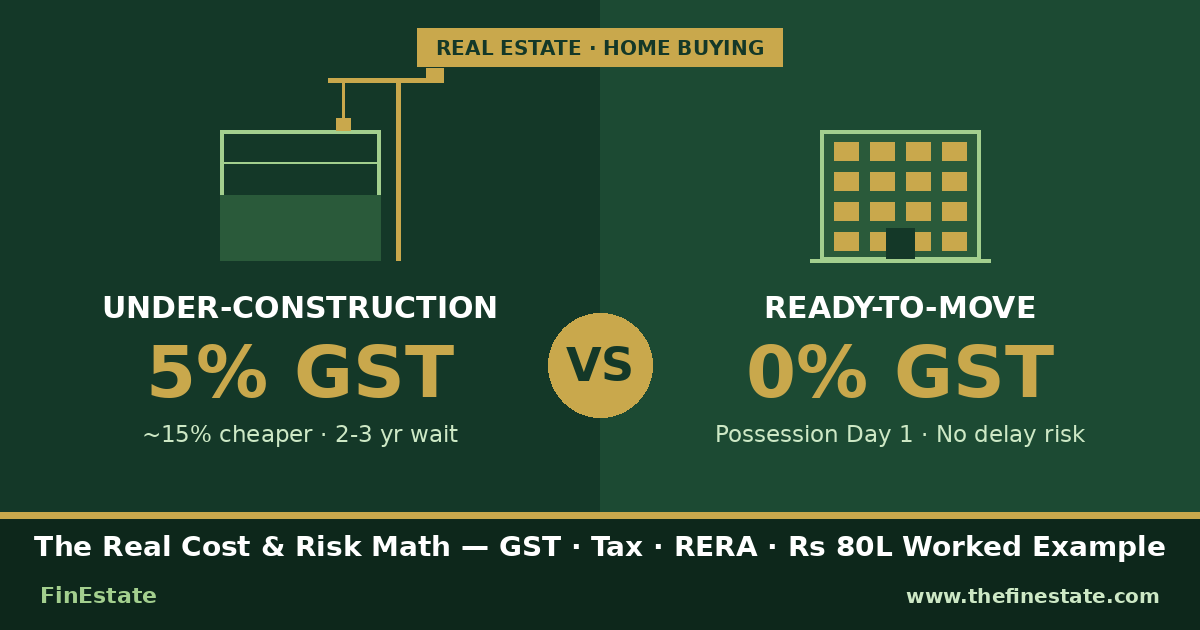
The short answer: An under-construction flat attracts 5% GST (1% for affordable housing) but typically prices below a comparable ready-to-move flat, which attracts no GST and carries no delivery risk. End-users who need possession now usually do better with ready-to-move; investors with a 3–5 year horizon usually do better with under-construction.
Under-construction (UC) vs ready-to-move (RTM): it feels like a lifestyle choice. In reality, the right answer comes from three financial levers — GST, tax treatment, and delivery risk — that most buyers evaluate separately. This article puts all three on the same table with a worked example on a real ticket size, so you can make the decision with actual numbers rather than instinct.
The UC vs RTM decision matters most right now because 2025-26 saw meaningful changes in how lending, tax, and developer behaviour interact. EBLR-linked (external-benchmark) home loans are now standard. The tax regime shift means Old-Regime benefits (including Section 24(b) deductions) are now a deliberate choice. And RERA’s enforcement record is now old enough to evaluate realistically.
Here is the paradox of the Indian market: under-construction is where the investment case lives, yet most buyers only commit when they can see and touch a finished flat. That tangibility bias is exactly what creates the 15% discount in our worked example — Rs 12 lakh on a Rs 80 lakh ticket. Even after GST (Rs 3.4 lakh) and the lower stamp duty on the cheaper agreement value, Rs 9.3 lakh of the advantage survives. You are being paid to accept what others will not: delivery risk, execution quality, and capital locked in before possession. The buyers who win on UC underwrite the developer the way a lender would — escrow (ring-fenced project account) record and payment schedule first, show flat later.
What Each Category Actually Means
Under-construction (UC) means the property has not yet received an Occupation Certificate (OC) or Completion Certificate (CC) from the local authority. You are buying on the basis of a RERA-registered project and a builder-buyer agreement, with possession promised at a future date. Payments are typically stage-linked (on slab completion, plastering, etc.) or time-linked.
Ready-to-move (RTM) means the property holds an OC/CC and is legally habitable. You can register the sale deed and take physical possession on the same day or within days. For GST purposes, the critical test is whether the property has received the OC/CC before the date of sale — if yes, no GST applies to the buyer.
The GST Gap: 5% vs Zero
This is the single largest cost difference between the two options and is frequently underweighted in buyer comparisons.
Under-construction properties attract GST because you are purchasing a “service” (construction) from the developer. The effective rates applicable to residential under-construction properties in India are: 5% GST for non-affordable housing (carpet area — the net usable floor area, not super built-up — above 60 sq m in metro cities or above 90 sq m in non-metro cities, OR agreement value above Rs 45 lakh); and 1% GST for affordable housing (meeting both the area and value criteria above). Input Tax Credit (ITC) is not available under either rate — meaning the developer cannot offset taxes paid on inputs, so the 5%/1% is the final buyer-facing rate. Verify current rates at cbic.gov.in — these have remained unchanged since 1 April 2019.
Ready-to-move properties with a valid OC/CC attract no GST — the transaction is treated as a land sale (immovable property), which is outside GST’s scope. This zero-GST advantage can represent Rs 3–4 lakh on a Rs 70–80 lakh property, a figure that significantly narrows the apparent “discount” of UC.
Stamp duty and registration apply to both UC and RTM properties, payable at the time of registration on the agreement value. The rate varies by state — Maharashtra, Karnataka, and Delhi have different schedules. For a state-by-state breakdown, see the Stamp Duty by State 2026 guide.
Section 24(b): The Tax Timing Difference
If you are buying under the Old Tax Regime and financing with a home loan, the treatment of interest under Section 24(b) is meaningfully different for UC vs RTM.
For RTM buyers, Section 24(b) interest deduction is available from the year of possession — which is the same year as purchase. The deduction of up to Rs 2 lakh per year on interest for a self-occupied property begins in Year 1.
For UC buyers, Section 24(b) works differently. Interest paid during the pre-construction period (from the year of loan disbursement to the year before possession) is not deductible in the years it is paid. Instead, the total pre-construction interest is aggregated and allowed as a deduction in five equal annual instalments, starting from the year of possession — subject to the overall Rs 2 lakh annual cap for self-occupied properties. This pre-construction interest is what lenders commonly call pre-EMI interest — the tax benefit on it is deferred, not lost (subject to the cap). One more condition matters for delayed projects: if construction is not completed within five years from the end of the financial year in which the loan was taken, the self-occupied cap falls from Rs 2 lakh to Rs 30,000 — a badly delayed project can shrink the very tax benefit you modelled.
The 5-instalment pre-construction interest rule is one of the most misunderstood provisions in home-buying tax planning. The Rs 2 lakh cap applies to the combined total of current-year interest and the one-fifth pre-construction instalment — so if your current-year interest alone exceeds Rs 2 lakh, the pre-construction component gets squeezed out. For buyers with large loans, this effectively means the pre-construction interest tax benefit is partially or fully lost. Factor this into your UC vs RTM cost model, not as a bonus.
This tax timing difference can affect cash flows significantly for UC buyers who take large loans and wait 2–3 years for possession. The interest paid during that wait does not generate any immediate deduction, while an RTM buyer starts claiming from Year 1.
New Regime buyers: Under the New Tax Regime, Section 24(b) deduction is not available on self-occupied properties. If you have opted for the New Regime, the pre-construction interest rule and the Rs 2 lakh cap are irrelevant — the GST gap and delivery risk are your primary financial differentiators. For a detailed comparison of Old vs New Regime for property owners, refer to our Home Loan 2026: EBLR, Section 24 & Tax Guide.
RERA Protections for Under-Construction Buyers
The Real Estate (Regulation and Development) Act, 2016 fundamentally changed the risk calculus for UC buyers, though many buyers still do not fully understand what protections they actually have — and what they don’t.
Project registration: All projects with more than 8 apartments or above 500 sq m of land must be registered with the state RERA authority before marketing or selling. RERA registration is a minimum baseline check — verify that your project is registered and that the registration is current (not lapsed) on your state’s RERA portal before booking.
The 70% escrow rule: RERA Section 4(2)(l)(D) mandates that at least 70% of the amounts received from buyers must be deposited in a separate designated bank account and used only for land and construction of that project. This is meant to prevent fund diversion to other projects. In practice, the enforceability of this rule varies — check your state RERA’s audit compliance record for the specific project.
A developer’s payment plan tells you more than the brochure does. A genuine construction-linked plan bills you on certified milestones — slab, brickwork, plaster — with escrow withdrawals permitted only against CA, engineer, and architect certification. A schedule that front-loads 60–70% of the price in the first year, or a subvention offer where the builder pays your pre-EMI, usually signals a developer funding construction from your money rather than their balance sheet. From the construction-finance side of the table, that is the first sign of cash stress — make it your first question, not your last.
Delay remedies: If the developer fails to deliver possession by the agreed date (as registered in RERA), the buyer has the right to: withdraw from the project and receive a full refund with interest; or continue in the project and receive interest on the amount paid for the delay period. The applicable interest rate is typically the State Bank of India’s highest Marginal Cost of Funds-Based Lending Rate (MCLR) + 2 percentage points per annum, payable for each month of delay — verify the exact rate notified under your state’s RERA rules.
MahaRERA example: Maharashtra’s RERA portal (maharera.mahaonline.gov.in) allows buyers to check real-time project registration, QR code validation, escrow bank account details, and the developer’s complaint history. Use similar portals for your state before booking.
Worked Example: Under-Construction vs Ready-to-Move on a Rs 80L Flat
To make the comparison concrete, here is a worked example on a Rs 80 lakh equivalent RTM flat in a non-affordable category (non-metro city; carpet area above 90 sq m). The UC property is priced at a 15% discount to the RTM comparable. All figures are illustrative — use as a framework, not as market data. Run your own EMI and tax numbers with the FinEstate calculators.
| Cost Component | Under-Construction (UC) | Ready-to-Move (RTM) |
|---|---|---|
| Base agreement price | Rs 68L (15% UC discount) | Rs 80L |
| GST (@5% non-affordable / nil) | Rs 3.4L | Nil |
| Stamp duty + registration (@6%) | ~Rs 4.1L | ~Rs 4.8L |
| Total acquisition cost | ~Rs 75.5L | ~Rs 84.8L |
| 2-yr carrying cost: interest + rent (loan Rs 55L @8.5%; rent Rs 18K–20K/month — both buyers service a loan over the same window) | ~Rs 9.2L — stage-linked pre-EMI ~Rs 4.7L (deduction deferred) + rent ~Rs 4.5L; full-disbursement worst case ~Rs 13.9L | ~Rs 4.9L — EMI interest ~Rs 9.35L minus rent saved ~Rs 4.5L |
| Net end-user advantage to UC | ~Rs 4–5L under a stage-linked plan; near zero in the full-disbursement worst case — before pricing in delivery risk | |
| Section 24(b) pre-construction benefit (Old Regime, 30% bracket, 5 yrs, Rs 2L/yr cap) | Up to ~Rs 2.8L tax saving (if cap not fully consumed) | Standard Rs 2L/yr deduction from Year 1 |
| Delivery risk | Yes — delay possible (RERA provides remedy, not immunity) | Minimal — verify the OC for your specific unit |
All figures illustrative. Stamp duty rate and GST category vary by state and property type. Verify with your CA before transacting.
The takeaway from the worked example: On total acquisition cost — after GST and stamp duty — UC saves roughly Rs 9.3 lakh in this illustration. But both buyers service a loan over those two years: the UC buyer pays pre-EMI interest plus rent, while the RTM buyer pays EMI interest net of the rent they no longer pay. Run symmetrically, the headline Rs 9.3 lakh narrows to roughly Rs 4–5 lakh under a genuine stage-linked plan — and towards zero in the full-disbursement worst case — before pricing in delivery risk. The investor case for UC adds construction-period price appreciation plus partial Section 24(b) absorption (up to ~Rs 2.8 lakh), weighed against that same risk.
For home loan planning — including how EBLR and MCLR affect your EMIs during the pre-possession wait — see MCLR vs EBLR: Should You Switch Your Home Loan?
Who Should Buy Under-Construction
Investors with a 3–5 year horizon are the natural UC buyers. They absorb no rental cost during the construction period and can harvest the price appreciation between booking and possession. The UC discount provides a margin of safety, and a well-selected RERA-registered project in a corridor with infrastructure visibility (ring road, metro extension) can compound that return.
In the Pune market, for example, the Ring Road project and expanded metro connectivity have drawn increased investor interest to corridors like Wagholi, Manjri, and Chakan — though corridor selection still requires project-level RERA due diligence and your own assessment of risk capacity. See the Pune Real Estate Market 2026 analysis for developer-level data.
That changes the shape of the trade. The under-construction discount is compensation for one thing — delivery risk — and delivery risk has just gone up across the sector while the discount has not widened to match. So on the current market I would say the discount is not automatically worth the risk any more, and the diligence has to shift from the project to the balance sheet behind it. The gap between developers is now the whole story. Godrej Properties closed FY26 with bookings up 16 per cent to a record Rs 34,171 crore and operating cash flow of Rs 7,830 crore — a developer with that kind of collection strength and access to capital can absorb a cost shock and keep building. A developer without it applies for an extension.
So the test I would apply before signing an under-construction agreement today: how many projects has this developer delivered in this city, what were the actual versus committed dates on the last three, is the current project’s RERA completion date already once-extended, and where is the money coming from — pre-sales collections alone, or a balance sheet that can carry a cost overrun. If the answer to the last question is only the first, you are not getting a discount for risk. You are funding it.
—
End-users who already have accommodation — whether owned or rented at low cost — can also rationally choose UC, particularly if the developer has a strong RERA compliance record and the delivery timeline is 18 months or less.
Buyers in the New Tax Regime who are not getting the Section 24(b) benefit anyway face a simpler cost comparison: just GST + delivery risk vs the RTM premium. If the UC discount exceeds the GST cost plus a reasonable risk premium, UC may win.
Before You Book Under-Construction: Seven Checks
- RERA registration is current (not lapsed) on your state portal, and the registered possession date matches what the sales team is promising.
- Extension history — how many times has this project, or the developer’s earlier projects, extended the RERA completion date?
- Escrow account details are disclosed on the RERA portal, with withdrawals certified by CA, engineer, and architect.
- The payment plan is genuinely construction-linked — not front-loaded or subvention-based.
- The developer’s OC track record — did earlier towers or phases receive Occupation Certificates on schedule?
- The agreement’s possession date and grace period match the RERA-registered date, not a softer marketing date.
- Exit and assignment clauses — what it costs you to transfer or exit before possession.
Who Should Buy Ready-to-Move
End-users with immediate possession needs are the natural RTM buyers. The zero-GST advantage, immediate deduction under Section 24(b), and complete elimination of delivery risk make RTM the rational choice for anyone who needs to move in.
Old Regime buyers with Rs 2 lakh+ annual interest benefit from RTM because the Section 24(b) deduction starts in Year 1 rather than being deferred and spread over 5 years under the pre-construction rules. For a buyer with a Rs 60 lakh+ loan, this can represent roughly Rs 60,000–70,000 in annual tax saving from the first year itself (illustrative, at the 30% slab — actual saving depends on your bracket; confirm with your CA).
First-time buyers who are not experienced in RERA compliance assessment are generally better off with RTM. The RERA framework provides legal protection, not a guarantee of on-time delivery. If you cannot independently evaluate a developer’s execution record and escrow compliance, the certain possession of RTM is worth the premium.
For a pure investor, RTM has one number UC cannot match: rental income from day one. The same Rs 18,000–20,000 a month that sits as a cost on the UC side of our table becomes Rs 4.3–4.8 lakh of income over the 24 months in which a UC buyer earns nothing from the asset. At roughly 2.7% gross yield it will not beat an 8.5% loan rate — but it services part of the EMI while the asset compounds, and it removes construction risk entirely. Investors who want real-estate exposure without execution risk are not wrong to pay the RTM premium for exactly that.
The middle path — nearly-complete UC. A project within a few months of its OC offers a hybrid: GST still applies, but delivery risk is close to zero and any discount to RTM is largely de-risked. And if neither side of the math works in your city — if rents are far below EMIs for equivalent homes — continuing to rent and investing the difference is a legitimate third answer, not a failure to decide.
Risks and Counterpoints
The UC discount is not guaranteed. In markets where demand outstrips supply, developers may price UC properties at or near RTM levels — particularly for premium projects or in high-demand corridors. Always compute the actual GST-adjusted, possession-adjusted net discount before assuming UC is cheaper.
RERA does not prevent delays — it remedies them. The legal right to interest on delayed possession or a refund is valuable, but executing it requires filing a complaint, which has a timeline of its own. Buyers who need possession certainty should buy RTM or choose developers with a documented on-time delivery record.
OC quality matters. Not all RTM properties with an OC are equivalent. Some developers obtain OCs for partially complete projects. Independently verify that the OC has been granted for the specific floor and unit you are buying, and that the building plan matches what was approved. A property lawyer review of the OC and conveyance deed is not optional.
The GST “savings” on RTM are not symmetric. If a developer builds GST cost recovery into the base price of a UC project (by pricing the base higher), the apparent 5% GST may already be partially absorbed. Negotiate on the all-in cost including GST, not just the base price.
Under-construction tends to work out financially better for investors with no rental cost burden, a 3–5 year horizon, and the skill to select a RERA-compliant developer in an appreciating corridor. Ready-to-move tends to work out better for end-users who need immediate possession, Old-Regime buyers who want Section 24(b) from Year 1, and anyone who cannot independently assess developer delivery risk. The numbers rarely lie — run the full cost model (GST + stamp duty + pre-EMI interest + rental outgo + tax benefit timing) before deciding. The UC discount is real; but so is the cost of waiting.
Key Takeaways
- Under-construction properties attract GST at 5% (non-affordable) or 1% (affordable); ready-to-move properties with OC/CC attract no GST — this single difference can be Rs 3–4L on a mid-segment flat.
- Section 24(b) pre-construction interest is claimable in 5 equal instalments after possession, within the Rs 2L annual cap (Old Regime only) — for large-loan buyers, this benefit is often partially absorbed by current-year interest, and a delay beyond 5 years cuts the cap to Rs 30,000.
- RERA’s 70% escrow rule and delay-interest remedy protect UC buyers legally, but do not guarantee on-time delivery. Check RERA registration and the developer’s prior project extension history before booking.
- For end-users, run the 2-year carrying-cost math both ways — pre-EMI plus rent on UC vs EMI net of rent saved on RTM. It narrows the UC advantage to roughly Rs 4–5 lakh, and with delivery risk priced in, RTM is often the better choice.
- For investors or those with existing accommodation, UC in a RERA-compliant, infrastructure-linked corridor can generate meaningful appreciation over the construction period.
- New Regime buyers lose the Section 24(b) advantage entirely — their UC vs RTM decision simplifies to: GST cost + delivery risk vs RTM premium.
Frequently Asked Questions
Get real estate, tax, and macro analysis in your inbox — before you need it, not after.
Sources & References
- CBIC GST notification framework — GST on under-construction residential properties (cbic.gov.in)
- Income Tax Act, 1961 — Section 24(b) pre-construction interest provisions (incometaxindia.gov.in)
- Real Estate (Regulation and Development) Act, 2016 — Section 4(2)(l)(D), Section 18 (India Code — Act text)
- MahaRERA — project registration and escrow compliance check (maharera.mahaonline.gov.in)
- FinEstate: Stamp Duty by State India 2026 — transaction cost reference
- FinEstate: Home Loan 2026 — EBLR, Section 24 & tax guide
Keep reading
This article is part of our real estate guide — the full set of explainers for salaried Indians, in the order you actually meet them.