India’s CPI Inflation for May 2026: The Numbers at a Glance
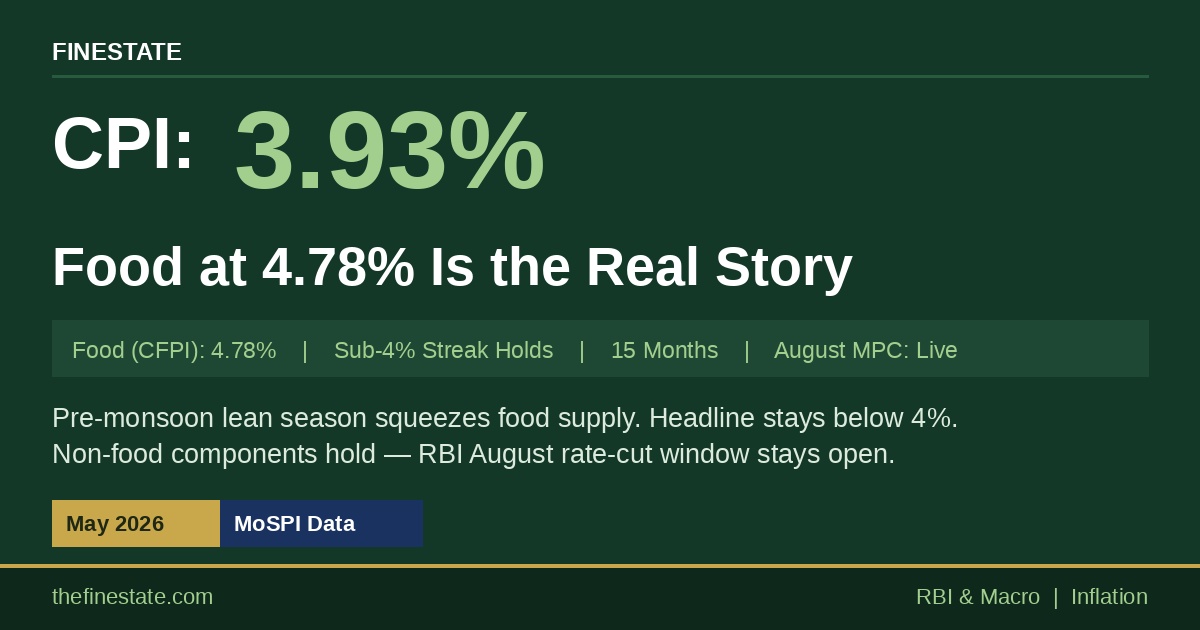
India’s retail inflation (CPI, base year 2024=100) rose to 3.93% in May 2026, up from April’s 3.48%, according to data released by MoSPI on 12 June 2026. The 15-month streak of below-4% inflation survived. Food inflation (CFPI) was the dominant driver at 4.78% — up sharply from April’s 4.20% — while non-food components remained relatively contained, keeping the headline below the RBI’s 4% target.
- Headline CPI May 2026: 3.93% (April: 3.48%) — sub-4% streak extends to 15 months
- Food inflation (CFPI): 4.78% (April: 4.20%) — primary driver
- Fuel (electricity, gas & other fuels): 0.81% (April: 0.69%) — barely moved
- Housing inflation: 2.12% (April: 2.15%) — essentially flat
- Rural vs urban CPI: 4.25% / 3.53% (April: 3.74% / 3.16%) — rural running hotter
- Biggest movers (YoY): Tomato +48%, Ginger +32% up; Potato −24%, Peas −11% down
India’s CPI rose in May but stayed below the RBI’s 4% target — the headline statistic that dominates coverage. The more consequential number is the food print: 4.78% food inflation against a 3.93% headline means the rest of the basket (fuel, housing, core services) held inflation down despite a meaningful food squeeze. For the salaried household whose grocery bill accounts for 40–50% of monthly spending, 4.78% CFPI is the number that matters more than the headline. The August rate-cut window stays technically open — but food, and the monsoon’s ability to cool it, is now the swing factor the RBI is watching.
What Drove May’s CPI: Food Did the Heavy Lifting
| Component | April 2026 | May 2026 | Direction |
|---|---|---|---|
| Headline CPI (YoY) | 3.48% | 3.93% | ↑ +0.45pp |
| Food inflation (CFPI) | 4.20% | 4.78% | ↑ +0.58pp — primary driver |
| Fuel (electricity, gas & other fuels) | 0.69% | 0.81% | ↑ +0.12pp — barely moved |
| Transport (Division 07) | −0.01% | 1.75% | ↑ fuel hike, offset by cheaper vehicles |
| Housing inflation | 2.15% | 2.12% | ↓ essentially flat |
| Rural CPI | 3.74% | 4.25% | ↑ running hotter than urban |
| Urban CPI | 3.16% | 3.53% | ↑ |
| Precious metals (silver, gold) | — | Silver +155%, Gold +41% | Global safe-haven surge, not domestic demand |
Food (CFPI at 4.78%): The Consumer Food Price Index is the headline behind the headline. At 4.78% — 85 basis points above the overall CPI — food is not just contributing to May’s rise; it is carrying it. May sits squarely in the pre-monsoon lean season: the window between the end of the rabi harvest and the arrival of the kharif crop, when vegetable supply tightens and prices spike. Tomatoes, onions, leafy greens, and pulses historically show 15–30% month-on-month increases in May–June. Cooking oil (imported from Malaysia and Indonesia) stayed elevated on rupee depreciation. These are supply-side pressures that monetary policy cannot directly address — and which a timely monsoon can reverse in 6–8 weeks.
Fuel and transport — the smaller story: The Rs 3/litre petrol-diesel hike from 15 May did show up, but only modestly. Electricity, gas and other household fuels (Group 04.5) rose just 0.81% year-on-year, barely above April’s 0.69%. The transport division (07) climbed to 1.75% from near-flat in April — but that figure hides an offset: the cost of operating a vehicle (petrol, diesel) rose 3.06%, while the cost of buying one fell 4.79% as vehicle prices kept easing. Net, fuel and transport added little to the headline. May was a food story, not a fuel story — the mirror image of April’s fuel-led WPI spike.
Why the headline stayed sub-4% despite food at 4.78%: Food and beverages carry roughly 45.86% of the CPI basket, so food alone contributed about 4.78% × 0.4586 ≅ 2.2 percentage points of the 3.93% headline — more than half of it. The rest of the basket was tame, with one striking exception. MoSPI does not publish a “core” CPI, but the Annexure detail makes the picture clear: strip out food and fuel and almost every division printed between 0.3% and 3.0% — clothing 2.98%, housing 1.73%, health 1.49%, transport 1.75%, communication 0.30%, recreation 1.98%, education 2.99%. The one genuinely hot non-food line was precious metals: silver jewellery up 155% and gold up 41% year-on-year, which dragged the “personal care and miscellaneous” division to 18.46%. That is a global safe-haven price surge, not Indian demand pressure. The signal for the RBI is clean: there is no broad, demand-driven inflation in this print. The only heat is seasonal (food) or global (gold) — and monetary policy looks through both.
This is the print where I would tell a home buyer to be careful about reading their own situation off the headline. A 3.93 per cent CPI describes a consumer basket in which food and beverages carry roughly 46 per cent of the weight. It does not describe what a building costs. The wholesale index has been telling a different story for months — WPI ran at 8.30 per cent in April 2026 against a CPI of 3.48 per cent, a gap of nearly five percentage points, driven by crude and industrial commodities rather than by vegetables. Steel, cement, aluminium and imported fit-out components sit in the second basket, not the first.
What that gap does is show up as a date before it shows up as a price. A developer facing higher input costs mid-project generally cannot reprice units already sold, so the adjustment lands on the schedule instead — phasing gets stretched, launches get deferred, and completion dates move. That has now been formally recognised rather than merely observed: in late July 2026 the Ministry of Housing and Urban Affairs advised state RERA authorities to grant a four-month extension to registered projects whose completion, revised completion or extended completion date falls on or after 28 February 2026, citing West Asia supply-chain disruption. When the regulator moves the deadline for everybody, the input-cost shock has stopped being anecdotal.
So for anyone holding an under-construction flat, a comfortable CPI print is not reassurance. The number that prices your possession date is the wholesale one, and the thing worth checking is not the headline but whether your own project’s RERA completion date has already been revised.
—
What May’s Print Means for the RBI August 2026 MPC
The RBI held repo at 5.25% at the June 2026 MPC, flagging “West Asia conflict risks” as an upside inflation threat. That decision — detailed in our RBI MPC June 2026 analysis — positioned August as the next live decision point. May’s 3.93% shifts that calculus, but not as badly as a fuel-led print of the same magnitude would have.
The distinction matters: food inflation driven by seasonal supply gaps is not what monetary policy is designed to address. The RBI cannot make it rain sooner or increase vegetable supply by cutting the repo rate. The MPC knows this, and their own inflation projection of 5.1% for Q1 FY27 (June quarter) was already factoring in this type of seasonal food spike. A 3.93% headline — below 4%, with food clearly the driver — gives the RBI cover to look through May and wait for June data.
- Base case — August cut stays possible: The May detail shows underlying demand-driven inflation stayed contained — most non-food, non-fuel divisions printed 1.5–3%, with the only spike in precious metals (a global, not domestic, signal). That supports the MPC looking through May as a food-and-seasonal blip. June CPI (releasing mid-July) becomes the decisive data point; a good monsoon onset keeps June food prices from worsening, and August stays live.
- Pause scenario — August hold, October cut: If the June print shows price pressure broadening beyond food and gold — services and wages accelerating — the MPC will likely wait for two consecutive months of evidence before cutting. October 2026 becomes the base case, and the Governor’s statement would emphasise “watchful” over “accommodative.”
- The monsoon variable: The IMD 2026 southwest monsoon forecast of approximately 90% of Long Period Average provides a reasonable base expectation. An early, well-distributed monsoon arrival — Kerala onset by 5–8 June — could pull CFPI from 4.78% back toward 3.5% by July. That single variable is worth more to the August rate-cut probability than any other data point between now and the MPC.
Your Wallet in June: The Food Squeeze and What to Watch on EMIs
Grocery bills: The 4.78% CFPI is the number that lands in your household budget every week. Unlike fuel inflation — which affects travel costs and indirectly reaches food through supply-chain logistics — direct food inflation hits the weekly grocery run. The pre-monsoon period (June through early July) is typically the most expensive stretch of the year for fresh produce. Budget for elevated vegetable and cooking-oil prices through at least late June; the post-monsoon easing historically starts mid-July.
EMI outlook: If the RBI holds in August (which remains a coin-flip at this reading), home loan EMIs on EBLR-linked loans will not change. The 125 basis points of cuts since February 2025 are already embedded in your loan — detailed in our Home Loan 2026 guide. MCLR-linked borrowers will continue to see delayed pass-through regardless of MPC timing. If you are weighing a balance transfer from MCLR to EBLR, the break-even calculation is worth running — the decision does not hinge on the August MPC outcome alone.
Fixed deposits and savings: A potential August pause is, on balance, good news for FD holders. Rates stay elevated a quarter longer. If your FD matures in July–September, current rates offer a reasonable lock-in opportunity ahead of what will eventually be a further rate-cut cycle. This is an observation on the rate environment, not a recommendation — consult your financial planner for your specific situation and tenure.
Monsoon Watch: The June–July CPI Swing Factor
- IMD 2026 forecast: The IMD projected approximately 90% of Long Period Average (LPA) for the 2026 Southwest Monsoon. The June update from imd.gov.in should be verified before using this figure in further commentary — the seasonal outlook may have been revised.
- The food-inflation reversal mechanism: Monsoon arrival at Kerala (normal: around 1 June, with variability of ±1–2 weeks) begins the supply-recovery cycle for vegetables. Within 3–5 weeks of onset, fresh-vegetable prices in major markets typically fall 20–35% from pre-monsoon peaks. A timely, normal monsoon is the fastest and most reliable disinflationary force available for CFPI.
- The June CPI math: If CFPI falls from 4.78% back toward 3.5% in June — plausible with a good monsoon — and fuel stays contained, the June headline could print in the 3.5–3.7% range. That would make August a near-certainty for a rate cut.
- The downside risk: If onset is delayed past 20 June or distribution is uneven (as in 2023), pre-monsoon vegetable-price spikes persist into July. Tomato, onion, and pulse prices could rise another 15–25% MoM in that scenario, pushing June CFPI above 5% and the headline back toward 4%. In that case, October is the next realistic cut window.
- What to track: IMD daily monsoon progress reports (imd.gov.in). The gap between onset date and normal (1 June for Kerala) is the single most important leading indicator for the June–July CPI trajectory.
The US Bureau of Labor Statistics reported US CPI at 4.2% YoY for May 2026 — the highest since April 2023 — driven by energy prices surging 23.5% YoY following the US-Iran conflict. Core US CPI held at 2.9%. Fed futures are pricing a rate hike for December 2026.
Two transmission channels matter for India: first, if the Fed hikes, FPI outflows from Indian equity and debt intensify (FPIs pulled an estimated US$12 billion from Indian markets in Q4 FY26), putting further depreciation pressure on the rupee and keeping import costs elevated. Second, if Brent crude continues to soften from its $97 peak (it traded near $87 on 12 June), the energy-shock component of both US and Indian CPI reverses — removing the most acute near-term inflation pressure for the RBI.
India’s CPI for May 2026 printed at 3.93% — above April’s 3.48% but below the RBI’s 4% target for the fifteenth consecutive month. The sub-4% streak survived, but the food story is the one that matters: CFPI at 4.78% is a 58 basis-point jump from April and reflects the pre-monsoon lean-season squeeze on vegetables and cooking oil.
For the RBI: this is a food-led print, not a demand-driven one. The August MPC window (3–5 August) stays open if core CPI remains anchored and the monsoon cooperates. June CPI — releasing mid-July — is the decisive data point. Watch the IMD monsoon progress reports, not the Fed headlines, as the primary leading indicator for the August rate decision.
For your household: your personal food inflation is running well above the headline. Budget for elevated grocery costs through late June. EMI relief remains contingent on the August-October rate path; prepayment decisions should be based on your own cash flow, not on waiting for a marginal MPC cut.
- India’s retail CPI inflation rose to 3.93% in May 2026 (MoSPI, 12 June 2026), up from 3.48% in April — the 15-month sub-4% streak survived.
- Food inflation (CFPI) at 4.78% was the primary driver — a 58 basis-point jump from April’s 4.20%, driven by pre-monsoon vegetable and cooking-oil price increases.
- The headline stayed below 4% because non-food components stayed tame: fuel (0.81%) and housing (2.12%) barely moved, and most divisions printed 1.5–3%. The only non-food spike was precious metals (silver +155%, gold +41%) — a global safe-haven signal, not domestic demand.
- The RBI’s August 2026 MPC (3–5 August) remains a live decision. A food-led print is more easily looked through than a demand-driven one; core CPI and the monsoon trajectory are the two variables that settle the August call.
- The southwest monsoon is the fastest disinflationary mechanism available — a timely, well-distributed onset could pull June CFPI back toward 3.5% and make August a near-certainty for a rate cut.
- For household finances: 4.78% food inflation means your effective grocery cost is ≈Rs 600–900/month higher year-on-year on an average salaried budget; EMI relief is on hold pending the August-October rate-path.
- MoSPI — CPI May 2026 press release (12 June 2026): mospi.gov.in/press-release
- MoSPI — CPI April 2026 (PIB PRID 2260251, 12 May 2026): pib.gov.in — PRID 2260251
- RBI — MPC Resolution June 2026 (PR 2026-2027/385): rbi.org.in
- PPAC — Petrol/Diesel retail prices (May 2026 hike schedule): ppac.gov.in
- IMD — Southwest Monsoon 2026 seasonal outlook: imd.gov.in
All figures are verified from the MoSPI CPI May 2026 press release (released 12 June 2026) and its Annexures I and II. May 2026 data is provisional; final figures are released the following month.
Get FinEstate updates on tax rules, EPF, and RBI policy straight to your inbox.
Keep reading
This article is part of our RBI and macro guide — the full set of explainers for salaried Indians, in the order you actually meet them.