Quick answer
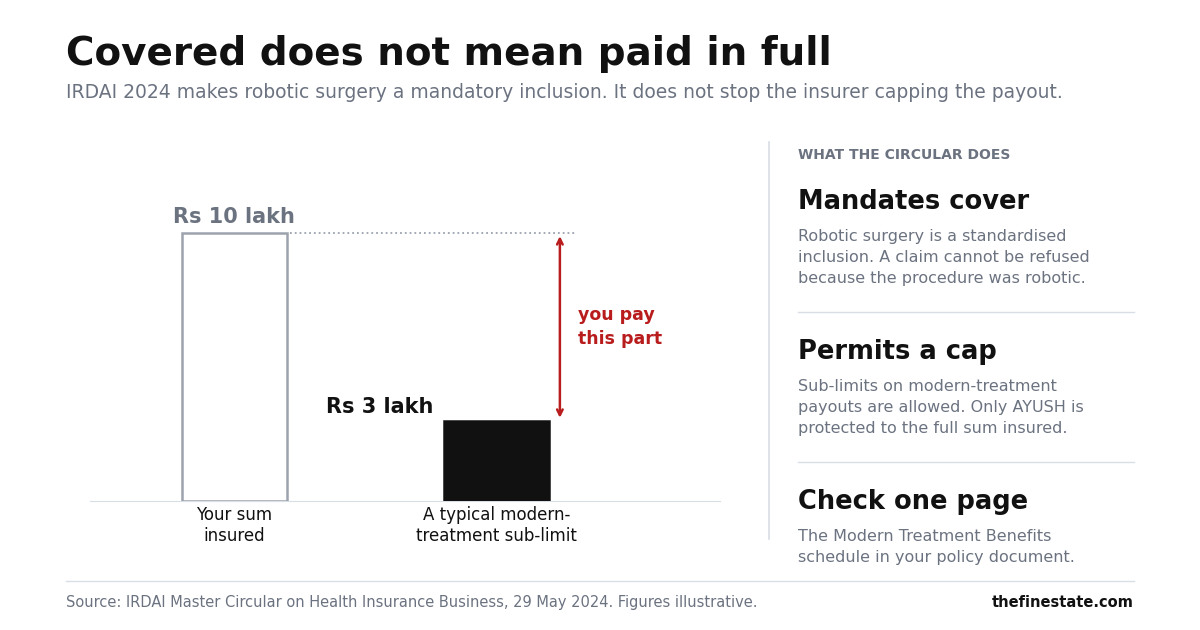
The robotic surgery health insurance sub-limit question has a clear answer under IRDAI’s Master Circular on Health Insurance Business (29 May 2024): an insurer cannot exclude robotic surgery from coverage, but it can legally cap the amount it pays. A Rs 10 lakh policy can carry a Rs 3 lakh ceiling on robotic surgery costs. Coverage is mandatory. Payout quantum is not. AYUSH treatments are the one category the circular protects from sub-limits; other modern treatments, including robotic surgery, receive no such protection.
On this page
Does IRDAI 2024 permit a robotic surgery health insurance sub-limit?
Yes — and the distinction between coverage and payout amount is the entire issue. The IRDAI Master Circular on Health Insurance Business, 29 May 2024, lists robotic surgery among the modern treatment methods that every indemnity health policy must include. An insurer cannot refuse a claim solely because the procedure was performed robotically. The procedure cannot be called experimental if it appears on the modern treatments list in the policy’s annexure.
What the circular does not do is fix the payment amount. Insurers remain free to apply a sub-limit — a ceiling — on what they will pay toward modern treatment costs, including robotic surgery. Public-sector insurers and many older private-sector plans impose these caps. A policy with a Rs 10 lakh sum insured may carry a Rs 3 lakh maximum for robotic surgery; the policyholder bears the remainder.
The distinction matters because the IRDAI parent article on health insurance rules acknowledged that sub-limit permission for modern treatments had not been verified against the circular’s annexure. This article closes that gap. The answer, consistent across secondary sources: sub-limits are permitted. The prohibition in the circular is specific to AYUSH — those treatments must be paid up to the full sum insured. Robotic surgery and other modern treatment methods do not carry that protection.
Two things the circular explicitly does not permit: rejecting the claim outright because surgery was robotic; and labelling the procedure experimental if it appears on the modern treatments list. Both grounds, if used, are grievable.
Check your own policy in 10 minutes
The 11 things to look for in a policy schedule, and the IRDAI rule behind each one.
One email when something changes. No daily digest.
What your policy’s Modern Treatment schedule actually says
The Modern Treatment Benefits section of your policy schedule — usually a single page in the policy document — is the document that determines your actual exposure, not the insurer’s verbal assurance at renewal. What is said at the point of sale is not a term of the contract, which is the conduct problem the regulators have been working on from the other direction as well — see our note on the RBI rules on mis-selling and bundling. Every policy issued or renewed after the 2024 circular must name each covered modern treatment method and state the coverage terms. Robotic surgery will appear by name. The adjacent column shows either “up to sum insured” or a sub-limit figure.
Two line items on the same page often go unchecked:
Consumables and disposables. Robotic procedures use single-use components — disposable draping, instrument adapters, and in some systems the robotic arm tip itself — which appear as a separate line on the hospital bill. Policies issued before the 2024 circular frequently exclude “consumables” as a general category without carving out items listed under modern treatments. If your policy was issued before May 2024 and has not been renewed under the revised framework, the robotic procedure may be covered while the consumables cost — which can run to several lakhs for complex procedures — is excluded separately. Check whether your policy’s consumables exclusion contains an exception for modern treatment items.
Room rent interaction. If your policy carries a room rent sub-limit and you occupy a room above that limit, the insurer applies a proportionate deduction to the entire claim — including the robotic surgery component. A room-rent cap of Rs 4,000 per day against an actual room cost of Rs 8,000 means 50 percent of all eligible costs is deducted after the surgery sub-limit is applied. These two caps compound; they do not operate independently. This is the practical reason a headline sum insured overstates real cover, and why sizing health cover on the sum insured alone produces the wrong number.
One thing a sub-limit does not affect: the premium remains deductible under Section 80D of the Income-tax Act, 1961 (Section 126 of the Income-tax Act, 2025) if you file on the old regime. The deduction attaches to the premium paid, not to what the policy eventually pays out — see our income tax guide for salaried filers for the limits that apply.
When the insurer partially approves the claim: your options
The most effective tool is a Medical Necessity Letter from the operating surgeon, obtained before pre-authorisation is finalised — not after the claim is filed. The IRDAI 2024 circular requires insurers to respond to planned-procedure pre-authorisation requests within one hour. If the insurer pre-approves an amount that reflects a conventional laparoscopic benchmark rather than robotic surgery costs, you have time to dispute before the procedure begins.
The insurer’s “traditional cost” argument — that a standard laparoscopic procedure would have achieved equivalent outcomes at lower cost — is countered with clinical documentation. The Medical Necessity Letter from the surgeon should document specifically why robotic assistance was clinically required for this patient and this procedure: anatomical complexity, reduced risk of conversion, post-operative recovery expectations. It must establish medical necessity, not preference. Submit the letter with the pre-auth request and ask the insurer to revise the approved amount in writing before the surgery date.
If the claim is rejected on grounds of the procedure being experimental — which is not a valid ground if robotic surgery appears on the policy’s modern treatments list — the escalation sequence under IRDAI’s integrated grievance framework is: (1) file with the insurer’s internal grievance cell, which must acknowledge within three working days and resolve within 30 days; (2) if the response is unsatisfactory or no response within 30 days, file a complaint with the Insurance Ombudsman for the relevant region. Ombudsman orders are binding on insurers for claims up to Rs 30 lakh and are free of charge for the complainant. The same two-step architecture — the institution’s own grievance cell first, an ombudsman second — is what governs a disputed bank transaction on the RBI side.
Check your own policy in 10 minutes
The 11 things to look for in a policy schedule, and the IRDAI rule behind each one.
One email when something changes. No daily digest.
Key takeaways
- IRDAI 2024 mandates that every health policy cover robotic surgery. Sub-limits on the payout amount are permitted — this is not contradictory.
- AYUSH treatments must be covered up to the full sum insured. Robotic surgery and other modern treatments do not have this protection against sub-limits.
- Read the Modern Treatment Benefits section of your policy schedule to find your actual cap — not the brochure and not what the agent said at renewal.
- Consumables (disposable robotic components) may be separately excluded in plans issued before May 2024. Verify before the procedure date, not after.
- Room rent sub-limits apply a proportionate deduction to the entire claim, compounding with any robotic surgery sub-limit.
- A Medical Necessity Letter from the surgeon, submitted at pre-auth stage, is the primary tool to contest a low pre-approval. Grievance cell then Insurance Ombudsman if rejected as experimental.
Frequently Asked Questions
Can an insurer refuse to pay for robotic surgery?
Not on the ground that the surgery was robotic, and not on the ground that it is experimental where robotic surgery appears on the policy’s modern treatments list. The IRDAI Master Circular on Health Insurance Business of 29 May 2024 lists robotic surgery among the modern treatment methods every indemnity policy must include. What the insurer can do is cap what it pays, through a sub-limit on modern treatment costs. Coverage is mandatory; the payout amount is not. The wider set of obligations the circular created is covered in our guide to the IRDAI health insurance rules.
Are the disposable components used in robotic surgery covered?
Check the consumables clause, not the modern treatments clause. Robotic procedures use single-use components — disposable draping, instrument adapters, and in some systems the arm tip itself — which appear as a separate line on the hospital bill. Policies issued before the May 2024 circular frequently exclude “consumables” as a general category without carving out items listed under modern treatments. If your policy has not been renewed under the revised framework, the procedure can be covered while the consumables cost, which can run to several lakhs, is excluded separately.
What can I do if the insurer pre-approves less than the robotic surgery will cost?
Get a Medical Necessity Letter from the operating surgeon and submit it with the pre-authorisation request, before the pre-auth is finalised rather than after the claim is filed. The letter must document why robotic assistance was clinically required for this patient and this procedure — anatomical complexity, reduced risk of conversion, post-operative recovery — and establish necessity rather than preference. Ask for the approved amount to be revised in writing before the surgery date. If the claim is then rejected as experimental, escalate to the insurer’s internal grievance cell, which must acknowledge within three working days and resolve within 30 days, and then to the Insurance Ombudsman.
Primary sources
- IRDAI Master Circular on Health Insurance Business, 29 May 2024. irdai.gov.in/document-detail?documentId=4942918. The circular’s annexure lists modern treatment methods and mandates their coverage. The sub-limit conclusion — that sub-limits are permitted for modern treatments other than AYUSH — is drawn from the absence of a prohibition in the annexure structure and confirmed by secondary sources below. The circular PDF was not retrieved directly in this research cycle (document is JS-rendered at source); readers should verify the annexure wording at the permalink above before making coverage decisions.
Secondary sources and commentary
- OneAssure, “Robotic Surgery Health Insurance Coverage,” April 2026. Confirmed sub-limits are legally permissible; identified the Medical Necessity Letter as the policyholder’s primary tool for contesting partial approvals.
- Ditto Insurance, health insurance coverage notes, 2025. Noted that robotic arm consumables may appear separately from surgery costs on hospital invoices, creating an unexpected gap in older plans.
- Bajaj Finserv Markets, health insurance explainers, 2025. Room rent sub-limit proportionate deduction mechanics and compounding with procedure sub-limits confirmed.
Bottom line
IRDAI 2024 closed the door on outright exclusion of robotic surgery. It did not close the door on sub-limits. The policy schedule’s Modern Treatment Benefits section — not the insurer’s brochure — is the document that determines how much you will actually receive. That holds for every policy in the household, term cover included: the schedule governs, the brochure does not.
One email when something is published. No daily digest, no tips.
Subscribe freeDisclosure and method
The specific risk on this page: the central conclusion — that sub-limits on robotic surgery are permitted while outright exclusion is not — is drawn from the structure of the IRDAI Master Circular on Health Insurance Business (29 May 2024) and confirmed against the named secondary sources above. The circular PDF was not retrieved directly in this research cycle because the document is JavaScript-rendered at source. Read the annexure wording at the irdai.gov.in permalink above before you rely on it. Sub-limit terms vary by insurer, by product and by issuance date, so the only figure that governs your claim is the one printed in your own policy schedule — not this page, not the brochure, and not what an agent said at renewal. Nothing here is insurance, tax or financial advice, and it is not a substitute for advice from a licensed insurance advisor — see our full disclaimer. Researched and drafted with AI assistance and reviewed before publication.
Keep reading
This article is part of our personal finance guide — the full set of explainers for salaried Indians, in the order you actually meet them.